

The Ministry of Industry and Trade proposes that the remaining balance of the Fuel Price Stabilization Fund should not be held by fuel distribution companies as it is currently, but should be held by the State, with the use of this Fund governed by the 2023 Price Law.
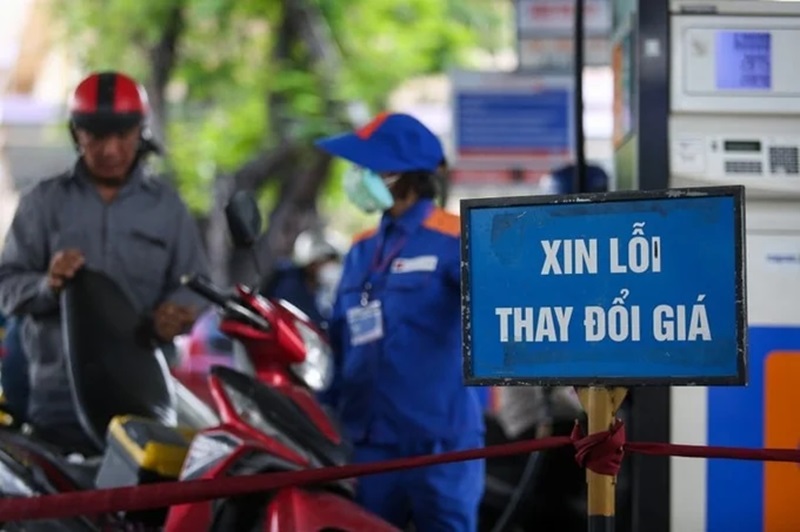 |
| In the latest draft regulations on petroleum business, the Ministry of Industry and Trade proposes that the petroleum price stabilization fund should not be held by the main petroleum distributors but should be controlled by the State. |
The third draft of the Decree on petroleum business, submitted by the Ministry of Industry and Trade to the Ministry of Justice for review, includes a new point. Accordingly, the Ministry has not included regulations on managing the Petroleum Price Stabilization Fund as in previous drafts.
According to the draft, the remaining balance of the Fuel Price Stabilization Fund is not expected to be held by the fuel distribution companies as it is currently, but will be held by the State. The use of the Fund will be governed by the 2023 Price Law (effective from July 1st).
The Ministry of Finance will guide businesses in transferring and depositing the remaining balance of the Fuel Price Stabilization Fund into the state budget, according to the draft decree.
According to a representative from the Domestic Market Department (Ministry of Industry and Trade), the 2023 Price Law stipulates five price stabilization measures, one of which is the use of a price stabilization fund for goods for which such a fund has been established.
Ministries and agencies develop price stabilization plans and submit them to the Ministry of Finance for compilation and submission to the Government for approval in principle. After approval, ministries and agencies organize implementation. The use of the Price Stabilization Fund is carried out in accordance with the 2023 Price Law. Price stabilization measures are time-limited.
Therefore, in cases where the prices of petroleum products fluctuate abnormally, causing significant impacts on the economy, society, production, business, and people's lives, the Ministry of Industry and Trade, in coordination with relevant ministries and agencies, will assess the extent of market price fluctuations of petroleum products and the level of impact on the economy, production, and business; and send a document to the Ministry of Finance for compilation and submission to the Government for consideration and decision on price stabilization policies.
"The new point is that the Price Stabilization Fund will not be used regularly. When gasoline and diesel prices fluctuate unusually, the Ministry of Industry and Trade will take the lead in coordinating with other ministries and agencies to develop stabilization measures, which will be submitted to the Ministry of Finance for compilation and presentation to the Government for consideration and decision on the policy to be implemented," a representative from the Domestic Market Department clarified.
In recent times, the use of the Fuel Price Stabilization Fund has been controversial, with many arguing that it's time to abolish it because it's ineffective. At times, the fund's operation has lacked transparency, creating loopholes for some businesses to misappropriate funds, leading to financial mismanagement and market instability.
According to the conclusions of the Government Inspectorate announced at the end of 2023, seven petroleum distributors misused the Price Stabilization Fund, failing to transfer money to the fund's account and instead leaving it in the businesses' payment accounts, totaling nearly 8,000 billion VND.
"The Price Stabilization Fund is continuously being misappropriated and misused by major traders for the purpose of stabilizing gasoline and diesel prices," the Government Inspectorate emphasized.
In recent discussions on drafting a new decree on petroleum business, major enterprises such as Petrolimex and PV Oil have argued that, in the current context, maintaining the Petroleum Price Stabilization Fund is no longer appropriate. They point out that with a 7-day price adjustment cycle, domestic petroleum prices closely track world prices, and the level of price fluctuation between adjustments is no longer significant.
Source: https://baodautu.vn/de-xuat-ve-quy-binh-on-gia-xang-dau-co-gi-moi-d219913.html




























![[Photo] Reception to welcome General Secretary and President To Lam and his wife on their State visit to the Philippines](https://vphoto.vietnam.vn/thumb/1200x675/vietnam/resource/IMAGE/2026/06/01/1780295488620_vna-potal-chieu-dai-chao-mung-tong-bi-thu-chu-tich-nuoc-to-lam-va-phu-nhan-tham-cap-nha-nuoc-toi-philippines-8798060-7855-jpg.webp)




































































Comment (0)