

 |
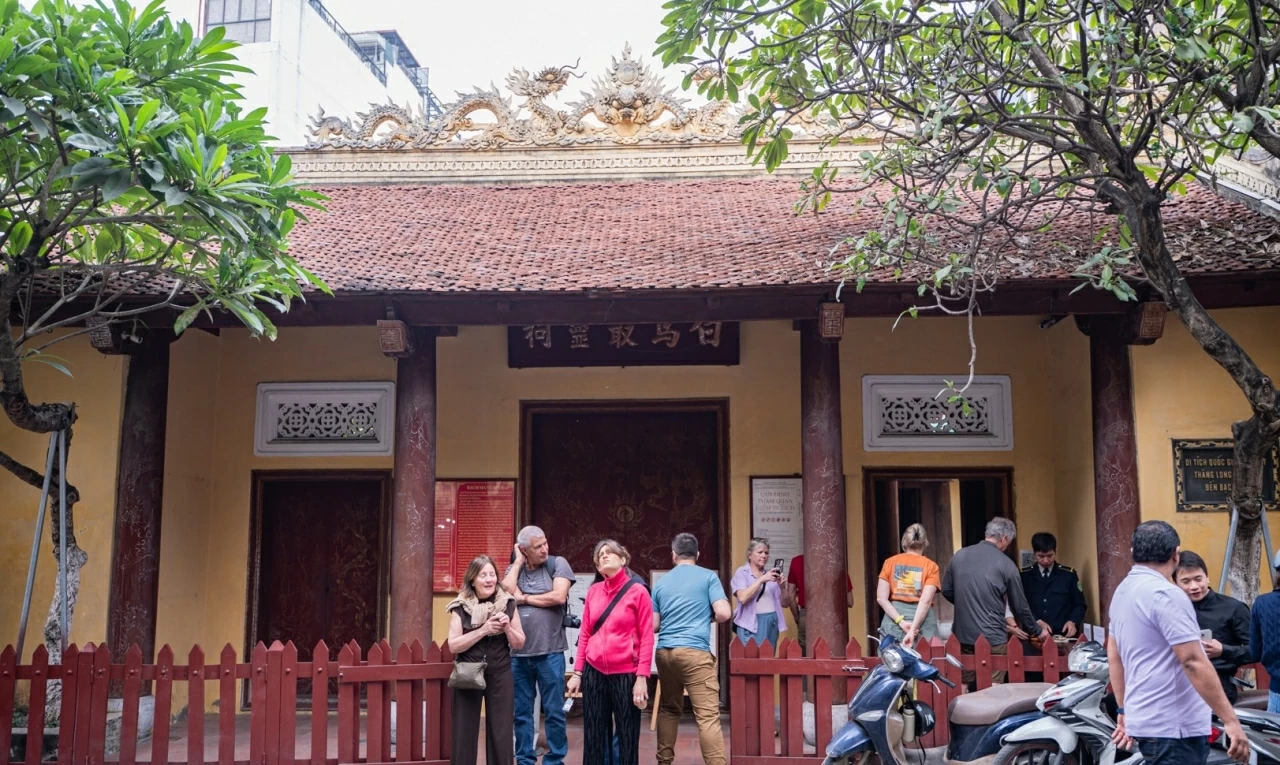
| The Bach Ma Temple is located in the heart of the old town and attracts many visitors. (Photo: Nguyen Huy) |
As the guardian of the eastern flank of the ancient Thang Long citadel, Bach Ma Temple possesses an ancient and solemn beauty, along with many cultural and historical stories associated with Hanoi .
The Bach Ma Temple is located at 76 Hang Buom Street, amidst a bustling neighborhood. Stepping through the temple gate, visitors will enter a tranquil and serene space, completely separate from the noise and hustle of the outside world.
This is a place many locals and tourists choose to visit during the first days of the Lunar New Year of the Horse 2026 to pray for peace and good fortune.
Among the relics belonging to the "four guardian temples," the Bach Ma Temple, located in the East, was built the earliest. The temple is dedicated to the god Long Do, a deity associated with Nung Mountain, which receives the sacred energy of the capital's rivers and mountains.
According to documents from the Bach Ma Temple Management Board, during the time when Vietnam was under the rule of the Tang Dynasty from the North, the official Cao Bien built the Dai La citadel, but the land continuously collapsed.
Seeing the divine Long Do appear, Cao Bien was terrified and immediately used spells and buried copper and iron to suppress the dragon vein. But that very night, thunder and lightning erupted, destroying everything. Knowing he could not subdue the sacred deity of Vietnam, he built a temple and prayed for protection.
The Bach Ma Temple is also associated with the legend of King Ly Thai To's construction of the citadel. In 1010, the king moved the capital from Hoa Lu to Dai La. During the construction of Thang Long citadel, the project was completed and then collapsed several times.
The king then sent someone to the temple to pray to the god, and suddenly saw a white horse gallop out of the temple. The horse circled the land, leaving footprints wherever it went, then returned to the temple and disappeared. The king followed those footprints and had a rampart built, and the structure no longer collapsed. Therefore, he bestowed upon the deity the title of Thành Hoàng (Guardian Deity of Thăng Long).
Having undergone numerous renovations, especially the major restoration in 1839, the temple now bears the distinct mark of Nguyen Dynasty architecture with a harmonious layout along a central axis. A unique feature is the system of "crab shell" domes connecting the buildings, creating a continuous, spacious, and airy atmosphere.
The pavilion stands out with its exquisite patterns and carvings. The main worship area features a wooden frame with overlapping beams and a bell-shaped support, decorated with cloud, fire, and floral motifs.
In the Forbidden Palace, a statue of the deity Long Đỗ sits majestically on a throne, with a straight back, wearing a flat-topped crown, and covered entirely in red cloth, revealing only his face. A white horse statue stands in the central area. Its belt, bridle, and saddle are painted red and gilded, symbolizing the divine power of the sacred deity.
Associated with the legend of the citadel's construction, Bach Ma Temple holds a sacred position guarding the eastern side of Thang Long. Along with Voi Phuc Temple (guarding the West), Quan Thanh Temple (guarding the North), and Kim Lien Temple (guarding the South), these four temples form the "Four Guardian Temples of Thang Long," protecting the ancient capital.
The Bach Ma Temple is strategically located in the Old Quarter, attracting many foreign tourists who visit Hanoi.
Carotta, 33, from Italy, shared: "I learned about the temple through social media and a tour guide. The architecture here is completely different from the churches in my country. It was a fascinating cultural experience during my trip."
Currently, Bach Ma Temple still preserves 15 ancient steles. The content of the steles mentions the history of the temple and the deity, the rituals of worshiping the deity, and the times of restoration and renovation. The temple has a set of ceremonial artifacts, including ancient weapons such as spears, swords, lances, and sickles... which are painted red and gilded, and intricately carved.
Besides bronze incense burners, bronze vases, and human statues, the temple also contains a Buddha statue. This detail reflects the folk belief in "the three religions being equal."
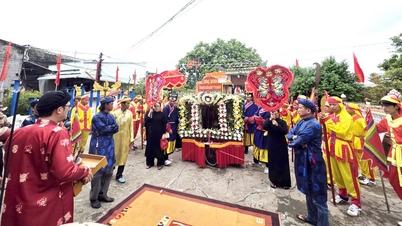
Every year in the second lunar month, the temple holds a festival with a spring procession and the custom of "beating the clay ox" - using a whip to beat a clay ox, symbolizing the "beating the spring ox" custom of ancient agricultural communities. This ritual signifies bidding farewell to the cold winter air and praying for favorable weather and a bountiful harvest. This custom dates back to the time of Ly Thai Tong (1048) and continued until the Le dynasty.
Mr. Dang Quoc Cuong (48 years old, from Thai Binh province) has visited Bach Ma Temple many times. For him, it is a familiar destination, a place where he entrusts his faith and seeks peace.
"I came to the temple to pray for health, success, wealth, and peace for my family. Visiting temples and pagodas has become a habit in the spiritual life of Vietnamese people. Bach Ma Temple is especially unique because it is one of the four sacred temples belonging to Thang Long's Four Guardian Temples," Mr. Cuong shared.
Due to its sacredness, every New Year, Bach Ma Temple welcomes a large number of domestic and international tourists who come to visit and pray for good fortune.
Source: https://baoquocte.vn/den-bach-ma-di-san-linh-thieng-giua-long-ha-noi-360961.html



















![[Photo] Reception to welcome General Secretary and President To Lam and his wife on their State visit to the Philippines](https://vphoto.vietnam.vn/thumb/1200x675/vietnam/resource/IMAGE/2026/06/01/1780295488620_vna-potal-chieu-dai-chao-mung-tong-bi-thu-chu-tich-nuoc-to-lam-va-phu-nhan-tham-cap-nha-nuoc-toi-philippines-8798060-7855-jpg.webp)




















































Comment (0)