

The emergence of Chinese e-commerce platforms such as Temu, Taobao, and 1688 is creating a craze for cheap goods in Vietnam, pushing Vietnamese businesses into unprecedented difficulties.
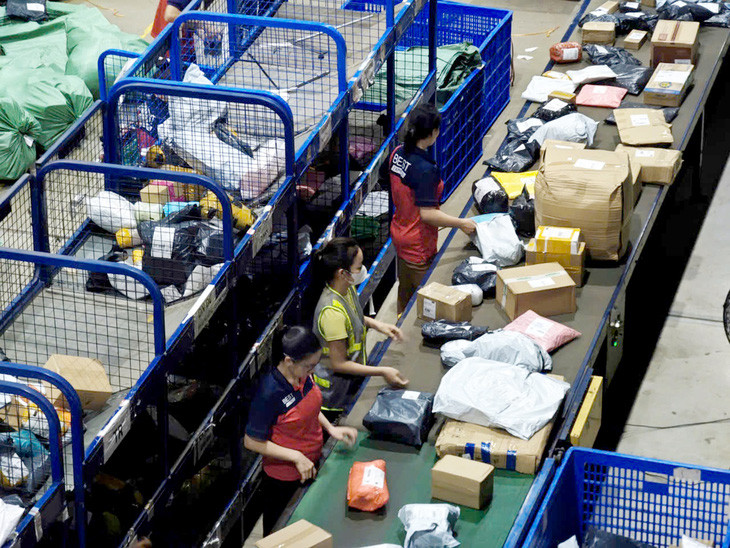
This is not simply a price war, but also opens up a fierce competition in product and service quality right on Vietnam's home turf.
Without timely adaptation measures, Vietnamese businesses risk being eliminated from the game.
"19K" fixed-price store, free delivery.
Much consumers Vietnam is no longer concerned about where to buy goods; the question has shifted to "Why not choose Chinese goods?" - because they are cheaper, more convenient, and have faster delivery services.
This has plunged Vietnamese businesses into a crisis of confidence from their own domestic consumers.
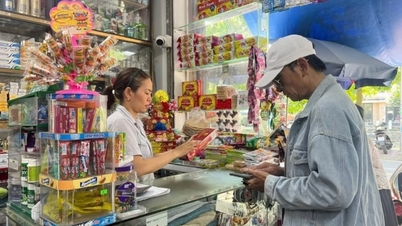
Ms. Duong Thuy shared her shopping experience at a store on Phan Van Tri Street (Go Vap District, Ho Chi Minh City). "They had a sign that said 'all products are 19K,' which I couldn't resist."
Items such as ceramic bowls, household goods, and fashion accessories have beautiful designs and are much cheaper than Vietnamese products at supermarkets."
According to Thuy, the items sold at this fixed price are said to be imported in large quantities from China, which is why they are so cheap.
The widespread availability of cheap Chinese goods in discount stores and on online marketplaces. e-commerce E-commerce platforms like Shopee, Lazada, and TikTok Shop are making it increasingly difficult for Vietnamese products to maintain their market share.
Ms. Quynh Tran, a housewife in Ho Chi Minh City, said she once bought a Vietnamese rice cooker for 300,000 VND, plus an additional 20,000 VND for shipping.
Meanwhile, a similar Chinese rice cooker costs only 180,000 VND and comes with free shipping. The huge price difference led Ms. Tran to choose the Chinese product.
With its free shipping, fast delivery, 90-day return policy, and promotions offering discounts of up to 90%, Temu – a newcomer to the Chinese e-commerce market – has quickly attracted attention in Vietnam.
The platform has even updated its website to support Vietnamese, making shopping easier.
With just a few clicks, customers can buy any product, from household goods to fashion items, at incredibly low prices. Ms. Quynh Vy, a customer in Ho Chi Minh City, shared that she couldn't resist the discounts of up to 66% and the delivery time of only 4-7 days.
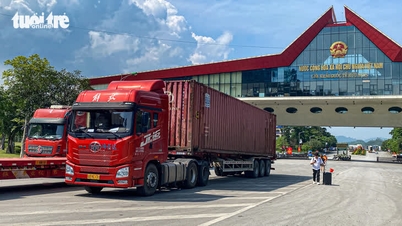
Shipping from Guangzhou to Vietnam is primarily done by road, resulting in significantly faster delivery times for Temu compared to other Southeast Asian markets such as Malaysia and the Philippines, where shipping times can range from 5 to 20 days.
It's not just Temu; other Chinese e-commerce platforms like Taobao And 1688 has also provided wholesale and retail goods that are popular with Vietnamese consumers. This has led to Chinese goods being present everywhere on e-commerce platforms, as well as in discount stores in Vietnam.
Retail and domestic production are "suffocating".
The emergence and expansion of Chinese e-commerce platforms such as Temu, Taobao, and 1688 are changing the landscape of the Vietnamese market.
The competition is not only between domestic businesses but also with powerful international competitors who have advantages in pricing, distribution systems, and marketing strategies.
Before Temu entered the market, the Vietnamese e-commerce market was dominated by foreign platforms such as Shopee, Lazada, and TikTok. The fierce price competition between these e-commerce platforms, which lasted for five years, had put domestic businesses in a difficult position.
In discussions with us, many manufacturing and retail businesses noted that the competition between Vietnamese and Chinese businesses in the e-commerce market is no longer solely about price but also requires a shift in business strategy.
If Vietnamese businesses fail to adapt in time, they will be eliminated from this fiercely competitive market.
Mr. Nguyen Ngoc Luan, General Director of Meet More Company, a coffee production enterprise in Cu Chi (Ho Chi Minh City), said that he has faced many difficulties competing with Chinese products.
Meet More's products, for example, a box of coffee priced at 85,000 VND, when including a 20,000 VND shipping fee, bring the price up to 105,000 VND.
"Customers hesitate because similar Chinese products are cheaper and offer free shipping. We are forced to lower our prices to get this offer, but the more we lower prices, the less profit we make," Mr. Luan said.
According to Mr. Luan, many Vietnamese businesses have received cooperation offers from China, proposing to bring Vietnamese goods to border gates for sale in the Chinese market.
However, when calculating shipping costs and discounts, the profit margin is almost nonexistent, while Chinese goods entering Vietnam maintain low prices thanks to subsidies and support from the transportation system.
Vietnamese businesses not only face price disparities but are also pressured by China's powerful logistics system and superior distribution services. According to some businesses, it is no coincidence that Vietnamese consumers are increasingly favoring Chinese goods.
"Besides being cheap, Chinese goods also appeal to the modern consumer's desire for 'quick, convenient, and affordable shopping.' Many customers admit they choose Chinese goods not only because of the lower prices but also because of the convenience of shopping," said a household goods manufacturer.
We need to change and expand into international markets.
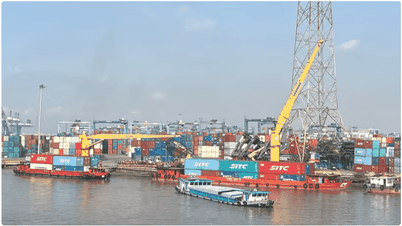
According to domestic retailers, Chinese goods will flood into Vietnam due to numerous advantages stemming from synchronized investment, including the construction of numerous large warehouses along the border, the establishment of central warehouses in Guangdong and Guangzhou, optimized transportation routes in terms of time and cost, abundant supply of cheap goods, and a comprehensive labor and logistics support system within Vietnam.
Mr. Nguyen Xuan Hung, head of the e-commerce logistics committee of the Vietnam Logistics Association (VLA), believes that to cope with the influx of cheap Chinese goods into Vietnam, Vietnamese businesses need to focus on product quality and after-sales service, while improving their logistics systems to reduce costs and increase competitiveness.
An expert in the e-commerce field also suggested that Vietnam needs to invest heavily in warehousing systems specifically for e-commerce, because most current warehouses serve large manufacturing companies rather than e-commerce businesses. This reduces order processing capacity and increases logistics costs.
"Improving logistics infrastructure will help optimize operational processes, thereby enhancing business efficiency," this person said, while also advising that developing reasonable promotional strategies, offering free shipping or discounts on delivery fees will help Vietnamese goods compete with Chinese goods on e-commerce platforms.
According to this source, leveraging brand strength and product quality is an opportunity for Vietnamese businesses to regain the trust of domestic consumers.
"In addition to businesses needing to improve their own competitiveness, the experience of many countries shows that there also needs to be a protective framework for domestic production and retail," this person advised.
Mr. Nguyen Ngoc Luan believes that Vietnamese businesses need to quickly diversify their export markets, targeting potential countries such as India, Southeast Asia, Europe, and the United States. This is a way to minimize risks and achieve sustainable development in the era of globalization.
Many countries are trying to block shipments from Temu and Shein.  Many countries are seeking to block the cross-border sale of Chinese goods through platforms like Temu and Shein due to concerns about unfair competition. For example, the US has imposed higher tariffs and reduced tax exemptions for low-value items. The EU is also considering imposing tariffs on goods under 150 euros and investigating shipping subsidies from China. Indonesia recently banned Temu to protect small domestic businesses. According to e-commerce experts, if Vietnam wants to protect domestic production and retail, it also needs a similar legal framework. Furthermore, investing in specialized warehousing systems for e-commerce, reducing logistics costs, and developing sound promotional strategies are necessary steps to help Vietnamese products maintain consumer trust. |
How do they offer cheap goods and fast delivery? According to our research, Temu has a large supply of inexpensive goods and fast delivery times partly because the platform operates on a consignment model, meaning suppliers negotiate wholesale prices and ship goods to Temu's warehouse. The remaining steps, such as marketing, shipping, and retail, will be handled by the company. Temu collaborates with major shipping partners such as ZTO and KYE (domestic shipping within China) and DHL, FedEx, and UPS (international shipping). Particularly in the final delivery stage, domestic shipping companies such as Ninja Van and Best Express will handle the delivery to customers in Vietnam. This model helps minimize shipping and marketing costs, allowing Temu to offer products at lower prices while still ensuring sellers maintain profitability. For example, an item that retails for $19 on Amazon can be reduced to $16 at Temu while still maintaining the seller's profit margin through cost optimization. |
Foreign businesses dominate e-commerce in Vietnam. According to a report by Momentum Works, as of September 2024, Temu was present in 78 countries and territories. In the Vietnamese market, Shopee held 61% of the market share, TikTok Shop 24%, and Lazada 14%. Of those, two are from China. Regarding average order value in Vietnam, Shopee ranges from 6-8 USD, Lazada from 8-10 USD, and TikTok Shop from 5-6 USD; Temu has not yet compiled statistics. |
Source



![[Photo] General Secretary and President To Lam presides over a meeting with the Central Organizing Committee.](https://vphoto.vietnam.vn/thumb/1200x675/vietnam/resource/IMAGE/2026/06/03/1780482764658_a1-bnd-4741-3342-jpg.webp)
![[Photo] Secretary of the National Assembly Party Committee, Chairman of the National Assembly presides over the meeting of the Standing Committee and Executive Committee of the National Assembly Party Committee.](https://vphoto.vietnam.vn/thumb/1200x675/vietnam/resource/IMAGE/2026/06/03/1780480353201_ndo_br_bnd-2585-jpg.webp)



















![[Photo] First session of the 14th Congress of the Vietnam Trade Union](https://vphoto.vietnam.vn/thumb/1200x675/vietnam/resource/IMAGE/2026/06/03/1780465947883_ndo_br_img-3852-jpg.webp)





























![[Video] Sunset at Lap An Lagoon – Where the sun sets over the fishing nets](https://vphoto.vietnam.vn/thumb/1200x675/vietnam/resource/IMAGE/2026/05/31/1780192137701_beach-landscape-sea-water-nature-grass-745871-pxhere-com.jpeg)































Comment (0)