

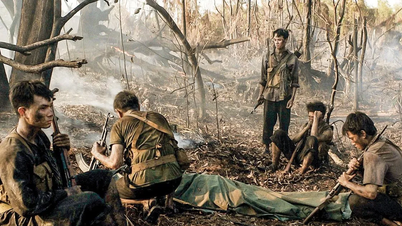
Set against the backdrop of 1967, the height of the Vietnam War, the film tells the story of a 21-person guerrilla group's struggle to hold out at the Binh An Dong base after the Cedar Falls raid. Team leader Bay Theo (Thai Hoa) and his comrades are tasked with protecting the tunnels so that the intelligence group can carry out a crucial mission. However, facing numerous enemy sweeps and attacks, the guerrilla group finds itself in a perilous situation, teetering on the brink of death.
"Tunnels: The Sun in the Darkness" captivated audiences with its authentic historical story, relatable narrative style, and subtle portrayal of camaraderie, love, and everyday moments on the battlefield.
By choosing underground tunnels with their wide, spreading passages, the film immerses the viewer in a cramped, suffocating, and dark space. From there, the fate and psychological development of each character are clearly revealed. Living and fighting underground, standing on the fragile boundary between life and death, the eyes, gestures, and actions of each member of the guerrilla team are filled with ideals and aspirations, as well as inner conflict and unwavering resilience.
Furthermore, color is a major plus for the film. The film crew controlled the lighting very well using the Bleach Bypass film processing technique. While the surface features earthy brown tones of mud, ash gray of burnt forests, and the withered, faded color of tree trunks in the harsh battlefield setting; underground, the warm yellow tones of the tunnels illuminated by oil lamps create a film that is both nostalgic and dramatic, giving viewers the feeling of fighting alongside the enemy and listening to heroic historical stories. The flickering oil lamps illuminating the dark underground tunnels are like "suns in the darkness," representing the light of willpower and faith in a victorious tomorrow.
Officially reaching the 100 billion VND mark, "Underground Tunnels: The Sun in the Darkness" is the first revolutionary war film not funded by the state. Movie poster image |

The film's sound design is also very subtle, with a blend of the sounds of bombs and gunfire outside and the rhythmic breathing, whispers, and even absolute silence inside the tunnels. This creates a realistic and intimate cinematic experience, allowing viewers to visualize the brutality of war.
In particular, the key element that makes the film so appealing is its relatable, fresh storytelling style, focusing on the human aspect. The soldiers in the film are not only indomitable heroes with patriotism and camaraderie, but also ordinary people with their yearning for love, poetic everyday moments, and very real, genuine hesitations and fears. These are the Cu Chi guerrillas at the Binh An Dong battlefield, young men and women from Southern Vietnam. “They bent their backs and bowed their heads in the cramped tunnels so that today we can look up at the sky of freedom.”
This is also the first revolutionary war film written and directed by Bui Thac Chuyen himself. Bui Thac Chuyen's journey to complete the film stemmed from a dream he had nurtured for over 10 years. From a 10-minute 3D film about the Cu Chi Tunnels in 2014, a fortunate connection began to take root, opening up a 10-year journey of tireless work on the script, characters, fundraising, and journeys back and forth between North and South Vietnam to gather information. Bringing history to the screen, Bui Thac Chuyen's arduous cinematic dream finally came true in these heroic film sequences.
At a time when the film market is dominated by commercially driven films, the return of historical films is a bright spot for Vietnamese cinema. Vietnamese cinema has left its mark on viewers' hearts with outstanding works on historical themes such as: from "Sharing the Same River" (1959), "The Nightingale" (1961), "Sister Tu Hau" (1962), "Rising Wind" (1966), "The 17th Parallel Day and Night" (1973), "The Little Girl from Hanoi " (1974), "The Wild Field" (1979), "When Will October Come?" (1984), "Saigon Commandos" (1986)... to "Don't Burn" (2009), "Aspiration for Thang Long" (2011), "The Scent of Burning Grass" (2012), "Peach, Pho and Piano" (2024)... These films on the theme of war and history have contributed to igniting the flame of patriotism, through both laughter and tears, happiness and sorrow from those heroic years.
In reality, creating a compelling historical film requires immense effort from the director and crew; the investment for this genre is also substantial. Therefore, undertaking historical projects is a risky investment. Furthermore, according to experts, one of the reasons for the box office and box office failures of historical films in Vietnam is the "illustrative" filmmaking mindset, lacking compelling plot points and resulting in stiff, uninspired cinematic emotions.
However, new approaches in historical films such as "Peach, Pho and Piano" and "Tunnels: The Sun in the Darkness" are offering new prospects. "Peach, Pho and Piano," a war-themed film commissioned by the State, has become a box office phenomenon, attracting young audiences. "Tunnels: The Sun in the Darkness" not only breaks stereotypes about historical and war films but also touches the hearts of audiences and critics alike…
However, the journey of bringing history to the screen is still a long one for Vietnamese cinema. For historical films in Vietnamese cinema to truly take off and thrive, a systematic support system is needed for filmmakers, including: utilizing film development funds, expanding international cooperation, investing in screenwriting and special effects; strengthening promotion, developing communication strategies, and most importantly, changing mindsets.
Source: https://baodaklak.vn/van-hoa-du-lich-van-hoc-nghe-thuat/202505/dia-dao-mat-troi-trong-bong-toi-4300299/


![[Photo] National Assembly Chairman Tran Thanh Man attends the policy seminar to promote Vietnam-Türkiye cooperation.](https://vphoto.vietnam.vn/thumb/1200x675/vietnam/resource/IMAGE/2026/04/16/1776351415367_vna-potal-chu-tich-quoc-hoi-tran-thanh-man-du-toa-dam-chinh-sach-thuc-day-hop-tac-viet-nam-tho-nhi-ky-8705791-jpg.webp)
































































































Comment (0)