

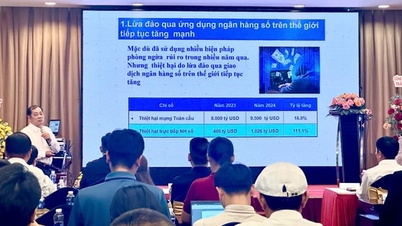
The increasingly sophisticated and unpredictable nature of online scams has cost Vietnamese users up to 18,900 billion VND in 2024.

Online scams are rampant in Vietnam's cyberspace in 2024 - Photo: WHITEHAT
2024 also saw a dramatic increase in scams, ranging from traditional methods to more sophisticated new scenarios.
The Whitehat Vietnam Cybersecurity Community Forum recently reviewed the most common online scams that trapped many users in 2024.
Bank fraud, impersonating delivery drivers.
Firstly, there's the scam involving fake delivery drivers and online transactions. This is a trick used by online shoppers where a fake delivery driver announces successful delivery. Customers are then asked to transfer payment, but this is actually a scheme to steal money, along with the risk of personal information leakage.
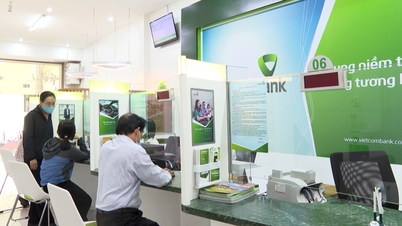
Secondly, there is bank fraud. Fake websites impersonating major banks in Vietnam have become tools to trick victims into providing account information. Furthermore, fraudsters are using the "mistaken money transfer" trick to lure victims into more sophisticated schemes, ultimately draining their accounts.
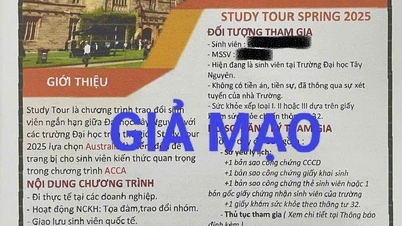
Thirdly, there's the nightmare of "skills-based summer camps" for children. Exploiting the demand for skill development in children, scammers create fake "summer camp" websites/fan pages to trick parents into transferring money or completing fictitious tasks. As a result, parents lose money unnecessarily, and their children receive no benefit whatsoever.
Financial investment scams, fake tickets, fake visas.
Fourthly, there are fake tickets at major concerts and events. 2024 saw a boom in large, high-quality music shows, which also led to a surge in ticket scams. Scammers not only sold fake tickets on websites but also exploited social media to conduct "ticket hunting" transactions at unreasonably high prices, trapping many people.
Fifthly, there are scams involving labor export and "fake" visas. Using deceptive tactics like promising "quick visa processing" or "labor export without document verification," fake social media accounts trick victims into providing personal information and making advance payments. The consequence is that users' personal information is stolen, money is lost, and neither the visa nor the job opportunity materializes.
Sixth, there are psychological attacks ranging from financial investments to online dating. Exploiting greed or emotional need, scammers employ tactics such as inviting victims to invest in finance or cryptocurrencies with "huge" returns, or offering online dating with sweet promises. After sweet-talking and luring victims into transferring money, they disappear without a trace, leaving victims bewildered and with no one to turn to.
Source: https://tuoitre.vn/diem-mat-nhung-chieu-tro-lua-dao-khien-nhieu-nguoi-dung-sap-bay-trong-nam-2024-20250101220211663.htm

![[Photo] Enchanting ancient rose garden on the mountainside in Nghe An](/_next/image?url=https%3A%2F%2Fvphoto.vietnam.vn%2Fthumb%2F1200x675%2Fvietnam%2Fresource%2FIMAGE%2F2025%2F12%2F19%2F1766109900916_vuon-hong-chin-do-thu-hut-du-khach-toi-check-in-o-ha-noi-3-20162778-1671624890024-1671624890104198100259.jpeg&w=3840&q=75)


![[Photo] General Secretary To Lam visits the exhibition space showcasing books, photo exhibitions, and achievements of digital transformation in journalism.](/_next/image?url=https%3A%2F%2Fvphoto.vietnam.vn%2Fthumb%2F1200x675%2Fvietnam%2Fresource%2FIMAGE%2F2025%2F12%2F19%2F1766110879215_1766110240024-jpg.webp&w=3840&q=75)






























































































Comment (0)