

Seventy years ago, around this time, the alleyway of Ngoc Hoi (Ngoc Ha Street, Hanoi ) suddenly became very lively. Mr. Ky, the wireman, kept whispering something very important to my father, Uncle Cat, and several other men in the alley.
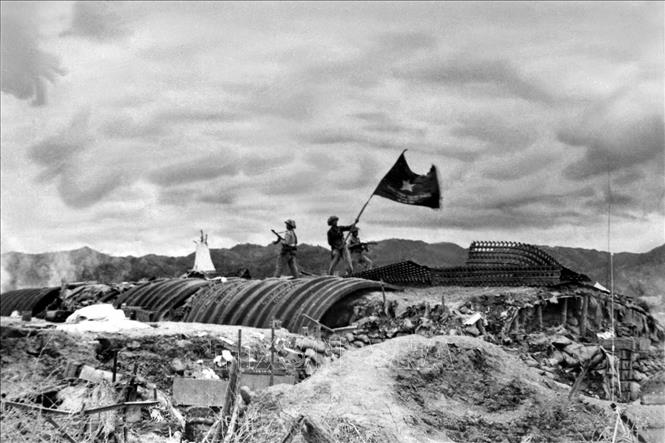
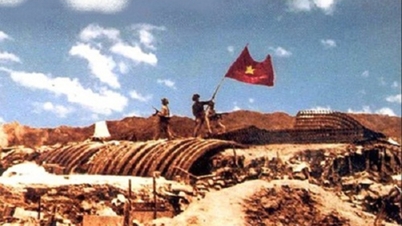
On the afternoon of May 7, 1954, the "Determined to Fight - Determined to Win" flag of the Vietnam People's Army flew atop General De Castries' bunker. The historic Dien Bien Phu campaign had achieved complete victory. Photo: VNA archives.
At the age of 12, while attending primary school at Lac Long, I boldly asked my teacher, Mr. Di, what "Groupe fief Dien Bien Phu" (Dien Bien Phu fortified complex) was that my father and the old friends in the alley kept whispering about. Mr. Di pinched my ear and lowered his voice: "Secret! Extremely secret!" You don't need to know, understand? It turned out that General De Castries' Dien Bien Phu fortified complex was about to fall. And indeed, on May 8, 1954, several newspapers in Hanoi published news of the French defeat and surrender at Dien Bien Phu. I kept those newspapers until I was evacuated to avoid American bombing of Hanoi in 1972, when I lost them. My childhood was marked by memories of Dien Bien Phu, but it wasn't until I became a reporter for the Vietnam News Agency (VNA) that I had many opportunities to visit Dien Bien Phu, descend into the De Castries bunker, light incense at the graves of heroes like Be Van Dan and To Vinh Dien, and quietly remember the brilliant commander who achieved the victory that "shook the world and resonated across continents" in the General's bunker in Muong Phang. I remember the 50th anniversary of the Dien Bien Phu victory, when I was assigned to accompany and report on the Party leaders' visit to Dien Bien Phu. The delegation traveled by helicopter, reportedly a special aircraft that had served President Ho Chi Minh. The trip left many profound impressions of the land and people of Dien Bien Phu. I remember a fig tree with lush branches and leaves near the entrance to the De Castries bunker partially concealing a bas-relief depicting De Castries and his officers surrendering. Opposite the bunker was a rose garden, in full bloom. Famous landmarks like A1 Hill, Independence Hill, Muong Thanh, Hong Cum, and Him Lam evoke memories of those fiery days. At the Muong Thanh bridgehead, there are remnants of the French artillery commander's bunker at the front. Looking through historical documents, it turns out this famous lieutenant colonel was Charles Piroth, a wounded soldier who lost an arm in the war against Nazi Germany and was awarded the Legion of Honor. Arriving at Dien Bien Phu, Charles Piroth confidently declared he would show the Viet Minh what French artillery was like. However, when our artillery unleashed fire on the Muong Thanh basin, Charles Piroth could only pray to God and weakly command counter-fire against dummy positions with blackened bamboo tubes resembling cannon barrels. After a humiliating defeat following 48 hours of artillery fire, Charles Piroth detonated a grenade, ending his career as a campaign artillery commander. According to the Vietnam News Agency correspondent in Paris, in early 1993, the vast majority of the French people supported the visit of French President Francois Mitterrand, the first head of state from a Western European country to visit Vietnam. However, there were still those who vehemently opposed the President's visit to Dien Bien Phu. General Marcel Bigeard (1916 - 2010), former Deputy Minister of Defense of France and a former prisoner of war at Dien Bien Phu, stated: "Dien Bien Phu is a humiliation for France. The President should not go there!" But the historic visit still took place, and surprisingly, later, before his death in 2010, General Marcel Bigeard willed that his remains be cremated and his ashes scattered over Dien Bien Phu! On the afternoon of February 10, 1993, Muong Thanh Airport, for the first time in exactly 39 years, saw a plane flying the tricolor flag of France land there, bringing President Francois Mitterrand to visit the former battlefield. The President stepped out of the airplane's gangway, paused, and gazed across the Dien Bien Phu basin before getting into a car with his entourage to visit the De Castries bunker. Inside the bunker, he carefully observed General De Castries' command post. The bunker was enclosed by steel arches and a sturdy reinforced concrete structure. The French President silently gazed for a long time at the war artifacts, stained with the passage of time. He placed his hand on General De Castries' desk, remaining silent. Past and present intertwined in that moment. The French President's eyes were filled with contemplation; perhaps he was reflecting on a tragic chapter of history and how he had bravely come here today to close the chapter on the past and open a new one in the relationship between Vietnam and France. On the occasion of the 70th anniversary of the Dien Bien Phu victory, let me quote a few lines about what the French wrote about this historic day 70 years ago. Jean Pouget, an aide and private secretary to General Navarre, in his work "Nous étions à Dien Biên Phu" (We at Dien Bien Phu), described May 7, 1954: "On that morning, Eliane 4 (as called by the French, or C2 as called by the Viet Minh), which had been shelled all night, was attacked by Viet Minh infantry at 5 a.m. Meanwhile, author Jules Roy, in "La Bataille de Dien Bien Phu" (The Battle of Dien Bien Phu through the Eyes of the French), described the battle around Hill C: Viet Minh soldiers climbed the high peaks of Hill C, their cheers carried on the wind with each ascent. On the slopes and summit of Hill C, they cheered in victory and raised their weapons high, exhilarated, as they saw the muddy yellow river winding and the ravaged encampment of the fortified complex. Faced with the Viet Minh's might, the artillery of the fortified complex, despite having 30 105mm and 10 120mm shells remaining, was rendered ineffective. Fighter planes dropped bombs and shells, but only managed to cause disruption for ten minutes before flying away. By 9:40 AM, the area had completely fallen. In his book "The 170 Days and Nights of the Siege of Dien Bien Phu" (Les 170 jours de Dien Bien Phu), Erwan Bergot (a former lieutenant who fought at Dien Bien Phu) wrote: "From 11 AM, not a single position east of the Nam Rom River could hold. All the forts and outposts were overrun by the enemy." On the afternoon of May 7th, at 5 PM, a ceasefire was implemented at the Dien Bien Phu battlefield, with victory for the Viet Minh and the surrender of the French forces. Some areas still showed resistance, such as Isabelle (Southern sector, comprising 5 strongholds, which we call Hong Cum). In France, at 5 PM on May 7th (1 AM on May 8th in Vietnam), President Laniel reported to the French National Assembly the fall of Dien Bien Phu. According to Jean Pouget, General De Castries had “requested an urgent resupply of mortar rounds of all calibers the night before. Forty-two tons of supplies had been dropped, but not a single package was recovered.” For ten consecutive nights, the general stayed awake. Therefore, at 10 AM when he called General Cogny at headquarters in Hanoi, De Castries' voice was weak. De Castries “suggested attempting a retreat.” According to the plan, light canned food with biscuits, nutritious chocolate, and Mong silver coins would be distributed to paratroopers and legionnaires to facilitate the retreat.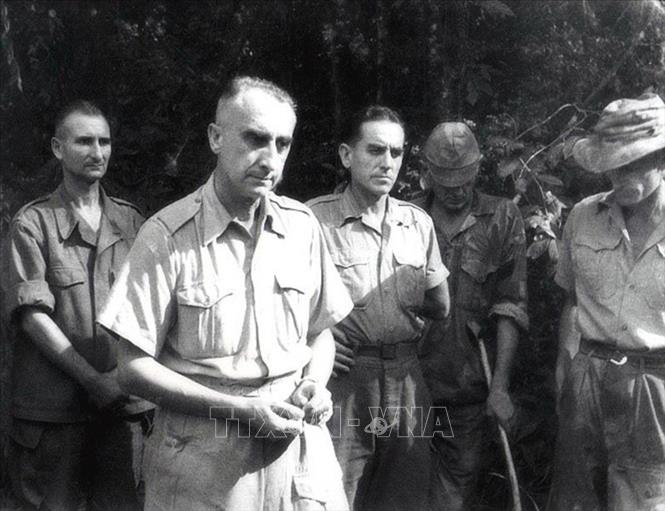
General De Castries (leading) and the entire General Staff of the Dien Bien Phu fortified complex surrender on the afternoon of May 7, 1954. Photo: Trieu Dai/VNA
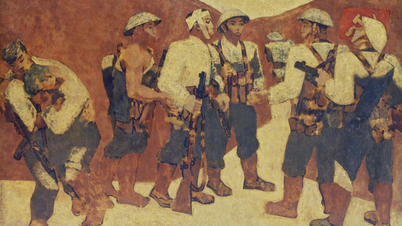
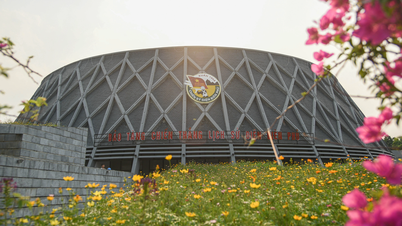
The final hours of Commander De Castries are vividly portrayed during the 170-day siege of Dien Bien Phu. In the central command bunker, the officers felt bitter about their defeat. And what about General De Castries? “De Castries concealed his embarrassment by adjusting his uniform and tightening his famous cavalry scarf.” Colonel Langlais, though silent, showed his frustration. Meanwhile, artillery commander Allioux fired the last of the mortar rounds. While almost waiting for the arrival of our troops, according to Jules Roy, Langlais burned letters and personal notebooks… The aides burned the command papers and destroyed the typewriter. When the first Viet Minh soldiers stormed the command bunker (a five-man group led by Company Commander Ta Quoc Luat), the French were visibly frightened, as Erwan Bergot described it: "From the service staff to the combat units, artillerymen, drivers, pilots, and communications personnel, everyone felt death in their souls." De Castries, in his book "The Battle of Dien Bien Phu Through the Eyes of the French," noted that when the Viet Minh soldiers descended into the bunker, he rolled up his sleeves, his uniform adorned with medals. “Paratrooper Sergeant Passearat de Silans of Langlais's 3rd Section was moved when, with his submachine gun pointed at him, Castries cried out: ‘Don’t shoot me!’ That wasn’t Castries’ usual tone; perhaps to soften the threatening attitude of the Viet Minh soldiers, he said: ‘You’re not planning to shoot, are you?’ De Castries, as he was led to the trench, his face pale under his red beret, a cigarette in his mouth, and blinded by the sunlight. Afterward, the French general was escorted into a Jeep. Langlais remained sullen and silent; Bigeard bowed his head under his beret… in the plight of a prisoner of war… 70 years is a lifetime. Few traces of the old battlefield remain. And most of the last soldiers of Dien Bien Phu are now gathered around General Giap on the other side of the sky. Their images have existed and continue to exist on the panoramic painting of the Dien Bien Phu Victory, spanning over 3,100 square meters – the largest in the world – on the second floor of the Dien Bien Phu Museum.” The painting, with its over 4,000 characters depicted so realistically, vividly, and soulfully, gives us, the descendants, a satisfying and proud view of our ancestors' historical achievements.
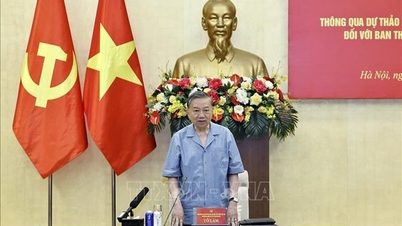
![[Photo] General Secretary and President To Lam presides over the meeting to approve the draft report on the results of the second inspection by the Politburo of the Standing Committee of the Hanoi City Party Committee.](https://vphoto.vietnam.vn/thumb/1200x675/vietnam/resource/IMAGE/2026/05/26/1779789811432_a2-bnd-4430-9620-jpg.webp)
























































Comment (0)