

Consumers worry about a double increase in electricity bills.
The National Power System and Market Operator (NSMO) recently proposed implementing a new peak hour schedule from 5:30 PM to 10:30 PM, Monday to Saturday, starting in June, to reduce pressure on the power system during the hot season. Currently, peak hours are calculated in two timeframes: 9:30 AM to 11:30 AM and 5 PM to 8 PM, Monday to Saturday. Thus, compared to the current regulations, peak hours are mainly concentrated in the evening, the time when electricity demand is highest during the day.
In discussions with Thanh Nien newspaper, many readers expressed concern that concentrating peak hours in the evening could lead to a sharp increase in household electricity costs, as this is the main time for most families. Ms. Minh Phuong (Tay Thanh Ward, Ho Chi Minh City) shared: "After 5:30 PM is the time for the whole family: cooking, showering, watching TV, using air conditioners, washing machines… During the day, everyone is at work or school, and the house is closed. If the electricity price increase is concentrated in the evening, will the electricity bill increase two to three times compared to now?"
Mr. Tran Dinh Khanh (Ham Thuan Nam commune, Lam Dong province) expressed his concern: "My family grows dragon fruit, and we mainly use lighting at night. If the electricity costs during peak hours are concentrated in the evening, the production costs for our farm will increase significantly."

With the application of peak-hour electricity pricing from 5:30 PM to 10:30 PM, the businesses most affected are those providing food and beverage services, entertainment, shopping centers, etc.
Photo: NA
This is also the general sentiment of many people in recent days. This worry is understandable because the average retail price of electricity is currently around 2,204 VND/kWh, while peak-hour electricity prices are about 1.46 to 2.4 times higher than the average retail price.
In response to these concerns, Mr. Bui Trung Kien, Deputy General Director of Ho Chi Minh City Power Corporation, affirmed that peak-hour electricity pricing only applies to non-residential customers such as those in production and business, who have installed three-tiered electricity meters. Residential electricity users will still be subject to the current six-tiered retail electricity pricing system. "According to Decision 963 of the Ministry of Industry and Trade , peak hours are extended by two hours in the evening, and the two-hour peak hour in the morning is removed. However, the total time for peak hours remains approximately five hours per day. The adjustment is primarily aimed at shifting the focus of electricity consumption from daytime to evening," Mr. Kien further explained.
The electricity sector is ready to adjust peak hours.
Regarding the adjustment of peak hours, Vietnam Electricity Group (EVN) previously stated that the total number of electricity meters used for buying, selling, and delivering electricity with time-of-use pricing is approximately 1.25 million. This is a very large volume, directly related to the measurement, calculation of bills, and payment of electricity throughout the entire system. Preliminary calculations suggest that the time required to re-install meters according to the new time frame at some large-scale units could extend to about 90 days. However, the regulations allow for a period after 90 days, so the electricity sector is currently ready for this adjustment, if a decision is made. Over the past period, the electricity sector has regularly disseminated information about load adjustment in production, conducted training for staff to prepare for re-installing meters for customers, and developed plans for immediate implementation once the new electricity usage time frame is applied.
"Mainly, it's large electricity consumers that are affected by the system. In the first 10 days, we were able to deploy the system for over 90% of large electricity consumers. In general, the electricity sector is doing a lot of work simultaneously to ensure system safety, as well as to guarantee electricity supply during the hot season," an EVN representative shared.
However, Mr. Kien also noted that even though households are not subject to peak-hour electricity pricing, the risk of price jumps during the hot season remains high due to increased electricity demand. "For households, the price of electricity during the day and night is currently the same. However, people should use electricity sparingly to avoid price jumps, leading to significantly higher electricity bills during the hot season. For manufacturing and business customers, costs can be reduced by shifting high-power consumption activities to off-peak hours and limiting the operation of high-power machinery during peak hours," Mr. Kien emphasized.
Peak hours only apply to electricity for production and business purposes.
Dr. Nguyen Duy Khiem, from Quy Nhon University (Gia Lai), further explained: the new policy mainly affects those who install three-tiered electricity meters. Among these, manufacturing businesses are less affected because the hours from 5:30 PM to 10:30 PM are the closing times for many units. Those most affected are businesses in the food and beverage, entertainment, and shopping centers sectors, primarily those operating at night. This is especially true for large cities, tourism, and agricultural production that uses electricity for greenhouse lighting, dragon fruit cultivation, etc.
Specifically regarding dragon fruit farmers who use electricity at night, Mr. Bui Quoc Hoan, Deputy General Director of the Southern Power Corporation, stated that these customers fall under the production price category. Circular 60 on electricity pricing issued by the Ministry of Industry and Trade stipulates that if customers use electricity for production and business purposes and have a dedicated transformer station of 25 kVA or more, or have an average electricity consumption of 2,000 kWh/month or more for three consecutive months, they are subject to the time-based electricity price (three prices).
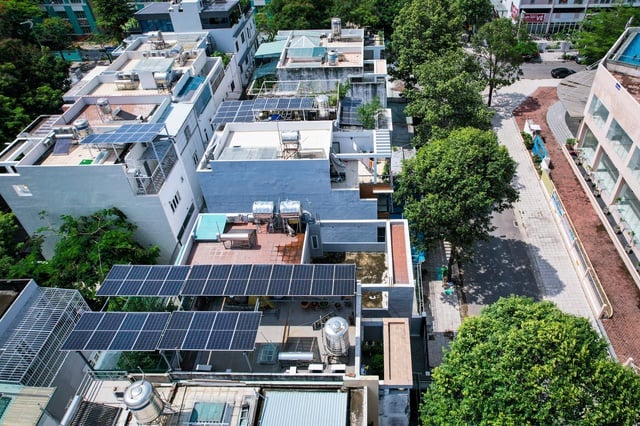
Rooftop solar power with battery storage will help boost electricity supply at night during the sunny season.
PHOTO: NHAT THINH
"Adjusting peak electricity usage hours, if it has an impact, will mainly focus on the group of customers who are required to purchase electricity at three different prices. This adjustment aims to change electricity usage behavior and encourage customers to apply solutions to reduce electricity consumption from the national grid during peak hours, as well as implement electricity saving measures and install rooftop solar power with storage. The goal is to help regulate the load curve, especially during the hot season, contributing to providing a safe and stable power supply," Mr. Bui Quoc Hoan emphasized.
Dr. Nguyen Huy Hoach, an energy expert from the Scientific Council of the Vietnam Energy Magazine, also believes that changing electricity pricing schedules forces users, particularly manufacturing and business customers, to adapt. Dr. Hoach explained: while a decade ago, peak load typically occurred during the day, associated with industrial production, the participation of solar power systems has made daytime electricity supply more abundant. Meanwhile, the demand for household electricity increases sharply in the evening, a time without sunlight, resulting in high electricity consumption between 5:30 PM and 10:30 PM. This is also the busiest period for the power system.
"Maintaining the current operating hours will burden the power system with enormous costs without any tools to regulate user behavior. At the same time, if peak hours aren't shifted to the evening, the power system will have to mobilize high-cost resources for a short period. Therefore, adjusting these hours is not only technically appropriate but also has a significant impact on changing electricity consumption behavior, as the cost of electricity depends not only on the amount consumed but also on the time of use. With this new adjustment, businesses need to optimize their systems, from energy management and technology investment to solutions such as energy storage and load control, in order to adapt more flexibly to the changing power system," said Dr. Nguyen Huy Hoach.
Accelerate your growth with rooftop solar power with storage.
However, given the extreme weather conditions and increasing heatwaves, adjusting the load and changing peak electricity usage hours are only temporary solutions. On the evening of May 24th, the National Power Grid Corporation (NSMO) announced that it had ordered the start-up of expensive oil-fired power plants S1 and S2 at O Mon I (running on fuel oil) to ensure availability for the national power grid and to connect to the grid before 7:00 AM on May 25th to meet peak electricity demand.
Intense and widespread heatwaves continue to blanket many areas across the country, putting immense pressure on the national power grid due to sharply increased electricity demand, especially in the North. Data from the National Power Grid Corporation (NSMO) indicates a real risk of power shortages during peak hours if demand continues to rise in the coming days.
According to information from NSMO, although May 24th was a Sunday, electricity demand nationwide remained very high. The national load capacity during the afternoon peak reached 47,854 MW, equivalent to approximately 90% of a normal workday's consumption and the highest level ever recorded on a Sunday. The North alone reached a peak capacity of 24,722 MW, a 16% increase compared to the previous Sunday.
Previously, on May 23rd, the national power system's peak capacity reached 53,512 MW at 1:45 PM, while nationwide electricity consumption reached 1.116 billion kWh. Despite falling on a Saturday, the peak capacity in the Northern region still reached 26,562 MW at 10:20 PM, setting a new record for the year, 143 MW higher than the peak load recorded on May 15th. Electricity consumption in the North, Central, and South regions reached 551 million kWh, 105 million kWh, and 460 million kWh respectively, accounting for 49.4%, 9.4%, and 41.2% of the total national electricity production.
Notably, the heatwave is forecast to continue. Yesterday, May 25th, temperatures in some northern areas exceeded 40 degrees Celsius. While the southern region and Ho Chi Minh City experienced some cooling rain, the weather remained extremely hot and humid.
With the hot weather and high electricity consumption, rooftop solar power with storage is being mentioned by many experts as a useful solution during this period. Dr. Nguyen Duy Khiem emphasized that in the context of increasing electricity demand to serve economic development and cope with prolonged hot weather, it is necessary to promote policies that encourage small-scale and easily socialized forms of solar power such as rooftop solar power. The current peak-hour and off-peak electricity policies do not adequately address the supply issue. During off-peak hours, from midnight to morning, few people are out for leisure or can work overtime. Especially, companies, factories, and offices use the most electricity during working hours. "If there were a sufficiently good policy on rooftop solar power, it would significantly reduce the burden on the national power grid. This is also an effective solution for energy security. Rooftop solar power with storage would be the optimal solution to reduce system pressure during peak hours," Dr. Khiem stressed.
Dr. Ngo Duc Lam, an energy expert and former Deputy Director of the Institute of Energy (Ministry of Industry and Trade), also supports the application of a peak-hour pricing mechanism to regulate demand and ensure electricity security. This would allow electricity users in production and business to adjust their working hours to avoid paying high electricity prices. Dr. Lam stated frankly: in the current period, not only electricity but also fuel is an extremely important and sensitive issue of energy security. Especially in the context of Vietnam aiming for double-digit economic growth, electricity consumption will continue to increase. Adding power sources takes time, so efficient and economical use is crucial. Therefore, in addition to large-scale strategic projects, policies are needed to promote small-scale power sources, solar energy with storage, and renewable energy in general. Furthermore, the implementation of a two-component electricity pricing mechanism needs to be expedited to achieve high efficiency.
Warning: El Nino negatively impacts energy security.
According to a report by the Ministry of Agriculture and Environment, the El Nino phenomenon is highly likely to form between June and August 2026; it is likely to reach very strong levels in the later months of the year and extend into 2027. In Vietnam, hot and dry conditions have appeared early in 2026, with heat waves increasing earlier than the multi-year average. Rainfall may be deficient even during the dry season months of 2026. In fact, rainfall across the country from the beginning of the year to date has generally been lower than the multi-year average, causing flow and water levels in many river basins to reach their lowest levels in the observation series.
Forecasts indicate that rainfall is likely to decrease sharply by 25-50% between late 2026 and early 2027. Specifically, the Da River system risks a 10-25% flow deficit between May and July 2026, posing significant risks to downstream water supply and energy security.
Source: https://thanhnien.vn/dien-sinh-hoat-co-ganh-gio-cao-diem-185260525234435951.htm

![[Photo] General Secretary and President To Lam presides over the meeting to approve the draft report on the results of the second inspection by the Politburo of the Standing Committee of the Hanoi City Party Committee.](https://vphoto.vietnam.vn/thumb/1200x675/vietnam/resource/IMAGE/2026/05/26/1779789811432_a2-bnd-4430-9620-jpg.webp)













![[Video] General Secretary and President To Lam: Legislative work must shift strongly from a management mindset to a development-oriented mindset.](https://vphoto.vietnam.vn/thumb/402x226/vietnam/resource/IMAGE/2026/05/26/1779809321490_quoc-hoi-jpg.webp)

![[Video] Prime Minister Le Minh Hung: Vinh Long must establish a new model for achieving "double-digit" growth targets](https://vphoto.vietnam.vn/thumb/402x226/vietnam/resource/IMAGE/2026/05/26/1779809323770_tt-jpg.webp)
![[Video] General Secretary and President To Lam: Transforming the Capital into a Creative Megacity](https://vphoto.vietnam.vn/thumb/402x226/vietnam/resource/IMAGE/2026/05/26/1779809325193_ha-noi-jpg.webp)







































































Comment (0)