

 |
A woman holds an Iranian flag in Tehran on May 25. Photo: Reuters . |
"The fundamental principle is to not trust the United States," Iranian lawmaker Abbas Moghtadaei declared on state television on May 26.
Just hours earlier, Iran's Foreign Ministry accused Washington of a "blatant violation" of the fragile ceasefire agreement on April 8 by attacking the southern province of Hormozgan. The ministry asserted that the attacks demonstrated Iran's "deep suspicion" of the United States.
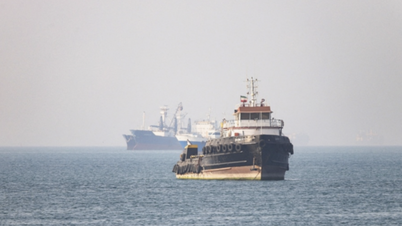
The situation escalated as the two countries attempted to finalize the last details of a Memorandum of Understanding concerning navigation in the Strait of Hormuz. Additionally, the proposal would allow Iran access to certain funds frozen overseas and pave the way for a future agreement on its nuclear program.
Professor Foad Izadi from Tehran University said Iran has been and remains willing to compromise to reach an agreement with the US. However, he noted that in the past, when the two countries were close to the final step, those opposed to diplomatic means always tried to obstruct it. “Israel and many others don’t want to see that scenario. The past has proven that, and we could see it again,” he said.
"Negotiating with the enemy is a losing battle."
Nicole Grajewski, an associate professor at Sciences Po's Center for International Studies, said many Iranian officials seem concerned that signing the agreement now would only be temporary, serving as a pretext for intelligence operations and a political cover for the U.S. and Israel to launch another large-scale attack.
"To gain political consensus, Tehran probably needs to demonstrate that this agreement is not driven by military pressure, but rather by controlled stability aimed at preserving core sovereign red lines," she told Al Jazeera.
"For example, Tehran needs to maintain some form of uranium enrichment, avoid immediately handing over its stockpiles, and ensure the easing of sanctions and regional deterrence structures, at least formally," she added.
From moderate Iranian politicians in the government to the most hardline military and security factions, all have pledged that Iran will not accept an agreement that amounts to "surrender."
Earlier this week, President Masoud Pezeshkian assured the international community that "we are not pursuing nuclear weapons, we do not want to destabilize the region."
However, Majid Mousavi – an influential air force commander within the IRGC – wrote on social media that “as our martyred leader once said, negotiating with the enemy is a humiliating failure.”
Mousavi said he would follow the orders of the new Supreme Leader Mojtaba Khamenei, who declared that "countries and territories in the region will no longer be shields for US bases."
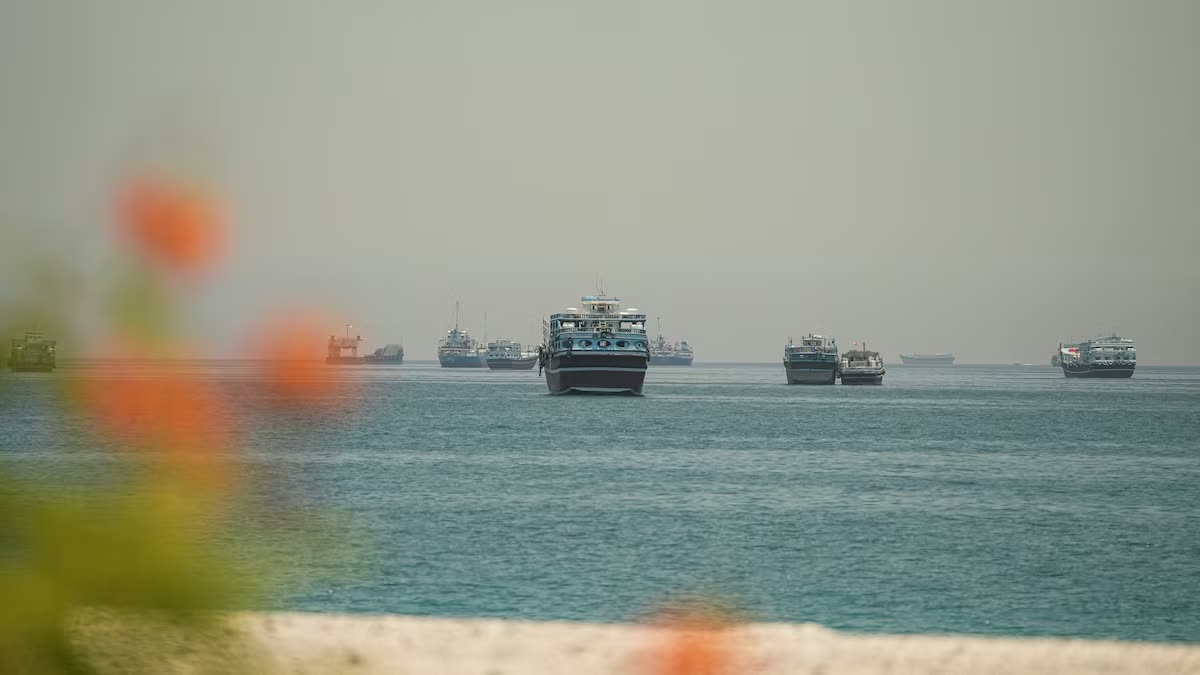 |
The US and Iran are discussing a memorandum of understanding regarding navigation in the Strait of Hormuz. Photo: Reuters . |
Alex Vatanka, a senior fellow at the Middle East Institute, said policymakers in Tehran are not only concerned about a "bad deal." They fear the agreement could force Iran to relinquish crucial leverage in the event of future conflict.
"The hawks are particularly wary of any discussion surrounding the Strait of Hormuz, the sanctions lifting process, or nuclear concessions. They view coercive leverage, especially pressure at sea, as Iran's most crucial bargaining asset in the post-war era. That's why Tehran has shifted from the question 'should we negotiate?' to 'exactly what should we give up?'" he said.
For the agreement to succeed, Iranian leaders need a process for easing some sanctions that will progress quickly. In addition, Iran will also seek to maintain a sufficiently strong deterrent mechanism and at least some diplomatic face to avoid being seen as defeated, while ensuring that another war does not break out in the future.
However, given the current situation, despite the limited information available, Mr. Vatanka believes the emerging memorandum "is not a historic peace agreement, but rather a mechanism for managing a ceasefire. The proposal aims to buy time, minimize the immediate risk of war, partially open the Strait of Hormuz, and postpone the most contentious nuclear issues to later rounds of negotiations." This means that lingering doubts and uncertainties will continue to plague the negotiations.
Israel is dissatisfied with the progress of the negotiations.
Meanwhile, Israel is completely dissatisfied with what is happening both on the battlefield and at the negotiating table.
A senior Israeli official said Tel Aviv considers the current memorandum "terrible." Israel fears the agreement will only go as far as opening the Strait of Hormuz without making any progress on the next phase, which involves curbing Iran's nuclear program.
Another concern relates to money. If the U.S. agrees to unfreeze Iranian funds held abroad, Tehran will have the resources for post-war reconstruction. This is completely contrary to Israel's wishes. Israel has made no secret of its intention to return to hostilities with Iran to further tighten its grip, thereby forcing Tehran into a deal more favorable to Tel Aviv.
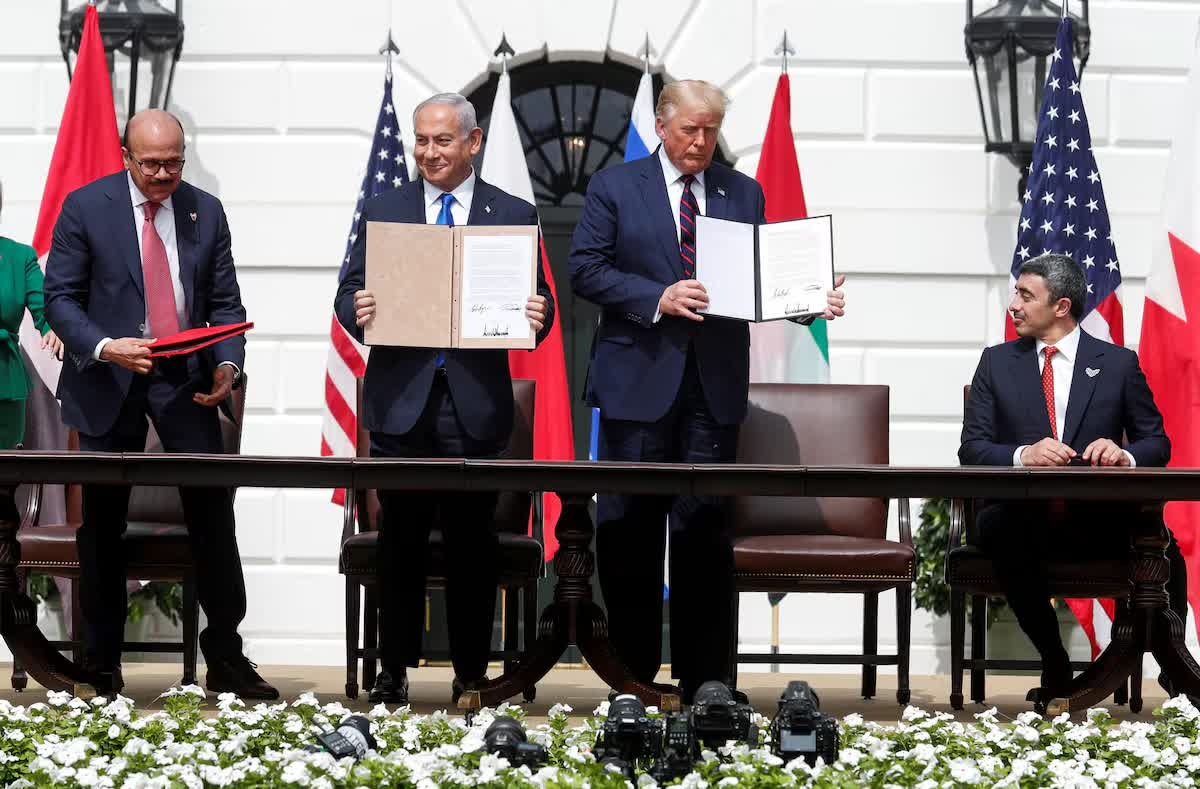 |
The Foreign Minister of Bahrain, the Prime Minister of Israel, the President of the United States, and the Foreign Minister of the UAE signed the Abraham Accords, normalizing relations with Israel on September 15, 2020. Photo: Reuters . |
However, the regional situation is very complex, because the story is not just about what Israel wants. The neighboring Gulf Arab states of Iran are collectively urging US President Donald Trump to choose a diplomatic solution.
Therefore, Trump is "stuck" between the Arab countries on one side and Israel on the other. He is trying to appease Israel by urging Saudi Arabia and Qatar to join the Abraham Accords to normalize diplomatic relations with Israel. However, this scenario is highly unlikely. Countries are unwilling to cooperate with Israel at this time, given what Israel has done to the Palestinians.
Meanwhile, both Israel and Hezbollah forces in Lebanon continue to clash bloody, despite Iran's insistence that any peace agreement with the US must include Lebanon. Israel is unwilling to relinquish its occupied territory in southern Lebanon, a position the US fully supports.
Over the past few days, a lingering fear of Israel resuming bombing raids on the capital Beirut and the suburb of Dahiye has gripped Lebanon, amid Israeli military struggles to prevent Hezbollah drone strikes.
However, Israeli media reported that the US disagreed with a full-scale attack on Beirut, a scenario that could derail ceasefire negotiations with Iran.
Earlier this week, Israeli Finance Minister Bezalel Smotrich publicly called for "collective sanctions" targeting civilian infrastructure in Lebanon in response to Hezbollah. "For every drone that explodes, 10 buildings in Beirut must collapse," he declared.
With Beirut becoming a "no-go zone" due to US demands, Israel is reverting to another tactic to pressure the Lebanese people: issuing mass evacuation orders. The latest evacuation order targets the port city of Tyre and its surroundings, one of the most densely populated areas in the south. In recent days, the Israeli military has repeatedly issued evacuation orders for dozens of towns, including the large city of Nabatieh.
Source: https://znews.vn/dieu-gi-dang-ngan-can-thoa-thuan-my-iran-post1654830.html


![[Photo] Opening Ceremony of the National People's Council Conference on the Implementation of Directions and Tasks for the 2026-2031 Term](https://vphoto.vietnam.vn/thumb/1200x675/vietnam/resource/IMAGE/2026/05/28/1779939257690_ndo_br_bnd-1991-jpg.webp)































































































Comment (0)