

Nearly $20 billion lost in one month.
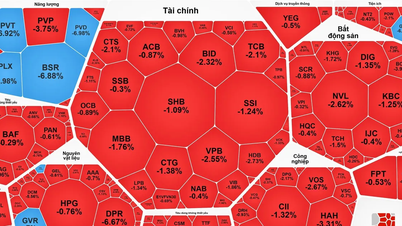
At the end of October, the VN-Index closed at 1,028.19 points, down 125.96 points, or 10.91%, compared to the end of September. With this decline within October alone, the market capitalization of the HOSE exchange evaporated by nearly 480,000 billion VND, equivalent to a decrease of 19.5 billion USD. This was the sharpest monthly decline for the VN-Index in the past 13 months, since October 2022. The consecutive declines wiped out all the gains made by stocks since the beginning of the year.
The VN-Index has retreated to near its level at the beginning of the year. Compared to the peak the market reached on September 11, 2022, the index has fallen by more than 17%. Similarly, the HNX-Index on the Hanoi Stock Exchange has also lost all its previous gains, returning to the level of early 2023. Notably, not only have stock indices plummeted, but market liquidity has also dropped sharply.
In October, the average daily trading value on the stock market reached VND 15,472 billion, a decrease of 36.7% compared to the September average. This was due to a decline in trading volume from the two most active investor groups, individual investors and foreign investors, in both buying and selling. Both groups continuously sold off their holdings; in particular, foreign investors alone continued to net sell over VND 2,300 billion in October. However, the net selling value of foreign investors decreased by nearly 42% compared to September 2023.
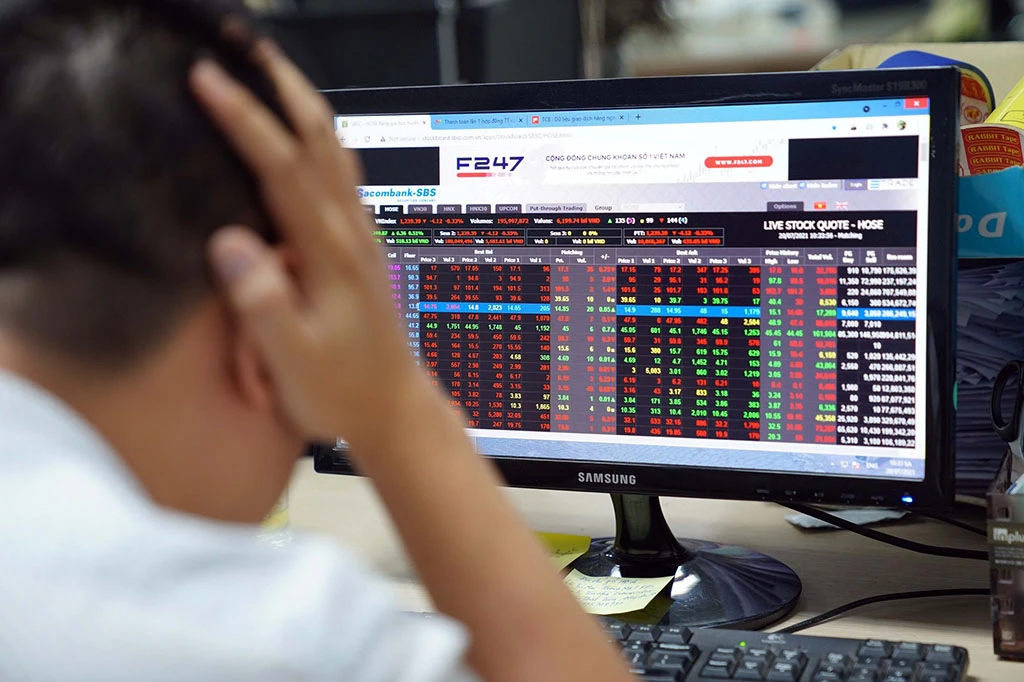
Rumors and misinformation contributed to the stock price plummeting.
During this market downturn, large-cap stocks in the VN30 index on the HOSE exchange contributed the most, dragging down small and medium-cap stocks as well. Securities companies share the view that investor sentiment is low, so risks remain quite high. This means that capital is unlikely to return to the stock market in the short term.
Stock market expert Nguyen Hong Diep analyzed that the sharp decline in the stock market during the last two weeks of October reflected the ongoing difficulties in the macroeconomic situation. This included the continuous rise in the VND/USD exchange rate, forcing the State Bank of Vietnam to use measures to withdraw money from the market. This created anxiety among investors in the stock market, as they predicted that interest rates would be difficult to lower as expected. In addition, the military conflict in the Middle East also triggered general anxiety worldwide, leading investors to adopt a defensive stance, choosing safer assets than stocks.
Stock market expert Nguyen Hong Diep
Sharing the same view, Mr. Nguyen Nhat Khanh, Head of Consulting Department at Mirae Asset Vietnam Securities Company, believes that the market had previously experienced a strong surge mainly due to expectations of government policies such as interest rate reductions, removal of bottlenecks in the real estate market, or a rebound in exports… However, many businesses have yet to recover as expected. While some companies have seen growth in business results, the main sectors remain weak. For example, the banking sector's profits have faltered while bad debts have increased, and net profit margins (NIM) have declined. Seafood and steel companies have shown some recovery, but it remains fragile, and the real estate sector has not yet shown clear signs of recovery and still needs more time.
Mr. Khanh emphasized: After a period of high demand driven by expectations, but with results not meeting predictions, a stock market correction is normal. In addition, negative information from the global market and domestic and international macroeconomic conditions has led to continuous heavy selling of many stocks.
Rumors contributed to the stock price decline.
Furthermore, it's impossible to ignore the fact that rumors also contributed to the decline in the stock market. In October, along with the sharp drop in the VN-Index, several rumors emerged about listed companies, such as the story of "Vingroup having to sell shares" or Masan's South Korean foreign shareholder "divesting all its capital"... Although unfounded, these rumors still caused individual investors to worry and rush to sell, even though the Q3 2023 business results of the aforementioned companies were higher than before.
According to Mr. Nguyen Hong Diep, rumors will always appear on the stock market. When the market declines and investor sentiment is low, even a small piece of information can be widely speculated and interpreted as a negative issue regarding a company's operations. "Expecting to eliminate rumors on the stock market is difficult, because all information has two sides. Many investor groups will exaggerate certain aspects depending on their own interests. Individual investors participating in the market must understand and accept this, as well as learn to remain calm. Sometimes, one shouldn't pay too much attention to rumors because one shouldn't choose stocks based solely on certain information or stories. Because when one rumor ends, another is likely to appear, which is normal," Mr. Nguyen Hong Diep said.
According to this expert, although it is not yet possible to determine the bottom of the stock market, the current VN-Index is close to its bottom, so there are more opportunities. At the same time, from a macroeconomic perspective, the stock market remains the most attractive investment channel with the highest potential for profit for many people, while traditional investment channels remain quite sluggish.
Mr. Nguyen Nhat Khanh himself believes that rumors did affect the psychology of individual investors in a few trading sessions, but this was not the main reason for the stock market decline in October. Therefore, even the companies affected by the rumors do not need to issue corrections; the market will adjust itself. Currently, it is too early to be optimistic about the trend of the stock market from now until the end of the year, but Mr. Khanh believes it is difficult to predict. This is because the profits of the banking sector in Q4 2023 are still unlikely to improve; the real estate sector is also facing many difficulties, and related industries such as steel and cement are unlikely to achieve positive results. Furthermore, although many predicted that individual deposits in banks might be withdrawn and partially transferred to the stock market when banks continuously reduced interest rates, this has not actually happened.
According to the latest data from the State Bank of Vietnam, as of August, the balance of household deposits in the credit institution system reached over 6.43 million billion VND, a sharp increase of 9.68% compared to the end of 2022. Deposits from economic organizations also exceeded 6 million billion VND, no longer showing negative growth as in previous months, but instead showing positive growth (+1% compared to the end of the previous year). Thus, in August, people with idle money deposited nearly 44,000 billion VND into the banking system, despite the fact that deposit interest rates had fallen rapidly at this time. Therefore, Mr. Khanh believes that the market will mainly remain sideways from now until the end of the year, but there will be short-term recovery periods.
According to technical analysis, the VN-Index's range of 1,050 - 1,100 points is considered a technical bottom. With the market's P/E (price/earnings ratio) at around 13 times and P/B (price/book value ratio) at around 1.7 times (lower than the average over the past 5 years), the market has corrected to a relatively attractive level.
Source link

![[Photo] Solemn bathing ceremony and Buddha procession in Hue](https://vphoto.vietnam.vn/thumb/1200x675/vietnam/resource/IMAGE/2026/05/31/1780228263543_1-jpg.webp)

![[Photo] The General Secretary, President and his wife begin their state visit to the Philippines.](https://vphoto.vietnam.vn/thumb/1200x675/vietnam/resource/IMAGE/2026/05/31/1780230559452_anh-man-hinh-2026-05-31-luc-19-28-11.png)
![[Photo] Admire the coral "masterpiece" amidst the million-year-old heritage of Dak Lak province.](https://vphoto.vietnam.vn/thumb/1200x675/vietnam/resource/IMAGE/2026/05/31/1780221235105_anh-man-hinh-2026-05-31-luc-16-53-27.png)











![[Video] Sunset at Lap An Lagoon – Where the sun sets over the fishing nets](https://vphoto.vietnam.vn/thumb/340x192/vietnam/resource/IMAGE/2026/05/31/1780192137701_beach-landscape-sea-water-nature-grass-745871-pxhere-com.jpeg)










































![[Photo] Admire the coral "masterpiece" amidst the million-year-old heritage of Dak Lak province.](https://vphoto.vietnam.vn/thumb/402x226/vietnam/resource/IMAGE/2026/05/31/1780221235105_anh-man-hinh-2026-05-31-luc-16-53-27.png)








































Comment (0)