

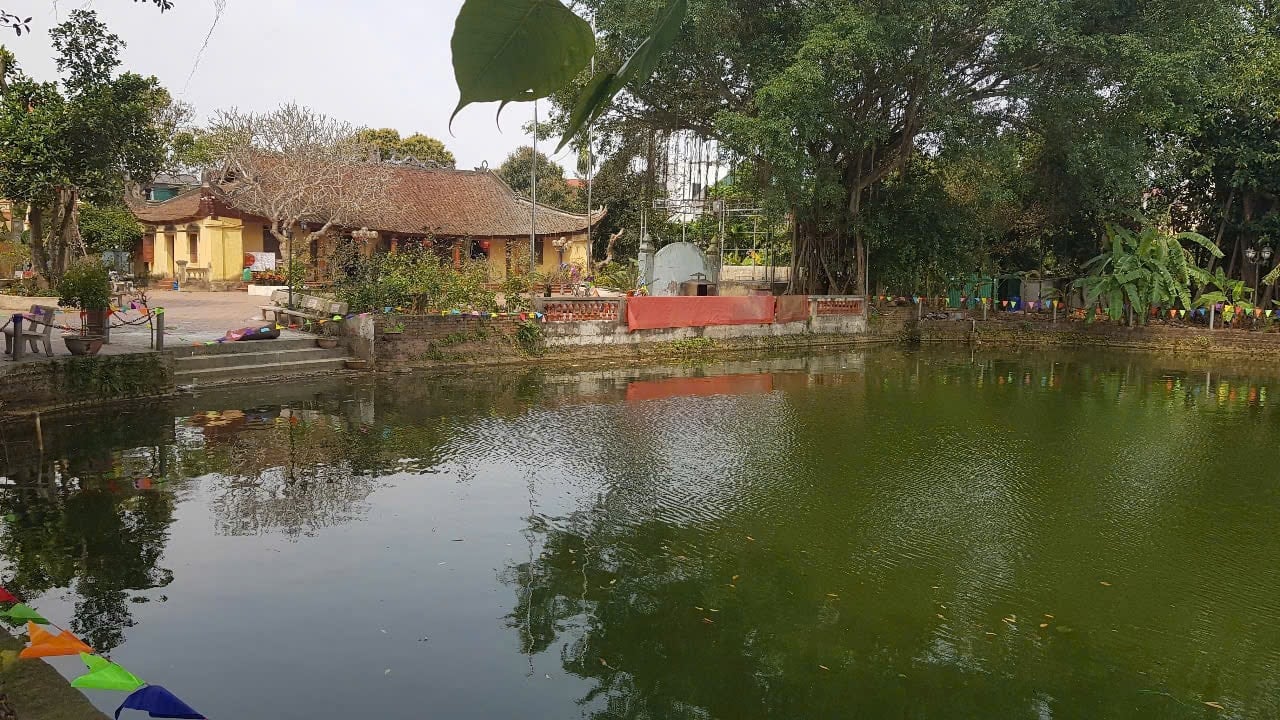
A view of Han Lac communal house, Phu Thi commune, Gia Lam district (now Thuan An commune, Hanoi ). Photo by Nguyen Nang.
Legend has it that before going into battle to defeat the Yin invaders, Saint Giong rested here, ate "seven baskets of rice, three baskets of eggplant, and drank a whole section of the river dry in one gulp." The eggplant in the Saint's meal was the Han eggplant, and that section of the river was the Duong River running along the village (According to Phan Dai Doan and Truong Huu Quynh, "Famous Historical Figures of Vietnam," Volume I, page 6, Education Publishing House, 1987) .
In Han Village, there is an ancient communal house facing east, with a clear, cool lake in front serving as a "ming tang" (auspicious area), surrounded by many banyan and fig trees, their green foliage reflecting beautifully. Slightly to the northeast is a bend in the Duong River dike.
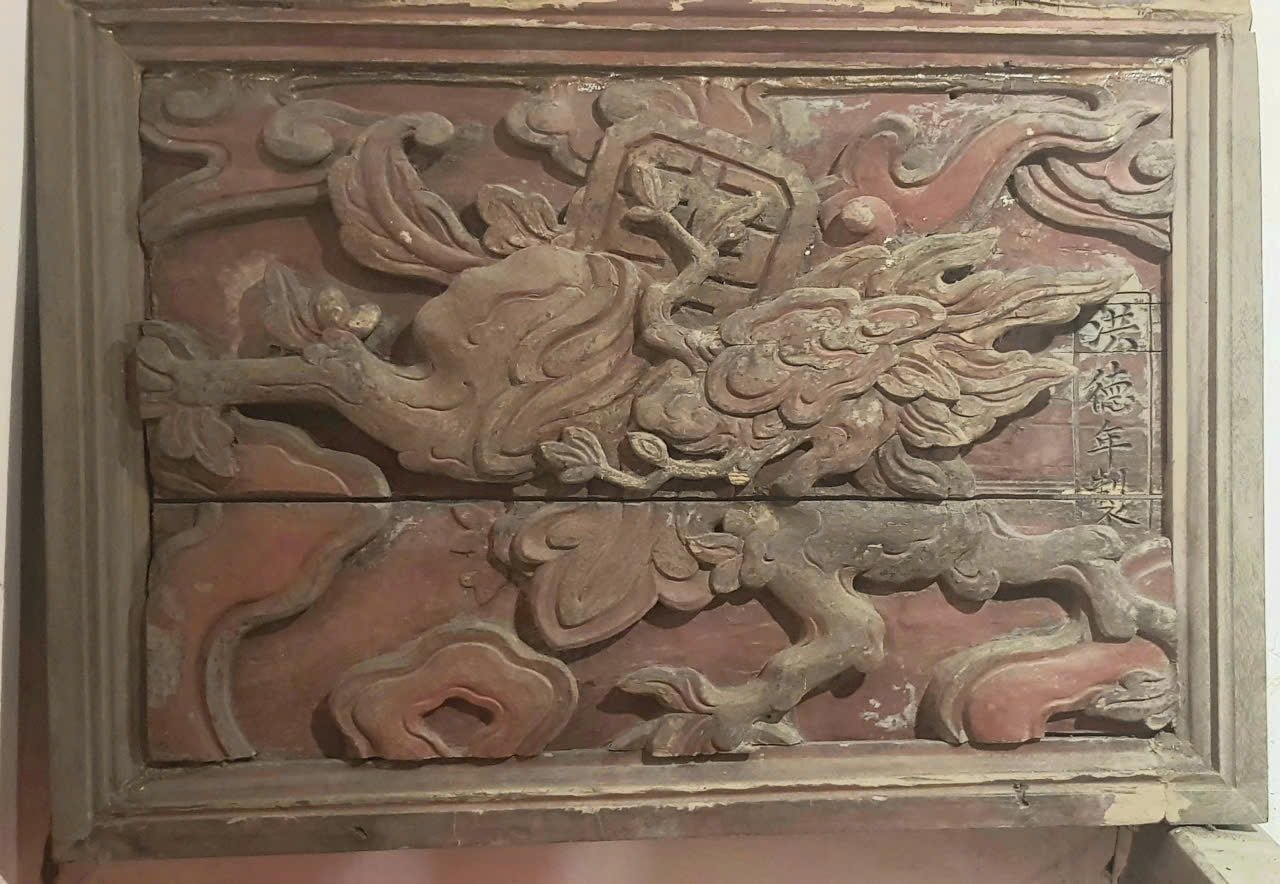
The wooden relief carving depicts a dragon-horse and bears the four Chinese characters "Hong Duc Nien Che" (Made in the Hong Duc era). Photo by Nguyen Nang.
According to the genealogies of many families in the village, based on the wooden relief carving of a dragon-horse with four Chinese characters "Hong Duc nien che" (Made in the Hong Duc era) still preserved in the communal house, many people speculate that the communal house may have been built during the reign of King Le Thanh Tong (1470 - 1497) in the Hong Duc era.
The temple has three bays, two side wings, and two side aisles, comprising a main hall, a rear sanctuary, and a shrine dedicated to the wife of the tutelary deity. The main hall consists of five bays: the central bay houses the worship hall and ceremonial objects, the right bay contains the horse statue and the set of eight treasures, and the left bay houses the dragon palanquin used during festivals. The rear sanctuary, the most sacred area, contains the altar of the tutelary deity, with ancestral tablets, imperial decrees, and surrounding paintings of dragons and phoenixes, creating a solemn and sacred atmosphere. To the right of the temple is a shrine dedicated to Lady Lã Bà.
According to Associate Professor Dr. Bui Xuan Dinh and Professor Dr. Dinh Khac Thuan, based on the stele erected in the year Bing Zi, the 17th year of the Chinh Hoa era (1696), Han Lac communal house was built at this time. The clearest remaining trace is the structure of the main beam with a gable on top of the main column. Recently, the two professors discovered for the first time on some columns and beams the name of the benefactor who contributed to the construction of the communal house: Ms. Dang Thi Tieu, who contributed in the year Mau Tuat (1838), nearly 200 years ago, alongside the name of Mr. Phung Van Yen.
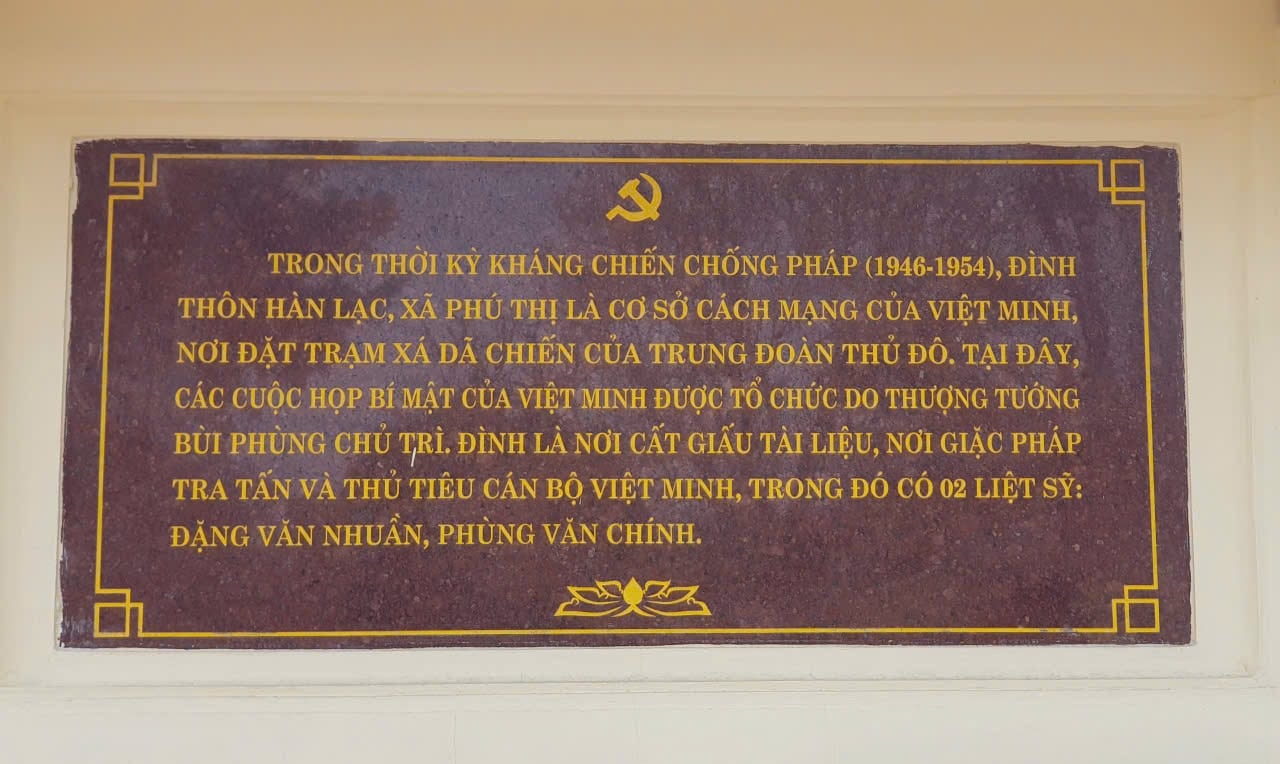
The communal house served as a revolutionary base, hiding soldiers during the resistance against the French. (Photo by Nguyen Nang)
The Han Lac communal house is dedicated to General La Ta Duong, one of the twelve warlords who ruled the Te Giang region, encompassing parts of Van Giang district (Hung Yen province), Gia Lam district (Hanoi province), and Thuan Thanh district (formerly Bac Ninh province). There are many different versions of La Ta Duong's history, and none have been agreed upon. According to documents by Mr. Phung Van Trung, head of the Han Lac communal house's ceremonial committee, he was born in 927. His father was La Dai Lieu, originally a general of the Military Command (?), who achieved many victories under Ngo Quyen. La Ta Duong succeeded his father and rose to become a powerful local leader, ruling independently in the Te Giang region, confronting many other warlords, before being subdued by Dinh Bo Linh. Legend says he led his army to fight the enemy and was beheaded. After his death, villagers went to the area later called the shrine (on the dike bordering To Khe village) and found a newly formed termite mound, next to which was a sword sheath engraved with the three words "La Ta Duong." They then brought his spirit back to the communal house to worship him.
The Han Lac communal house still preserves 6 royal decrees from the Nguyen dynasty, the earliest dating back to the 13th year of Minh Mang's reign (1832), and the latest to the third year of Duy Tan's reign (1909).
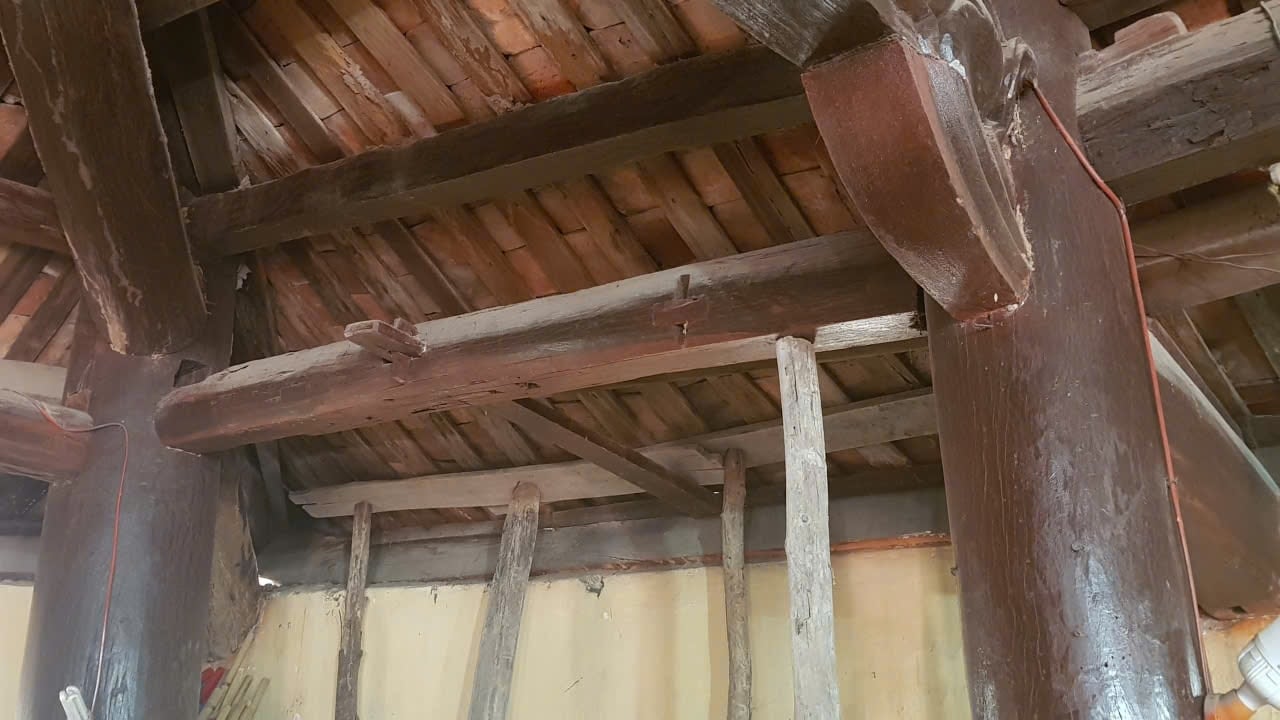
The temple is now in a state of severe disrepair and damage. (Photo by Nguyen Nang)
Over the years, the communal house had deteriorated and suffered severe damage, so in 1930-1932, the village elders met with the villagers to dismantle it completely, rebuild it, and reorient it from west to east, overlooking a lush green field of corn and potatoes, the sparkling Duong River flowing gently, and in the distance, the vast midland region with its rolling hills and mountains.
The village communal house was where General Bui Phung and Comrade Nguyen Chan (later Minister of Electricity and Coal) held meetings of Viet Minh cadres and pre-revolution cadres in the district. During the August Revolution of 1945, the communal house was where the local officials of the former Han Lac commune government submitted their official seals to the Provisional Revolutionary Committee. In December 1946, the communal house served as a field infirmary for the Capital Regiment, tasked with protecting the area north of the Red River. In 1950, the French brutally tortured and executed comrades Phung Van Chinh and Dang Van Nhuan here. The large wooden pillars of the communal house, too big for one person to embrace, were carved in many places to hide Viet Minh documents. On November 15, 1951, the French burned down half of the communal house. After the liberation of the capital, the remaining half was used as a primary school for the children of Han village and students of the commune's primary school. In 1965-1966, the communal house served as an important warehouse for the General Department of Logistics and as a workplace for the agricultural cooperative.
Driven by their love for their homeland, from 1996 to 2021, the villagers contributed their efforts to restore two communal halls, repair the temple, reinforce the lake embankment, build a gate, and acquire many other items, including ceremonial objects.
In 2012, Han Lac Temple was recognized as a Historical and Cultural Relic by the Hanoi People's Committee, and in 2020 it was recognized as a Revolutionary and Resistance Relic.
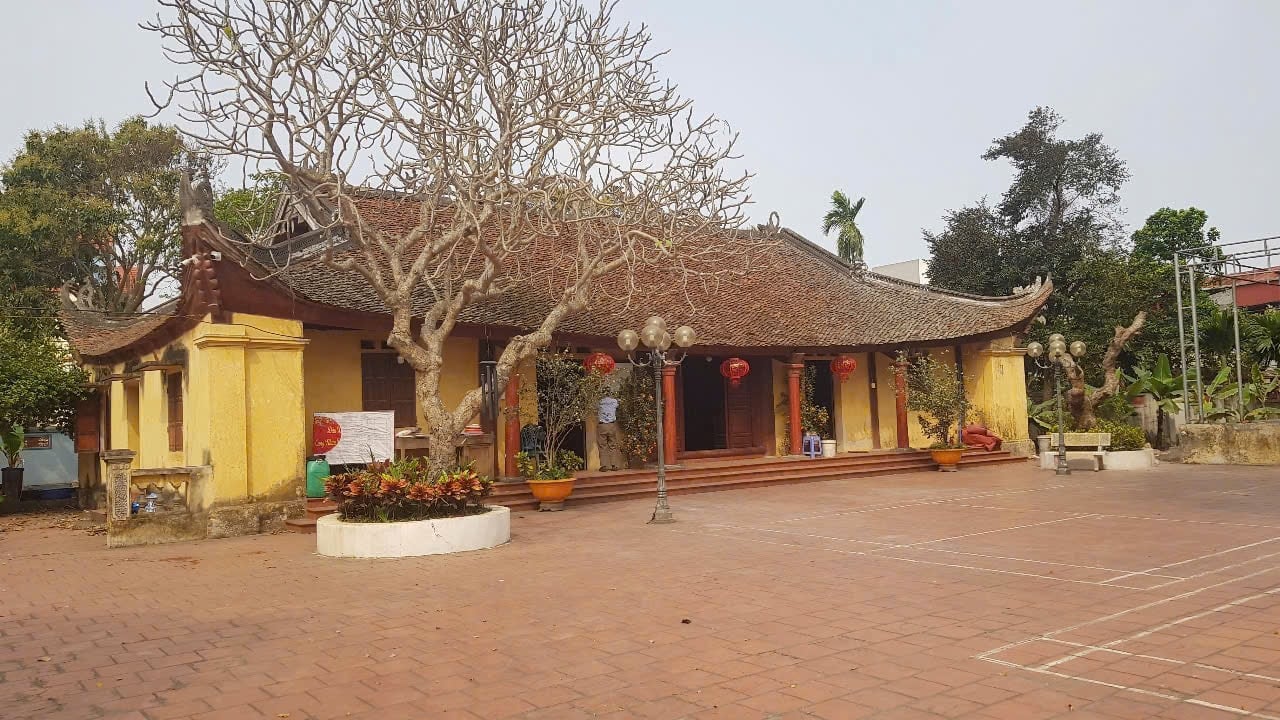
Han Lac Temple has been recognized as a Historical and Cultural Monument by the People's Committee of Hanoi City. Photo by Nguyen Nang
Reportedly, city authorities have surveyed the site and are developing a large-scale project for the restoration and renovation of Han Lac Temple. According to Appendix III-12 of the project: “The current state of the main temple is dilapidated. The main components are made of mahogany wood, with two truss systems made of reinforced concrete and painted to resemble wood. The roof tiles are misaligned, broken, and leaking. The walls are heavily damp and moldy, especially in the rear section. Some wooden components are heavily rotten and infested with termites; if not promptly addressed, this will affect the temple's load-bearing capacity. Temporary support columns have been added to the temple. The electrical wiring is exposed, failing to meet fire safety standards. The altar is tiled with decorative ceramic tiles, lacking traditional aesthetics. The temple still preserves two stone steles with the inscription 'Chinh Hoa 17' (1696) outdoors, which have not been properly preserved. The green spaces, gardens, and walkways are quite disorganized, and the infrastructure is not yet synchronized. The current site lacks many items according to the function of a traditional temple: there is still an inappropriate item within the site's grounds, a stage built in 2018, located in "To the right of the temple, the electricity and water supply systems, courtyard, garden, and greenery have not been planned comprehensively, and currently the ground level is lower than the road in front, causing frequent waterlogging. Therefore, investment is essential."
Accordingly, the total capital for the restoration and renovation project of Han Lac Temple is 30 billion 648 million VND, from the Gia Lam district budget, with implementation scheduled for 2026-2027.
The villagers hope that the project will be restarted soon, so that the communal house, a historical and cultural relic and a revolutionary and resistance war monument, will be renovated to be worthy of preserving and educating future generations about our traditions.
Source: https://hanoimoi.vn/dinh-co-han-lac-noi-luu-giu-lich-su-715966.html

![[Photo] Da Nang: A sea of people respectfully paying homage to the Bodhisattva Avalokiteshvara.](https://vphoto.vietnam.vn/thumb/1200x675/vietnam/resource/IMAGE/2026/04/06/1775454198203_ndo_br_lh24-jpg.webp)

![[Photo] National Assembly Chairman Tran Thanh Man takes the oath of office](https://vphoto.vietnam.vn/thumb/1200x675/vietnam/resource/IMAGE/2026/04/06/1775453300886_ndo_br_1-2229-jpg.webp)















![[Photo] Sidewalks in Vung Tau ward are now more spacious.](https://vphoto.vietnam.vn/thumb/1200x675/vietnam/resource/IMAGE/2026/04/06/1775455388046_5-6796-jpg.webp)




























































Comment (0)