

Recovery in the country
After a prolonged period of decline, on December 26th, despite gold causing turmoil in the financial markets, the US dollar continued to rise at a fairly strong pace.
At Vietnam Foreign Trade Commercial Bank ( Vietcombank ), the USD/VND exchange rate is currently trading at 24,111 VND/USD – 24,450 VND/USD, an increase of 50 VND/USD, equivalent to 0.21% in both buying and selling rates compared to the end of yesterday.
At the Vietnam Investment and Development Bank ( BIDV ), the USD/VND exchange rate is being traded at: 24,120 VND/USD – 24,420 VND/USD, an increase of 40 VND/USD, equivalent to 0.17%.
Vietnam Joint Stock Commercial Bank for Industry and Trade ( VietinBank ) listed the USD/VND exchange rate at: 24,132 VND/USD – 24,472 VND/USD, an increase of 107 VND/USD for the buying rate, equivalent to 0.45%, and an increase of 27 VND/USD for the selling rate, equivalent to 0.11%.
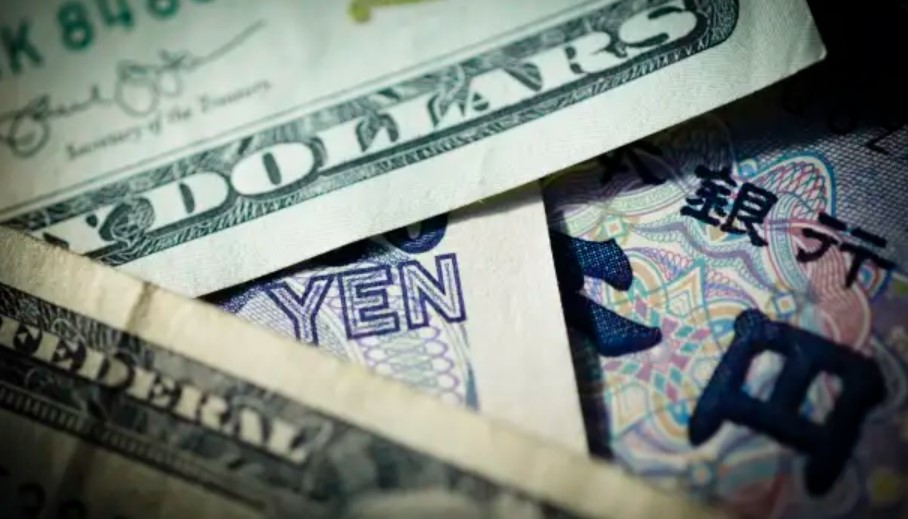
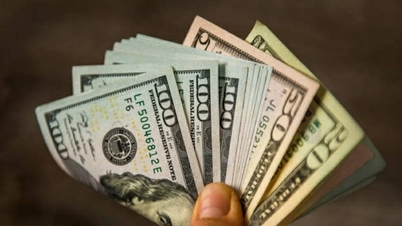
While continuing its five-month low in Asian markets, the US dollar reversed course and recovered in the domestic market. Photo: Getty Images
At commercial banks, the US dollar is rising at a more consistent rate, increasing by approximately 50 dong/USD.
At Techcombank (Vietnam Technological and Commercial Bank), the US dollar was adjusted upwards by 54 VND/USD for buying and 53 VND/USD for selling, reaching 24,146 VND/USD – 24,453 VND/USD.
TPBank (Tien Phong Commercial Joint Stock Bank) listed the exchange rate at: 24,138 VND/USD – 24,468 VND/USD, an increase of 50 VND/USD in both buying and selling rates, equivalent to 0.21%.
Meanwhile, the central exchange rate between the Vietnamese Dong (VND) and the US Dollar (USD) announced by the State Bank of Vietnam today is 23,870 VND/USD, a decrease of 25 dong compared to yesterday. The ceiling exchange rate applied by banks today is 25,063 VND/USD and the floor exchange rate is 22,676 VND/USD.
"Searching for the bottom" after 5 months in Asian markets.
The US dollar strengthened domestically but is now searching for a bottom in global markets. Currently, in Asian markets, the dollar is attempting to find a floor in sluggish trading amidst the holiday period. The dollar is under pressure from signs that inflation in the world's largest economy is cooling, which could pave the way for the Federal Reserve to ease interest rates next year.
Meanwhile, the yen stabilized near its highest level in five months on the prospect that the Bank of Japan (BOJ) may soon end its ultra-easy monetary policy. For much of 2022 and 2023, this policy put pressure on the Japanese currency as other major central banks globally embarked on cycles of aggressive interest rate hikes.
Currency volatility was largely subdued the day after Christmas, with markets in Australia, New Zealand, and Hong Kong still closed for Boxing Day.
Against the greenback, the euro fell 0.06% to $1.1019, but not far from its more than four-month high of $1.1040 reached last week.
The British pound was little changed at $1.2701, while the Australian and New Zealand dollars were near their highest levels in five months.
The dollar index weakened near its 5-month low of 101.42 reached last week and eventually fell to 101.65.
Data released on Friday showed that prices in the U.S. fell in November, for the first time in more than three and a half years, pushing annual inflation growth below 3% and boosting market expectations of a Fed interest rate cut in March.
This information comes a week after Fed policymakers left open the possibility of cutting interest rates in 2024 at the central bank's final policy meeting of the year, a move that caused the dollar to depreciate.
Wells Fargo analysts said: “The Fed has made significant progress on inflation, with the core rate starting the new year nearing 5% year-on-year, although work is not yet complete in ensuring inflation stays on a sustainable trajectory toward the 2% target.”
In Asia, the yen rose 0.1% to 142.20 per dollar, drawing further support from comments by BOJ Governor Kazuo Ueda, who signaled a possible policy shift.
Source
![[Photo] National Assembly Chairman Tran Thanh Man attends the groundbreaking ceremony for the National Highway 1A spatial axis project.](https://vphoto.vietnam.vn/thumb/1200x675/vietnam/resource/IMAGE/2026/05/19/1779161360398_ndo_br_bnd-1412-jpg.webp)
![[Photo] General Secretary and President To Lam presides over a meeting on the implementation of Directive No. 34-CT/TW of the Party Central Committee.](https://vphoto.vietnam.vn/thumb/1200x675/vietnam/resource/IMAGE/2026/05/19/1779187768672_a1-bnd-2350-631-jpg.webp)

![[Photo] Capturing the moment the tide recedes at Yen Binh Son rapids - a million-year-old scenic spot in Quang Ngai.](https://vphoto.vietnam.vn/thumb/1200x675/vietnam/resource/IMAGE/2026/05/19/1779175463885_yen9-1199-jpg.webp)




![[Infographic] Cross-exchange rates for determining taxable value from May 14-20](https://vphoto.vietnam.vn/thumb/402x226/vietnam/resource/IMAGE/2026/05/14/1778743340511_tiente-171652262483843322513020260514141027.jpeg)






















































![[Photo] General Secretary and President To Lam receives Indian Defense Minister Rajnath Singh](https://vphoto.vietnam.vn/thumb/402x226/vietnam/resource/IMAGE/2026/05/19/1779184046302_anh-man-hinh-2026-05-19-luc-16-46-58.png)































Comment (0)