


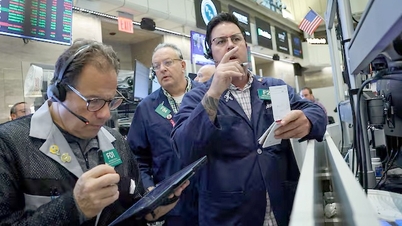
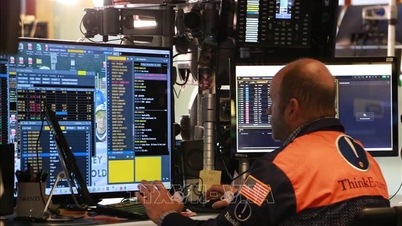
Although Wall Street's major indexes hit all-time highs mid-week, concerns about technology stock valuations and lackluster jobs data dragged the market down in the final stretch.
At the close of trading on December 12, all three major US indices were in the red. The Nasdaq Composite technology index suffered the biggest drop, falling 1.7% to 23,195.17 points. The S&P 500 index fell 1.1% to 6,827.41 points, and the Dow Jones industrial index dropped 0.5% to 48,458.05 points.
In Europe, markets were also negatively affected as sentiment shifted in New York. London's FTSE 100 index fell 0.6% to 9,649.03 points, further impacted by data showing an unexpected contraction in the UK economy in October 2025. The Frankfurt DAX 30 index fell 0.5% to 24,186.49 points, and Paris' CAC 40 index fell 0.2% to 8,068.62 points.
Pressure from technology pricing and economic data
According to analysts, the main reason for the market reversal is that investors are hesitant to make large bets on the future as the inflation and employment picture remains unclear. Specifically, data released on December 11th showed that the number of unemployment benefit claims in the US increased more sharply than expected, marking the largest increase in the past five and a half years, reinforcing the view of a weakening labor market.
Furthermore, concerns about overvaluation in the technology sector have increased following disappointing earnings reports from giants like Oracle and Broadcom. Ipek Ozkardeskaya, senior analyst at Swissquote, noted that Oracle and Broadcom have reminded the market that while AI demand remains strong, leveraged investments and uncertain profit paths are preventing investors from increasing their holdings at current valuations.
Key policy moves by the Fed this week.
Before falling at the end of the week, the market had experienced several bullish trading sessions thanks to the Fed's actions. On December 10th, the Fed decided to cut interest rates by 0.25 percentage points, bringing them to the range of 3.5% - 3.75%, the lowest level in about three years.
Federal Reserve Chairman Jerome Powell's remarks after the meeting were perceived as more dovish than initially feared, as he emphasized the focus on the job market. This helped the Dow Jones and S&P 500 set new all-time highs on December 11th. However, a clear divergence emerged as money shifted towards cyclical and defensive sectors, while technology stocks faced significant selling pressure.
During the week, the market also witnessed fluctuations in US government bond yields. The yield on 10-year Treasury bonds rose in the early sessions of the week to 4.18%, putting pressure on stocks, before cooling down to 4.141% after the Fed announced it would begin buying back short-term government bonds sooner and on a larger scale than expected.
Assessment and forecast
Looking ahead to the next trading week, global investors will focus on US employment data, due to be released next week, to look for clues about the Fed's plans for the coming year. Preliminary data released on December 11th showed that US jobless claims rose more sharply than expected in the week ending December 6th, marking the largest increase in five and a half years.
Despite the recent interest rate cut, the Fed's policymaking board's statement also signals that they may pause easing in January 2026.
Analysts predict the market may continue to face tug-of-war as investors weigh expectations of lower interest rates against the reality of technology companies' profits, particularly the sustainability of massive spending on artificial intelligence (AI).
Source: https://baotintuc.vn/thi-truong-tien-te/chung-khoan-my-va-chau-au-quay-dau-giam-do-ap-luc-chot-loi-20251213093525990.htm




![[Photo] Prime Minister Pham Minh Chinh attends the Conference summarizing and implementing tasks of the judicial sector.](/_next/image?url=https%3A%2F%2Fvphoto.vietnam.vn%2Fthumb%2F1200x675%2Fvietnam%2Fresource%2FIMAGE%2F2025%2F12%2F13%2F1765616082148_dsc-5565-jpg.webp&w=3840&q=75)
























































































Comment (0)