

 |
| Capital is flowing out of growth stocks and shifting towards value stocks. |
At the close of trading, the S&P 500 index rose 0.21% to 6,901.00 points, surpassing its previous high of 6,890.89 points set at the end of October. This was the first record high in over a month, occurring shortly after the Federal Reserve cut interest rates by 0.25 percentage points the previous day.
The Dow Jones index was even more impressive, rising 1.34% to 48,704.01 points, marking its highest closing level since November. The main driving force came from the financial sector, which has a high weighting in the Dow Jones, as investors shifted towards stocks perceived as safer and offering more stable earnings.
The rise in the two major indices reflects market confidence in the ability of the US economy to maintain its growth momentum, despite persistently high inflation and signs of a cooling labor market.
Meanwhile, the Nasdaq Composite index fell 0.25% to 23,593.86 points, heavily pressured by negative developments in Oracle (ORCL). Shares of the software company plunged 10.8%, its sharpest one-day drop since January, after the company issued a lower-than-expected business forecast and warned that spending would exceed expectations by $15 billion.
This news has raised concerns that Oracle, which has been investing heavily in AI, could fall into a situation similar to the dot-com bubble of the early 2000s due to its excessive reliance on borrowed capital. Furthermore, Oracle's decline has dragged down many other tech giants, making them a major drag on the Nasdaq.
The S&P 500 Technology Index fell 0.55%, while the Philadelphia Semiconductor Index, which represents the chip sector and is at the heart of the AI trend, also lost 0.8%.
One of the key highlights of the December 11th session was the clear shift in capital flows. The materials sector rose 2.2%, and the financial sector increased 1.8%, becoming the two leading groups in the market. Meanwhile, media services and technology declined by 1% and 0.6%, respectively.
According to Matthew Miskin, co-director of investment strategy at Manulife John Hancock Investments, the market is entering a "turnaround" phase, with money flowing towards small-cap stocks, cyclical stocks, and traditional sectors, instead of continuing to pour into technology and AI as in the previous period.
The Russell 2000 index, representing small-cap stocks, rose 1.2%, indicating a return to investor risk appetite, albeit in a more diversified direction, less reliant on technology.
Even within the technology sector, divergence remains. Broadcom fell 1.6% in regular trading but rebounded 4% in after-hours after releasing a revenue forecast that exceeded Wall Street's expectations ($19.1 billion compared to the $18.27 billion forecast).
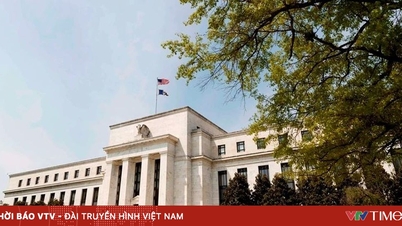
Today's developments continue to reflect the market's reaction to the Federal Reserve's policy update. Although the Fed indicated a pause in further interest rate cuts, the "dot plot" chart still suggests the possibility of further reductions next year, helping to alleviate some of investor concerns.
Mark Malek, CIO of Siebert Financial, commented: “The market was waiting for a more negative signal. The Fed’s more dovish stance than expected provided a strong impetus for the market today.”
However, newly released data from the US Department of Labor shows that jobless claims rose to 236,000, higher than the forecast of 220,000, indicating a slowdown in the labor market. This could impact the outlook for consumer spending, a major pillar of the US economy.
The December 11th trading session saw a clear trend of investors reducing their holdings of technology and growth stocks, while increasing their holdings of lower-valued stocks with stable dividends and cash flows. Financial stocks in the Dow, such as Visa, American Express, JPMorgan, and Goldman Sachs, all rose sharply, with Visa leading the way with a 6.1% increase.
Interestingly, Walt Disney's stock rose 2.4% after announcing a $1 billion investment in OpenAI, a move that shows traditional businesses are looking to strengthen their position in the AI wave.
In total, trading volume reached 17.05 billion shares, close to the 20-day average. The number of advancing stocks significantly outnumbered declining stocks, with a ratio of 2.2:1 on the NYSE and 1.28:1 on the Nasdaq, demonstrating that overall sentiment remained positive.
However, the divergence between technology and traditional sectors is becoming increasingly apparent. Concerns about overvaluation and the risk of an AI bubble could continue to weigh on technology stocks in the near future.
The December 11th trading session demonstrated the inherent strength of the US market, as capital quickly found new footholds in traditional and value-driven sectors. However, the sharp drop in Oracle and the weakness of the Nasdaq also warned that valuation risks in the AI sector remain a major concern.
In the upcoming sessions, the market is likely to continue fluctuating based on quarterly earnings reports and the Fed's next policy direction – key factors determining whether the record rally will be sustained.
Source: https://thoibaonganhang.vn/dow-jones-va-sp-500-dong-loat-lap-dinh-175021.html
![[Photo] Closing Ceremony of the 10th Session of the 15th National Assembly](/_next/image?url=https%3A%2F%2Fvphoto.vietnam.vn%2Fthumb%2F1200x675%2Fvietnam%2Fresource%2FIMAGE%2F2025%2F12%2F11%2F1765448959967_image-1437-jpg.webp&w=3840&q=75)


![[Photo] Prime Minister Pham Minh Chinh holds a phone call with the CEO of Russia's Rosatom Corporation.](/_next/image?url=https%3A%2F%2Fvphoto.vietnam.vn%2Fthumb%2F1200x675%2Fvietnam%2Fresource%2FIMAGE%2F2025%2F12%2F11%2F1765464552365_dsc-5295-jpg.webp&w=3840&q=75)




































![[OFFICIAL] MISA GROUP ANNOUNCES ITS PIONEERING BRAND POSITIONING IN BUILDING AGENTIC AI FOR BUSINESSES, HOUSEHOLDS, AND THE GOVERNMENT](https://vphoto.vietnam.vn/thumb/402x226/vietnam/resource/IMAGE/2025/12/11/1765444754256_agentic-ai_postfb-scaled.png)















































Comment (0)