


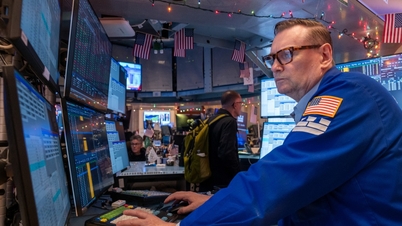
While the two major indices, the S&P 500 and Dow Jones, set new all-time highs thanks to the Federal Reserve's easing policy, technology stocks came under significant downward pressure due to concerns about valuation and investment performance in artificial intelligence (AI).
At the close of trading, the Dow Jones Industrial Average rose 646.26 points, or 1.34%, to 48,704.01 points. The S&P 500 also edged up 14.32 points, or 0.21%, closing at a record high of 6,901.00 points. This marks the first time in over a month that the index has reached a new peak. In contrast to the bullish momentum of blue-chip stocks, the Nasdaq Composite technology index fell 60.30 points, or 0.25%, to 23,593.86 points.
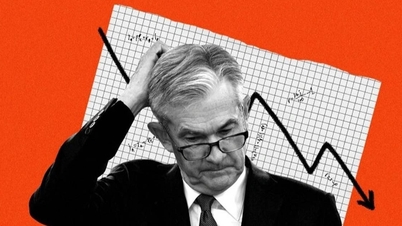
The main driver of the market rally was the Fed's decision to cut the benchmark interest rate by another 0.25 percentage points, bringing it to the 3.5% - 3.75% range. At the press conference, Fed Chairman Jerome Powell delivered a balanced message, stating that raising interest rates was not the baseline scenario for any member of the policymaking committee. This stance eased investor concerns about the possibility of monetary tightening and reinforced market expectations of at least two more interest rate cuts in the coming year.
Optimism about monetary policy stimulated a strong shift of capital from hot growth stocks to cyclical and defensive sectors. Specifically, the financial sector of the S&P 500 rose 1.8% and the materials sector rose 2.2%. At the same time, the yield on 10-year US Treasury bonds fell for the second consecutive session, to 4.141% after the Fed announced it would begin buying short-term government bonds sooner and on a larger scale than expected.
However, the market picture wasn't entirely positive. A cautious sentiment prevailed among technology stocks after Oracle announced disappointing quarterly earnings. Oracle shares plummeted 10.8% due to lower-than-expected revenue and profit, compounded by the company's warning of a massive $15 billion investment in AI infrastructure. Oracle's decline rekindled concerns about a technology bubble, dragging down shares of leading chipmaker Nvidia by 1.6%. Even Broadcom shares fell by about 3% after trading hours despite positive revenue forecasts.
Analyzing this phenomenon, Jim Reid, CEO of Deutsche Bank, noted that while investors are somewhat reassured by the Fed's interest rate cuts, concerns about AI remain very real. Similarly, Dave Grecsek of Aspiriant Wealth Management believes the market is increasingly wary of the sustainability and profitability of aggressive AI spending plans, especially when this funding is primarily debt-backed. Michael O'Rourke, chief strategist at financial services firm JonesTrading, also predicts that the AI narrative will continue to dominate the market in the short term.
In the domestic market, at the close of trading on December 11th, the VN-Index fell 20.08 points (1.17%) to 1,698.90 points. The HNX-Index fell 0.61 points (0.24%) to 255.87 points.
Source: https://baotintuc.vn/thi-truong-tien-te/chung-khoan-my-phan-hoa-manh-sau-quyet-dinh-lai-suat-cua-fed-20251212072745988.htm








































































Comment (0)