


Deputy Prime Minister Tran Hong Ha exchanges views with delegates attending the Vietnam Marine Economic Sustainable Development Forum 2025 - Photo: VGP/Minh Khoi
Shaping a modern marine economic ecosystem for a new phase of development.
In his opening remarks at the Forum, Minister of Agriculture and Environment Tran Duc Thang affirmed that the marine economy is increasingly playing a strategic role, serving as a connecting space between growth, security, the environment, and national standing. Sustainable development of the marine economy has become a measure of Vietnam's modern governance capacity in the 21st century.
Over the years, the Ministry of Agriculture and Environment has focused on perfecting the institutional framework for marine governance; promoting green and modern marine economic sectors; improving the lives of people in coastal areas; strengthening science and technology, data, and basic research; promoting international cooperation, environmental protection, and climate change adaptation while ensuring maritime sovereignty . These results have created an important foundation for the next phase of development of Vietnam's marine economy.
However, many challenges remain: inadequate institutions, inconsistent coastal infrastructure, overexploitation beyond recovery capacity, marine environmental pollution, and the need to increase inter-sectoral and inter-regional coordination capacity.
At the Forum, delegates discussed key issues: Identifying a suitable marine growth model for the new context, based on science, technology, data, and green growth; developing a comprehensive marine economic ecosystem, including energy infrastructure, logistics, coastal cities, human resources, and ocean research and forecasting centers; and strengthening modern marine governance with transparent and effective institutions; advanced observation and monitoring systems; pollution control; and marine ecosystem restoration.

Deputy Prime Minister Tran Hong Ha speaks at the Vietnam Marine Economic Sustainable Development Forum 2025 - Photo: VGP/Minh Khoi
According to Professor Mai Trong Nhuan, former Director of Hanoi National University, the spatial orientation for marine economic development, linked with the reorganization of administrative units, opens up enormous opportunities for Vietnam.
Following the merger, the country now has 21 out of 34 coastal provinces and 23 out of 34 provinces with seaports, creating favorable conditions for the formation of key marine economic zones, generating large land reserves for logistics and renewable energy, especially offshore wind power, while also ensuring seamless connectivity between economic corridors.
Professor Mai Trong Nhuan proposed four groups of solutions. First, perfecting the inter-provincial management institutions and mechanisms using a "maritime spatial governance" approach, connecting coastal provinces with landlocked provinces, and building a chain of inter-provincial economic zones, seaports, and logistics facilities to avoid duplication of investment and leverage the advantages of each region.
Secondly, we need to promote science and technology and digital transformation, form a marine technology ecosystem, and apply real-time monitoring and surveillance systems using IoT, satellites, and AI.
Thirdly, we need to strongly develop infrastructure, especially international gateway ports and multimodal logistics; while strictly managing land reclamation projects.
Fourth, develop high-quality marine human resources, provide in-depth training in offshore wind power, oceanographic forecasting, and high-tech aquaculture; and enhance the marine spatial management capacity of provincial and commune officials.
Following this statement, Associate Professor Dr. Nguyen Huu Dung, Chairman of the Vietnam Aquaculture Association, proposed the strong development of aquaculture industrial clusters as a breakthrough solution to lift Vietnam's aquaculture industry out of its manual, fragmented state and move towards large-scale production.
"By utilizing just 0.1% of the sea area, we have 1,000 km² for aquaculture, yielding up to 10 million tons of marine fish annually, not to mention other seafood," Mr. Nguyen Huu Dung emphasized.
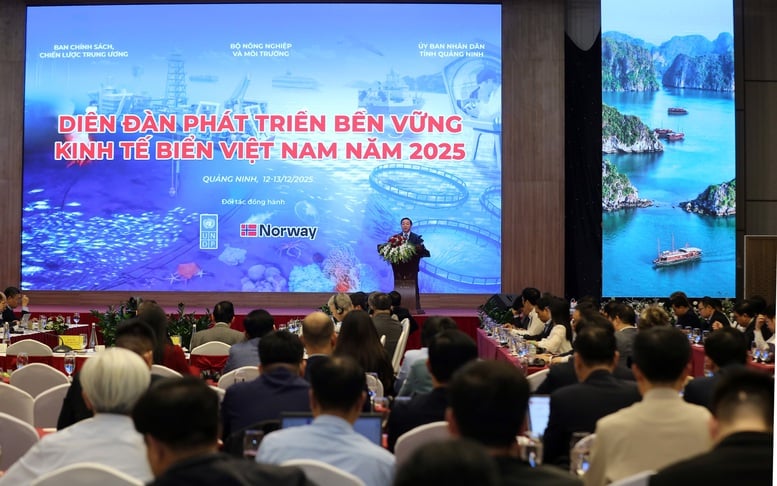
The Deputy Prime Minister highly appreciated the opinions at the Forum, especially the approach of the speakers and GWEC, in the context of the Government needing to "commission" research and refine policy thinking on green economy and laws related to energy transition - Photo: VGP/Minh Khoi
This approach creates a "leap forward," helping to form a large-scale aquaculture industry, attracting fishermen to venture further offshore, building a value chain with stable production and quality, and creating a foundation for integrating aquaculture with tourism, offshore wind power, and other marine economic sectors. At the same time, concentrated production also contributes to linking economic development with the protection of maritime sovereignty.
Meanwhile, Mark Hutchinson, Chairman of the Southeast Asia Working Group of the Global Wind Energy Council (GWEC), pointed out the enormous potential of Vietnam's offshore wind power. The revised Power Development Plan VIII sets a target of 6-17 GW of offshore wind capacity by 2030-2035 and 113-139 GW by 2050. This will form a large-scale new industry, create many jobs, enhance energy security, and boost economic development for Vietnam. GWEC is ready to support Vietnam in attracting billions of USD to develop offshore wind power projects.
Drawing on the experience of building an "Ocean Bank" capable of absorbing at least 18 million tons of CO₂ annually, and issuing the world's first sovereign green bonds to support sustainable fisheries and marine projects, Dr. Nico Barito, Special Envoy of the President of the Republic of Seychelles, argues that the blue economy is fundamentally different from traditional conservation. It is a model of economic development that uses technology and financial resources as tools to achieve sustainable development goals, not simply protection goals.
At the Forum, Mr. Hoang Thanh Vinh, Program Manager (UNDP Vietnam), shared sets of indicators and tools for analyzing and evaluating the "maturity" of marine spatial planning policies in Vietnam, as well as visualizing conflicts of interest between sectors such as fisheries, energy, and tourism, thereby supporting data-driven decision-making.

Minister of Agriculture and Environment Tran Duc Thang delivers the opening speech at the Forum - Photo: VGP/Minh Khoi
"Blue economy" continues to be driven by pioneering thinking.
Speaking at the Forum, Deputy Prime Minister Tran Hong Ha affirmed that the viewpoints and policies of the Party and State in Resolution 36-NQ/TW on the Strategy for Sustainable Development of Vietnam's Marine Economy to 2030, with a vision to 2045, remain valid. However, the thinking on the strategy for sustainable development of Vietnam's marine economy needs to be updated to suit the new context, especially as the whole country is preparing for the 14th National Congress of the Party. The two trends of digital transformation and green transformation will be the "common thread" running throughout.
Furthermore, the recent revolution in the reorganization of the administrative apparatus and units has created new development opportunities based on connectivity between regions. The goal is to ensure that even remote and disadvantaged areas have access to the sea, expanding the country's development space and helping to solve the problem of seamless connectivity between mountainous and coastal regions, and between remote and disadvantaged areas and developed regions.
"The forum was held in Quang Ninh, a locality considered a vivid example of the successful transition from a 'brown economy' to a 'green economy'. At this time, Vietnam can expect the beginning of a new phase of development, where the blue economy continues to be led by pioneering thinking," the Deputy Prime Minister said.
Emphasizing that Resolution 36-NQ/TW needs to be implemented sustainably, and that tasks and solutions must be flexibly adjusted according to each stage, Deputy Prime Minister Tran Hong Ha assessed that the presentations at the Forum are important arguments for policy planning on sustainable marine economic development in the coming time.
Highly appreciating the UNDP report, the Deputy Prime Minister stated that this is one of the important steps in perfecting analytical tools for policy planning; and requested UNDP to support Vietnamese research institutions in receiving and operating the data analysis toolkit using the methodology that UNDP is currently applying.
This toolkit, if fully implemented, will support Vietnam in cost-benefit analyses for each marine planning area, especially those with the potential for multi-sector development such as wind power, aquaculture, tourism, or energy. Quantitative analysis will help management agencies make data-driven decisions, thereby improving the efficiency of prioritizing development.
The Deputy Prime Minister proposed continued unified implementation and welcomed UNDP's collaboration with the Government in perfecting the tools, methodologies, and scientific basis for "blue economy," contributing to supporting Vietnam and other countries in choosing appropriate development models that combine conservation and development goals, harmonizing various sectors of the marine economy.

The Deputy Prime Minister and delegates attending the Forum - Photo: VGP/Minh Khoi
No single nation can solve the common challenges of the ocean on its own.
Regarding global maritime issues, the Deputy Prime Minister stated that no single country can single-handedly address common ocean challenges such as marine pollution, ecosystem degradation, ocean acidification, plastic waste, and climate change. "Vietnam agrees with the need for global concerted action and considers this a consistent commitment."
Furthermore, the implementation of the "blue economy" faces numerous global challenges stemming from disparities in development levels and scientific and technological capabilities among nations. Many key technologies serving digital transformation, green transformation, and the development of renewable energy from the sea are not yet widely shared. Therefore, without a mechanism for cooperation and technology sharing on a common platform of the United Nations, especially regarding inventions and innovations, the goals of developing a blue economy will be very difficult to achieve.
Similarly, in the transition to renewable energy, especially wind power, Vietnam possesses offshore wind potential of over 600 GW, but investment heavily depends on transmission technology, the cost of ensuring infrastructure sustainability, and the ability to overcome the limitations of a developing country.
According to the Deputy Prime Minister, the wind power issue is directly linked to the global goal of reducing CO₂ emissions. Therefore, it is necessary to clarify what constitutes a shared responsibility and what constitutes the individual responsibility of each country. The Deputy Prime Minister suggested that organizations like GWEC closely coordinate with ministries, agencies, and the Vietnamese Government to review related issues and implement several pilot projects, from surveys and investigations to planning, technology investment, and establishing responsibilities between the Government, businesses, and financial institutions.
These pilot projects will help assess how to effectively harness Vietnam's wind power potential, including connecting green energy infrastructure and researching the conversion of wind power into new energy forms such as green hydrogen or green ammonia.
The Deputy Prime Minister highly appreciated the opinions expressed at the Forum, especially the approach of the speakers and GWEC, in the context of the Government needing to commission research and refine policy thinking on green economy and laws related to energy transition.
The Deputy Prime Minister also emphasized that sustainable development requires a shift from growth based on resource exploitation to development based on knowledge, technology, and renewable energy. Therefore, strategies, plans, and policies must be concretized for each industry and sector, avoiding vagueness. Detailed and specific research will be an important foundation for building effective policies.
Agreeing with the opinion on developing the CO₂ credit market, the Deputy Prime Minister stated that, without a global mechanism for monitoring, tracking, measuring, and recognizing, CO₂ credits would only be traded within a few countries. In particular, for CO₂ absorption credits from the sea, created by human impact on marine ecosystems, countries would have to invest similarly to expanding natural forests to create forest credits.
However, currently this type of credit is only exchanged within a few international organizations such as the World Bank or a few other institutions. Therefore, this issue needs to become a common mechanism and policy soon; at the same time, there must be technology transfer and guaranteed equal access for all countries. "Only then can the world together solve the global problem of reducing emissions," the Deputy Prime Minister said.
Assessing the potential of high-tech aquaculture, the Deputy Prime Minister stated that this sector can be linked with tourism and open up new avenues for agricultural development, while current limitations remain, such as illegal, unreported, and unregulated (IUU) fishing. With the support of European countries in technology and implementation mechanisms, the Deputy Prime Minister believes that Vietnam can achieve a dual objective: organizing sustainable fishing and seafood exploitation while ensuring stable and long-term aquatic resources.

Deputy Prime Minister Tran Hong Ha receives Norwegian Ambassador to Vietnam Hilde Solbakken - Photo: VGP/Minh Khoi
Welcoming all opinions raised at the Forum, the Deputy Prime Minister stated that Vietnam is facing the need to perfect its legal system on green energy transition, while simultaneously building mechanisms to encourage marine conservation activities alongside sustainable development. These are new issues, requiring a shift from a growth model based on resource exploitation to one based on knowledge, technology, and renewable energy. To develop effective policies, it's impossible to provide general regulatory frameworks; each sector and field requires detailed and specific research to ensure the policy-making process is on the right track and feasible.
The Deputy Prime Minister expressed his hope that the Government would soon receive a concise list of recommendations containing key and feasible projects that would contribute to ushering Vietnam into an era of quality growth.
* On the sidelines of the Forum, Deputy Prime Minister Tran Hong Ha received the Norwegian Ambassador to Vietnam, Hilde Solbakken.
Earlier, speaking at the Forum, Ms. Hilde Solbakken stated that 70% of Norway's exports come from the maritime economy. Furthermore, its maritime areas are among the best managed in the world. Meanwhile, Vietnam is entering a new era with the aspiration to become a high-income country by 2045 and achieve net zero emissions by 2050. Vietnam's recent restructuring demonstrates a strong step towards a maritime economy.
"The cooperation between Norway and Vietnam is closely aligned with the priorities of sustainable marine development. Together with the Ministry of Agriculture and Environment, local authorities, UNDP Vietnam and partners, we are implementing projects to promote marine spatial planning (MSP), aimed at innovation in aquaculture and renewable energy."
Furthermore, Norway is ready to transfer technology and best practices to support Vietnam's sustainable development, ensure food security, and create more coastal livelihoods. We are also working alongside Vietnam through the pilot of the packaging return model (DRS) in Phu Quoc, promoting the Extended Producer Responsibility (EPR) policy, and expanding the co-processing of waste in the cement industry – a "win-win" solution for climate, environment, and businesses," said the Norwegian Ambassador to Vietnam.
These supports contribute to promoting Vietnam's development into a strong maritime nation and realizing its sustainable development goals, aiming for high income by 2045. Norway is committed to continuing its partnership with Vietnam in these priority areas.
Minh Khoi
Source: https://baochinhphu.vn/tiep-tuc-hoan-thien-chinh-sach-co-che-kinh-te-bien-xanh-102251212221814111.htm

























































Comment (0)