

In this context, commercial banks are actively supporting household businesses in transforming their models and becoming pioneers in leveraging new data sources to expand credit, especially microcredit.
Many loan packages come with incentives for digital transformation.
Since the policy to abolish lump-sum tax for household businesses was announced to be implemented from the beginning of 2026, cooperation between commercial banks and the tax authorities has been quite active in many localities.
Major banks such as Vietcombank, VietinBank, BIDV, Agribank , etc., have proactively signed agreements with tax authorities in provinces and cities to jointly support business households in their digital transformation with many specific solutions.
For example, Vietcombank, in addition to providing payment support and consulting services for registration, declaration, and electronic invoicing, is also promoting preferential short-term loan products for individuals, household businesses, and private enterprises with interest rates starting from 4.6% per year (the loan package size reaches approximately 250,000 billion VND).
VPBank has launched the V20000 comprehensive financial solution package with a scale of VND 20,000 billion, interest rates starting from 3.99%/year, and a maximum loan limit of VND 20 billion per customer. The bank is also collaborating with an accounting software platform to accelerate digitalization and support the transformation of household businesses, and partnering with 3TS to integrate online business account opening, card issuance, loan applications, and free use of accounting software.
Meanwhile, Techcombank is expanding its QR payment and SoftPOS ecosystem, connecting with sales management software to record revenue in real time, thereby developing credit based on cash flow rather than traditional collateral. ACB offers a solution package for household businesses and those converting into enterprises with incentives such as: free payment account transactions, reduced loan interest rates, free business cards, and support for business bank accounts. Sacombank, on the other hand, provides free comprehensive financial packages (beautiful account numbers, cards, payment speakers), support for POS/mPOS/QR Pay with low fees, and a 1% reduction in short-term/medium-to-long-term loan interest rates for household businesses converting into enterprises...
Another prominent trend that is spreading is the collaboration between commercial banks and businesses providing sales management platforms such as So Ban Hang, KiotViet, MISA, Sapo, etc. According to representatives of several commercial bank branches in Ho Chi Minh City, when cooperating with these businesses, the revenue of household businesses using So Ban Hang and KiotViet management applications will be recorded and integrated into the bank's customer data. Invoices, transactions, inventory, and cash flow are all systematized into digital data. This helps banks assess revenue, capital turnover, and loan needs with high accuracy.
 |
| The group of household businesses converting into enterprises with large capital needs presents an opportunity for commercial banks to develop microcredit products. |
The potential for expanding microcredit is significant.
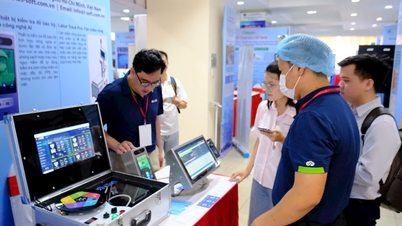
In Ho Chi Minh City and Dong Nai, fintech companies and sales platforms are now quite proactive in collaborating with commercial banks to expand their ecosystem of small customers, support digital transformation, and facilitate the transition of household businesses into financial services.
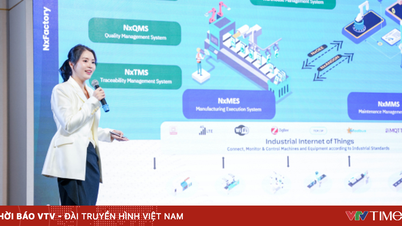
When sales management software like KiotViet, Misa SME Pro, or Sales Ledger is integrated with banks, revenue data is connected to the bank's customer management system and can automatically provide credit alerts, suggest products according to each business cycle, and allow customers to borrow more flexibly.
Currently, KiotViet has over 250,000 stores using its platform, and MISA has over 1.2 million users. Experts believe this will be a huge source of data, creating a foundation for commercial banks to strongly develop microcredit product packages with small, flexible loans, accompanied by incentives and promotions.
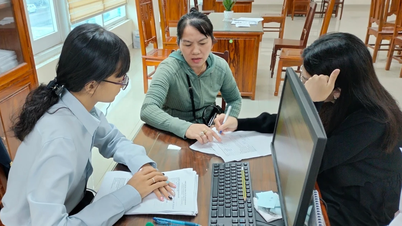
In fact, at commercial banks with a large proportion of retail lending such as ACB and Sacombank, there has been a strong shift in loan demand from household businesses in recent months. At some Sacombank branches (in Go Vap and An Nhon wards - Ho Chi Minh City), the number of customers opening new business accounts has increased by over 30%; ACB's loan package with a 1% interest rate reduction for converting household businesses has also disbursed tens of billions of VND to households that have recently converted into small businesses.
According to analyses by tax consultants and agents, the requirement for millions of business households to disclose their revenue and transform their business models according to new tax regulations will create a huge customer base for retail-focused commercial banks. A representative from a tax agency in Ho Chi Minh City estimates that currently, there are approximately 500,000 to 700,000 business households nationwide. If just 30% of these convert into enterprises, the demand for loans could reach 50,000 to 200,000 in the coming years (on average, each converted household needs to borrow around 100-500 million VND).
Besides developing microcredit, experts believe that as the group of household businesses transitions strongly to corporate models, commercial banks will also have the opportunity to expand their accompanying products and services such as: corporate cards, accounts, digital payments, insurance, cash flow management, etc. Therefore, commercial banks will compete in deploying large credit packages, integrating management technology, and cooperating with fintech to create a new customer base with transparent data, a need for large additional capital, and lower credit risk than before, when customer cash flow lacked transparency.
Source: https://thoibaonganhang.vn/co-hoi-but-pha-tin-dung-tu-ho-kinh-doanh-174449.html
















![[Photo] Prime Minister Pham Minh Chinh holds a phone call with the CEO of Russia's Rosatom Corporation.](/_next/image?url=https%3A%2F%2Fvphoto.vietnam.vn%2Fthumb%2F1200x675%2Fvietnam%2Fresource%2FIMAGE%2F2025%2F12%2F11%2F1765464552365_dsc-5295-jpg.webp&w=3840&q=75)













































Comment (0)