

 |
| The Payment Department of the State Bank of Vietnam |
From historical milestones to a journey of asserting its position and achieving breakthroughs.
Exactly 20 years ago, Governor of the State Bank of Vietnam, Le Duc Thuy, signed Decision No. 1210/QD-NHNN dated August 15, 2005, marking the establishment of the Payment Department, the predecessor of today's Payment Division. The Payment Department's function is to assist the Governor in researching and developing payment mechanisms, policies, and regulations, and to manage payment activities with the aim of promoting the safe and efficient operation of the payment system in the economy . The Payment Department is organized into three divisions: Payment Regulations and General Affairs, Payment Operations and Technical Division, and Payment Service and System Development Division.
In 2008, the Payment Department was dissolved, and all assets, personnel, and related documents were transferred to the Payment Division. This newly established unit, part of the State Bank of Vietnam's organizational structure, functions to advise and assist the Governor in the state management of payment services in the economy. The organizational structure of the Payment Division was also perfected with four functional departments, based on three existing departments from the Payment Department era and adding one new department: the Payment System and General Affairs Department, the Payment Operations and Technical Department, the Payment Development Department, and the Payment Systems Monitoring Department.
Since then, the Payment Department has maintained its organizational structure of four divisions, but has been supplemented with the function and nhiệm vụ of advising and assisting the Governor in performing state management of the payment sector in the economy and digital banking activities on November 22, 2019, in accordance with the law.
Over its 20-year journey of growth and development, the Payment Department has made significant contributions to the overall development of Vietnam's banking sector, supporting the implementation of monetary policy and socio-economic development by ensuring the smooth, safe, and efficient operation of key payment systems. The unit also plays a leading role in promoting cashless payments and inclusive finance in the country by shaping an inclusive payment ecosystem and creating momentum for innovation. As a pioneering unit of the State Bank of Vietnam in innovation, digital banking, and digital transformation, the Payment Department has progressively improved through various stages of development, gradually growing stronger and affirming its role and position through concrete results recognized by the Party, Government , and society. It has dared to face challenges and proactively addressed new issues and tasks of the times, contributing to the effective implementation of policies.

Completing the legal framework – a foundation for promoting e-commerce and digital banking activities.
In response to development and international integration requirements, the Payment Department has spearheaded and advised on the issuance of numerous groundbreaking documents that have helped to form and strongly spread cashless payments nationwide, such as: the Decree on Cashless Payments, the Decree on the Controlled Testing Mechanism in the Banking Sector (Fintech Sandbox); Circulars guiding cashless payments, payment intermediary services, payment agents, etc.; and documents aimed at standardizing interconnected payments and transparent information, not only creating a framework for banks and payment intermediaries to develop services but also bringing payment activities into a modern, transparent, and internationally integrated trajectory, such as chip card standards and QR payment standards.
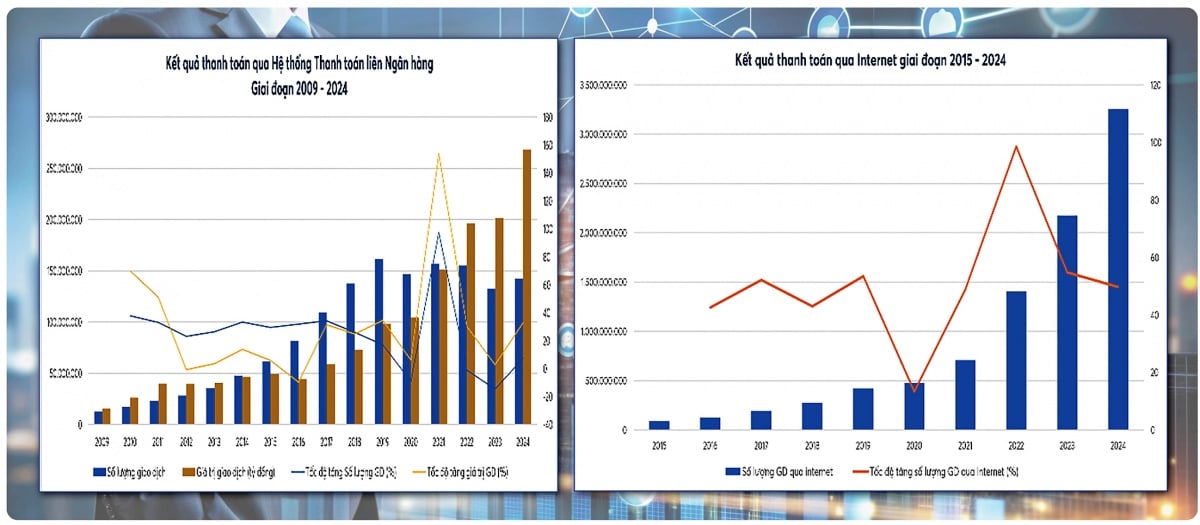
In particular, major projects such as the Electronic Payment System Development Project, the Digital Transformation Plan for the Banking Sector, the Decision on Piloting Mobile Money, and the Strategy for Developing Payment Systems – strategic documents with significant impact, innovative thinking, and pioneering spirit – all bear the Department's consistent mark throughout their formation and development. The impact of this policy system is clearly demonstrated by the remarkable growth in electronic payment systems. After 20 years, electronic payment transactions have increased approximately 500 times in volume and over 60 times in value; internet transactions have increased approximately 59 times in volume and 21 times in value; mobile transactions have increased approximately 280 times in volume and 600 times in value; and QR Codes, which only became popular in 2018, have seen a sharp increase, reaching over 700 times in volume and over 400 times in value. This shows that the payment policies advised and proposed by the Payment Department not only keep pace with international trends but also have a strong practical effect, creating an important impetus for the digital economy and inclusive finance.
From its early days, when the system was still rudimentary, processes were manual, and infrastructure and resources were limited, the Payment Department, along with other operational and business units of the State Bank of Vietnam, persistently laid the first bricks to build the country's modern payment infrastructure.
The Interbank Electronic Payment System (IBPS), launched in May 2002 and expanded nationwide by the end of 2008, has operated smoothly, safely, and efficiently, becoming the "backbone" of the economy. To date, the IBPS system has increased 36 times in number and 148 times in value compared to 2005. To meet the requirements of state management, the Payment Department has been assigned the function of supervising the interbank electronic payment system since October 2008. Supervising the IBPS system has contributed to its smooth, safe, and efficient operation, thereby supporting the implementation of monetary policy and economic growth.
The financial switching and electronic clearing system, established and operated by Napas since 2015, has become a crucial platform for instant retail payments, the development of domestic chip cards, and interoperability and standardized payments via QR code. Born from the merger of Banknetvn and Smartlink, Napas has grown strong, operates safely and stably. This is one of the significant achievements of the Payment Department, acting as the policy advisor on payments and supervisory body for the payment system. The financial switching and electronic clearing system is expected to operate stably from 2018 to 2025, with average annual transaction volume and value increasing by over 170% and 180% respectively.
To enhance payments in the public sector, the Payment Department also advises on promoting payment connectivity between banks and the Tax, Customs, Treasury, and other ministries and agencies, contributing to the modernization of public services and the transparency of budget revenue and expenditure.
Throughout various challenging periods, such as the banking restructuring era, the Covid-19 pandemic, and the explosive growth of e-commerce and the digital economy, the national payment system has always operated smoothly, safely, and reliably.
Pioneering digital transformation, creating a comprehensive and secure payment ecosystem, and strengthening user trust.
The period 2017–2025 marks a significant transformation of the digital payment and banking system. To meet practical requirements, the Payment Department has advised on the issuance of numerous mechanisms, policies, and development orientations for leading technology applications such as: Electronic Identification (eKYC) enabling citizens to open payment accounts, e-wallets, and use services entirely online; 24/7 fast payment, QR code, e-wallets, and mobile banking becoming popular and dominant methods in daily transactions; Connecting population data, business data, and anti-money laundering data in the implementation of Project 06; and Plan 01/KHPH-BCA-NHNN on the implementation of tasks under Project 06. Establishing a digital payment ecosystem and continuously expanding interconnectedness with other sectors such as education, healthcare, transportation, and public services will create a solid foundation for the development of level 4 public services and increasingly vibrant digital economic activities.
Electronic commerce has transcended the role of a financial service to become an essential platform, connecting financial and non-financial services, effectively serving people and businesses in all aspects of socio-economic life.
In response to the Party and State's policy on innovation, the Payment Department is also a leading unit in researching and managing new models: the controlled testing mechanism (Fintech Sandbox) in the banking sector - an important preparatory step for managing innovation. The deployment of Mobile Money services opens up opportunities for access to finance for people in rural, mountainous, and island areas. Connecting cross-border payments via QR code with ASEAN countries, China, South Korea, etc., contributes to promoting trade, tourism, and payments for the people. Researching central bank digital currencies (CBDCs) monitors crypto and stablecoin trends, analyzes the impact and risks on financial and monetary stability, and leverages potential opportunities from payment innovation. These are strategic tasks that contribute to shaping digital payments and safe, innovative digital banking operations towards the development of a digital economy and inclusive finance. Proactive innovation and creativity in implementing tasks to suit the new situation have demonstrated the Payment Department's ability to adapt to the rapid pace of change in financial technology and financial innovations in the market.
As digital payments develop rapidly, cybersecurity risks and financial fraud also increase. The Payment Department has advised the State Bank of Vietnam's leadership to implement a series of coordinated measures to strengthen the protection of the payment system and users.
The fact that the Payment Department advised the Governor to issue the Strategy for Supervising Payment Systems in Vietnam, the Circular regulating the supervision and implementation of supervision of important payment systems and payment intermediary service providers, and the commissioning of the Information System for Supporting Management, Supervision and Fraud Prevention in Payment Activities of the State Bank of Vietnam (SIMO) in 2025 is a significant milestone in the supervision of payment systems. The SIMO system will enable credit institutions to make decisions to immediately block transactions or require account authentication and identification before conducting online transactions, contributing to minimizing fraud and scams, thereby protecting the security of customers' payment accounts and e-wallets. As of November 25, 2025, 126 out of 149 units had successfully reported to SIMO, with a total of 585,310 accounts/transactions/informant cards/bank cards showing signs of suspected fraud, deception, or legal violations; over 652,017 customers had temporarily suspended/canceled transactions after receiving warnings, with a total transaction amount exceeding 4,619 trillion VND.

A solid foundation for a new phase of development.
Twenty years of formation and development is a journey marked by the persistent efforts of generations of staff in the Payment Department in perfecting the institutional framework, building infrastructure, and promoting innovation in the payment sector. In the coming period, the Payment Department will focus on implementing key solutions.
Firstly, perfect the legal framework – enhance management effectiveness. Specifically, build a unified legal framework for digital banking, digital payments, payment intermediaries, and fintech, while updating to new international standards. Conduct research and provide policy advice on new issues related to currency and banking operations such as CBDC, digital banking, etc.
Secondly, we need to significantly modernize the national payment infrastructure. We must continue to direct the improvement and development of a modern, safe, secure, and continuously operating retail payment system that ensures resilience, multi-channel and multi-service processing, real-time capabilities, and comprehensive financial support. We must also perfect seamless inter-sectoral payment connectivity (finance - public services - healthcare - education - transportation - logistics - e-commerce, etc.).
Thirdly, strengthen risk monitoring – ensuring safety for citizens and businesses, applying advanced technologies such as AI, Big Data, and behavioral analytics to support the detection, warning, and prevention of fraud and scams, thereby creating a safe and reliable digital payment environment; enhance monitoring capacity for critical payment systems to ensure safe and efficient operation, and for popular, emerging payment methods and cross-border payment connections to increase security and ensure sound operation.
Fourth, promote financial inclusion and the widespread adoption of digital payments: Expand digital payments in rural areas, remote regions, and among underserved populations. Ensure a balance of interests, inclusiveness, and sustainability in the relationships between stakeholders in the ecosystem, including banks, payment intermediaries, businesses, and citizens.
With outstanding achievements in payment services and digital banking operations, serving the community, the Payment Department was honored to receive the Third-Class Labor Medal in 2019; the Second-Class Labor Medal (according to Decision No. 1852/QD-CTN dated September 26, 2025) and many other prestigious emulation titles from the Party and State. The achievements of generations of officials and employees of the Payment Department are not only a source of pride but also an important foundation for the development of payment services, making them one of the key pillars of the Vietnamese banking industry.
Source: https://thoibaonganhang.vn/vu-thanh-toan-hanh-trinh-20-nam-truong-thanh-va-phat-trien-175037.html


![[Photo] Prime Minister Pham Minh Chinh holds a phone call with the CEO of Russia's Rosatom Corporation.](/_next/image?url=https%3A%2F%2Fvphoto.vietnam.vn%2Fthumb%2F1200x675%2Fvietnam%2Fresource%2FIMAGE%2F2025%2F12%2F11%2F1765464552365_dsc-5295-jpg.webp&w=3840&q=75)







































































Comment (0)