

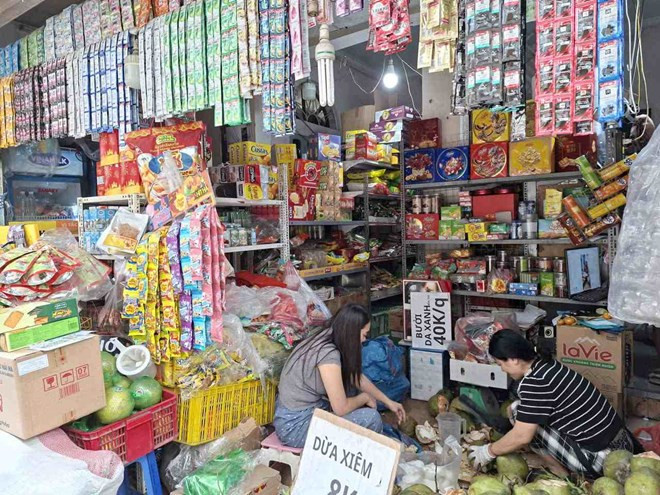
The new tax law brings about major changes for businesses and taxpayers. Photo: Luc Giang
The amended Personal Income Tax Law, effective from January 1, 2026, significantly expands the types of income exempt from tax. Some income items excluded from taxation include the transfer of real estate that is a single residential property or land plot; inheritance and gifts of real estate; and the value of land use rights granted by the State. Income from agriculture , salt, seafood, and preliminary forestry processing, along with interest on government bonds, bank deposits, remittances, pensions, and scholarships, will continue to be tax-exempt.
A major change lies in the area of household and individual businesses. The law stipulates that households with annual revenue of 500 million VND or less are exempt from personal income tax. It also allows for the deduction of this amount before calculating the tax based on a percentage of revenue. With this regulation, the majority of small-scale households will not have to pay tax. For the group of businesses subject to taxation, their tax obligations will also be significantly reduced.
For revenues between VND 500 million and VND 3 billion per year, the applicable tax rate is 15%; for revenues between VND 3 billion and VND 50 billion per year, the tax rate is 17%; and for revenues exceeding VND 50 billion per year, the rate is 20%. The law also adds a method of calculating income tax (revenue minus expenses) for the group with revenues between VND 500 million and VND 3 billion per year, providing flexibility for taxpayers.
Mr. Le Van Tuan, Director of Keytas Tax Accounting Co., Ltd., believes that the new tax rate ensures relative fairness with taxes applied to other types of income. He also emphasized the need to clearly distinguish between VAT and personal income tax: "VAT is an amount collected by business households on behalf of the State, while personal income tax only arises when there is profit."
Mr. Tuan gave an example: A household with annual revenue of 1 billion VND, if expenses are also at 1 billion VND, will not generate taxable income for personal income tax purposes, but will still have to pay 10 million VND in VAT (1% of revenue). With the new regulations, the household is allowed a deduction of 500 million VND before calculating tax. The remaining taxable revenue is 500 million VND. Applying a 1.5% tax rate to this revenue group, the tax payable will only be 7.5 million VND per year.
According to Mr. Tuan, this design reduces the disparity between households with low profits and those without profits, while avoiding the creation of new burdens.
Meanwhile, Dr. Nguyen Ngoc Tu, a lecturer at Hanoi University of Business and Technology, noted that raising the tax exemption threshold would mean that approximately 2.3 million households out of more than 2.54 million business households would not have to pay taxes. He suggested that the Ministry of Finance "carefully survey the actual revenue structure to ensure that the policy both nurtures revenue sources and maintains fairness."
Source: https://baoquangninh.vn/huong-loi-tu-thue-suat-giam-3388398.html


![[Photo] General Secretary and President To Lam meets with National Assembly delegates from ethnic minorities.](https://vphoto.vietnam.vn/thumb/1200x675/vietnam/resource/IMAGE/2026/04/20/1776696701056_a1-bnd-8331-3342-jpg.webp)
![[Image] National Assembly discusses the implementation of the socio-economic development plan.](https://vphoto.vietnam.vn/thumb/1200x675/vietnam/resource/IMAGE/2026/04/20/1776696707422_ndo_br_img-20260420-185419-jpg.webp)








































































Comment (0)