

 |
| Technical rebound "fails," VN-Index plummets more than 52 points as blue-chip stocks hit their lower limit. |
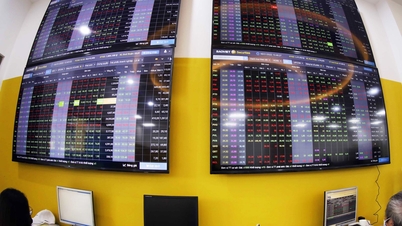
Specifically, the VN-Index closed at 1,646.89 points, down 52.01 points, or 3.06%. This was the fourth consecutive day of decline for the index, bringing the total weekly drop to 94.43 points (-5.42%), pushing the market to its lowest level since mid-November. The day's developments showed a continuous downward trend, particularly the sharp drop in the latter half of the afternoon session, reflecting the complete dominance of sellers.
Liquidity on the HoSE reached nearly 24,700 billion VND, an increase of over 52% compared to the December 11th session. The total trading volume exceeded 906 million shares, indicating intense selling activity, but also some bottom-buying activity. However, this demand appeared weak and insufficient to offset the rapidly increasing supply pressure.
From the start of the session, the VN-Index opened in positive territory thanks to opening price orders, creating expectations of a technical rebound after three consecutive days of declines. However, the positive momentum was quickly extinguished as selling pressure emerged early, pulling the index below the reference level. Throughout the morning, the market fluctuated around 1,680 points, with the number of declining stocks at one point accounting for nearly two-thirds of the total listed stocks on the HoSE.
Entering the afternoon session, the negative trend became more pronounced as sell orders were continuously placed. By around 2:20 PM, the market almost "plunged vertically" as a series of key stocks fell sharply, with many hitting their lower limit. The VN-Index at one point broke below 1,640 points, losing more than 60 points compared to the reference level. The ATC session helped the index narrow its decline slightly thanks to some blue-chip stocks shortening their corrections, but it was not enough to change the overall situation.
Market breadth heavily favored sellers. On the HoSE, 296 stocks declined compared to only 40 that rose, with 31 hitting the floor limit. The HNX recorded 135 declines and 39 gains, while UPCoM saw 219 declines compared to 123 gains. Overall, the number of declining stocks reached approximately 650, including nearly 60 that hit the floor limit, indicating a widespread correction across all three exchanges.
In terms of impact on the index, large-cap stocks continued to be the main source of pressure. VHM was the stock with the most negative impact, deducting approximately 4.2 points from the VN-Index. VPB caused the index to fall by nearly 3 points, followed by VPL, TCB, VIC, MBB, and VCB. Conversely, supporting stocks like PNJ, BMP, and QCG contributed less than 0.4 points, almost negligible.
In the VN30 basket, red dominated with 29 out of 30 stocks declining, with only BCM maintaining a positive trend. The VN30-Index closed at 1,867.03 points, down 57.26 points (-2.98%). MWG, VHM,FPT , VPB, and TCB were the stocks that dragged the index down the most, with MWG and VHM alone accounting for more than 10 points off the VN30-Index.
Notably, stocks related to the Vingroup ecosystem continued to exert significant pressure. VHM and VRE both hit their lower limit, falling to 94,100 VND and 27,450 VND per share respectively. VPL also dropped to its lower limit of 84,700 VND, while VIC only managed a slight decrease of 1.4%. In total, this group deducted more than 11 points from the VN-Index, becoming one of the main reasons for the index's sharp decline.
According to sector trends, red dominated most areas. The financial sector faced heavy pressure, with VPB falling 5.68%, VND down 5.91%, HDB losing 4.88%, TCB down over 4%, SSI down 3.27%, while VIX and EIB hit their lower limit. The real estate sector saw a series of stocks fall to their lower limit, including VHM, VRE, DXG, PDR, DIG, TCH, TAL, SCR; CEO down 8.68%, and KDH down over 6%.
The materials and industrial sector also followed the general trend, with HPG, GVR, DGC, NKG, HSG, and AAA all experiencing sharp declines. The consumer sector faced pressure, with MSN falling 3.42%, VNM dropping over 2%, and MWG losing 4.62%, while only a few stocks like PAN managed to stay in positive territory. In the energy sector, stocks such as GEX, CII, and VSC hit their lower limit, while PVD, PVS, and VJC all declined.
On the HNX exchange, the HNX-Index fell 5.78 points (-2.26%) to 250.09 points, with trading volume of nearly 1,956 billion VND. High-liquidity stocks such as CEO, MBS, and SHS all experienced sharp declines. The UPCoM-Index also fell 0.73 points (-0.61%) to 119.26 points, although the decline was less pronounced than on the two listed exchanges.
The developments on December 12th showed that predictions of a technical rebound were merely an illusion. The fact that the VN-Index quickly lost the support zone of 1,680-1,690 points and retreated to near 1,650 points indicates that the short-term outlook still harbors many risks, especially in the context of investor sentiment being strongly affected by the volatility of blue-chip stocks and the risk of margin calls in the real estate and construction sectors.
Source: https://thoibaonganhang.vn/ap-luc-ban-dang-cao-vn-index-co-phien-giam-manh-nhat-gan-hai-thang-175067.html































































Comment (0)