

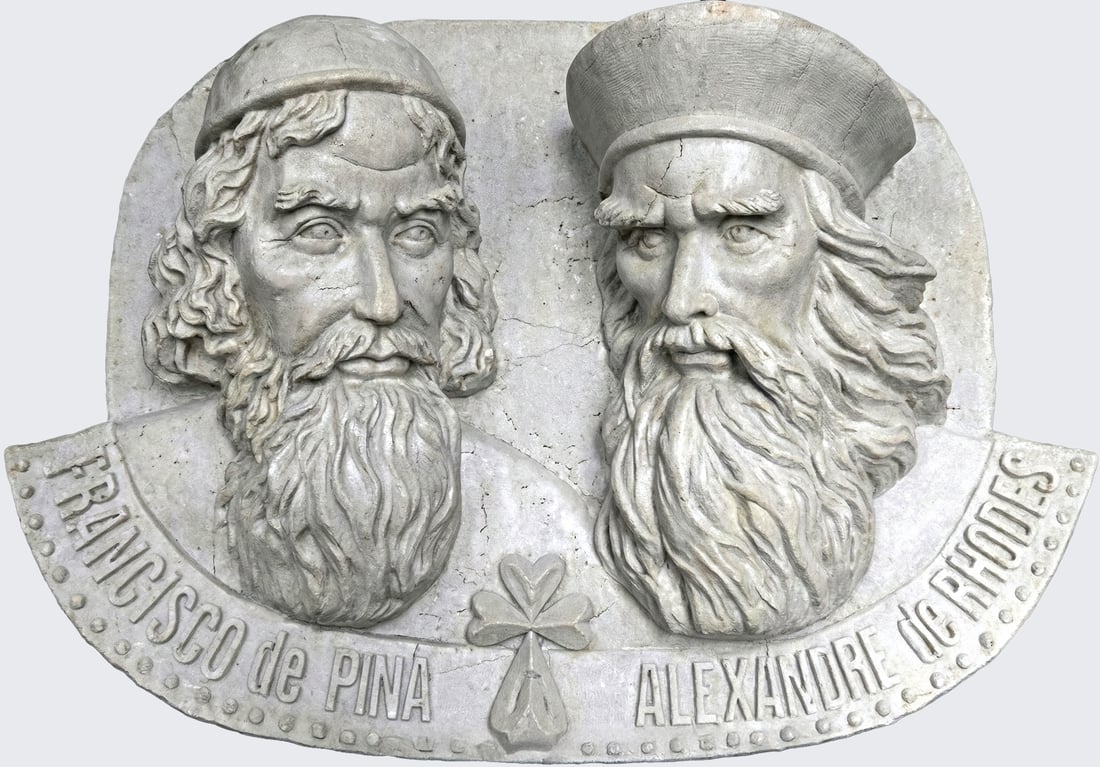
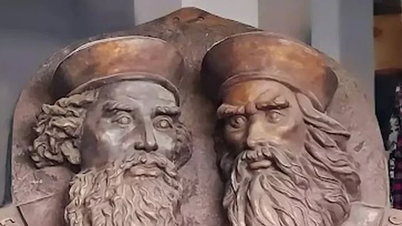
Two missionaries who are considered the "fathers" of the Vietnamese Quốc ngữ script: Francisco de Pina and Alexandre de Rhodes - Archival photo.
It is deeply moving to have the good fortune to pay tribute to a benefactor of the Vietnamese people in the sun-drenched Middle East – where he chose to live out his final years and rest in eternal peace after a long and arduous life in Vietnam.
It's been a dream come true since I was a young student working for the Tuoi Tre newspaper and submitting articles at the former editorial office at 161 Ly Chinh Thang Street ( Ho Chi Minh City) - where a bronze statue of Alexandre de Rhodes stands proudly in the front courtyard.
From my early childhood, as someone who loved literature and grew up through writing, I have held deep respect and gratitude for Alexandre de Rhodes, the "missionary Alexandre de Rhodes," for his crucial role in the formation of the Vietnamese national script in the 17th century, alongside other notable figures such as the missionaries Francisco de Pina and Gaspar d'Amaral (Portugal)...
Searching for the tomb of the missionary Alexandre de Rhodes in Persia.
Remembering the source of the water we drink, my purpose for traveling to Iran was to find the resting place of Alexandre de Rhodes so I could lay flowers at his grave. After several flights (there are currently no direct flights between Vietnam and Iran), I arrived in Tehran and from there hired a car to travel south to the ancient city of Isfahan – a historic city 350km from Tehran with a population of 2.5 million.
The local driver, Dariush, despite having driven countless tourists to Isfahan numerous times, was extremely surprised when I told him that I had come to this beautiful land with its rich history and culture to… find a cemetery!
"This is the first time I've heard the name of the Western Catholic missionary Alexandre de Rhodes in a Muslim country like Iran. Your journey will be very interesting, and I'd be delighted to join you," said Dariush, his surprise turning into excitement.
Unfortunately, while Dariush knew every famous tourist spot in Isfahan like the back of his hand and could take visitors there in a snap, he shook his head, not knowing where to find the cemetery containing the grave of Alexandre de Rhodes, who died more than 360 years ago!
Information from Vietnamese people who had been there before helped me determine: first, I had to go to the New Julfa district to find the ancient Armenian Holy Savior Church (also known as Vank - which means "monastery" in Armenian).
Alexandre de Rhodes was sent to Persia by the Vatican in 1654, lived there for six years, and died on November 5, 1660. He was buried in the Armenian Catholic cemetery on the outskirts of the city.
We asked the hotel manager in Isfahan for information, and he enthusiastically called an Armenian friend who told us we needed to go to the Vank Church to get a permit to enter the cemetery. Dariush drove me to the Vank Church early in the morning. This is the largest and first Christian church built in a Muslim country like Persia – a very special case in the history of religions.
After touring the church with its beautiful architecture and artistic domes, we went to the office to request a permit and were delighted to receive a signed and stamped document from the enthusiastic manager to visit the Armenian cemetery.
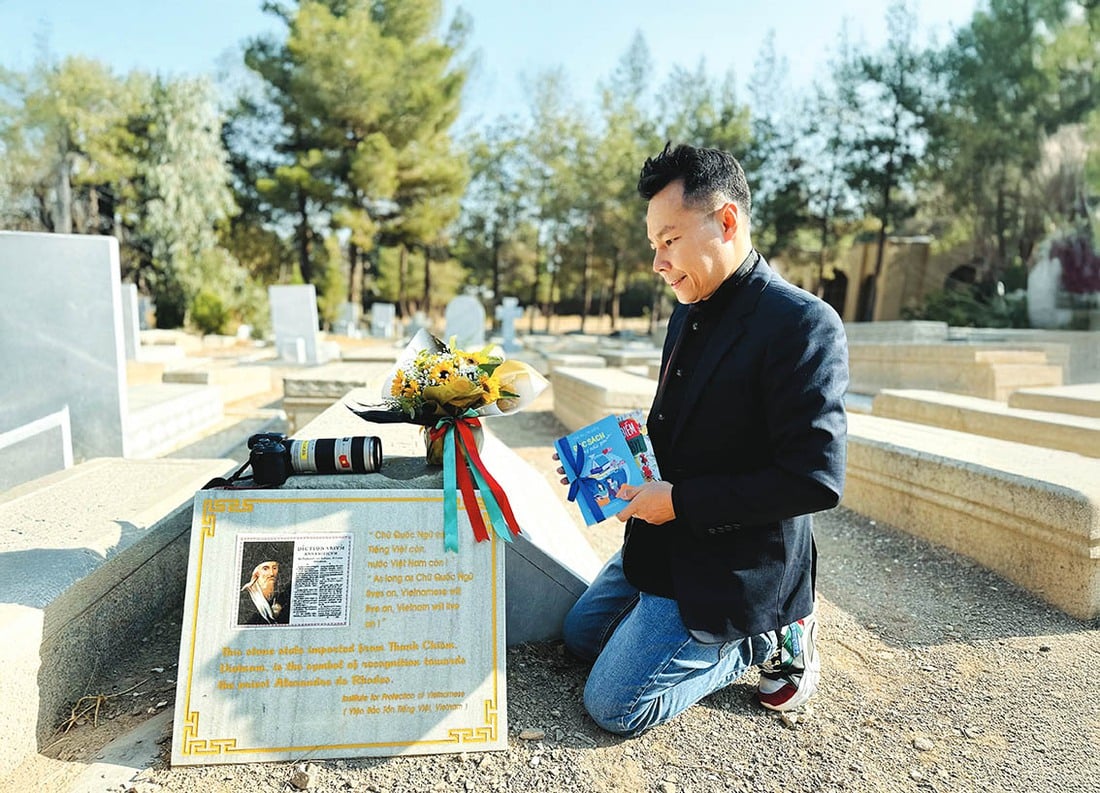
The author at the grave of Alexandre de Rhodes
A tribute to eternity.
From the Vank church, after about a 15-minute drive, we arrived at the Armenian cemetery, built over 500 years ago, covering more than 30 hectares. It is the resting place of many migrants from Europe, Jewish refugees, and pilgrims from Armenia…
The old security guard, Robert Vonikyan, opened the green-painted iron gate with a gentle smile. Having read the documents beforehand, I confidently guided Dariush along the main road lined with tall, evenly spaced green pine trees, past three intersections to the plot of land with the yellow sign numbered 7-10, designated for Catholics, where Alexandre de Rhodes' tomb is located.
Numerous stone tombs, slabs of stone of varying sizes, jutted out of the ground, scattered among the small pine trees planted along the path leading into the vast and tranquil cemetery. Many ancient graves were simply piles of stones buried in the earth, beside clumps of wildflowers. My driver, Dariush, and I wandered around for a while but couldn't find the grave we were looking for.
Suddenly, I stopped, clutching a bouquet of bright yellow sunflowers in my hands, and sincerely prayed: "I am a descendant from my homeland of Vietnam, here with only one wish: to visit the resting place of this great man…". Unexpectedly, after those heartfelt words, just a few meters further, I saw Alexandre de Rhodes' tomb right before me, as if he had manifested himself. An indescribable emotion overwhelmed me.

A wave of emotion washed over me as I knelt beside the simple, humble rectangular gray stone nestled among countless other graves. On the slab, etched Latin characters remained clearly visible despite the passage of time: "Here rests Father Alexandre de Rhodes. Died in Isfahan on November 5, 1660."
In front of the tomb is a stone stele originating from Quang Nam, engraved with a portrait of Alexandre de Rhodes and a page from the Vietnamese-Portuguese-Latin Dictionary, along with a bilingual Vietnamese-English inscription in gold paint: "As long as the national script exists, the Vietnamese language exists, Vietnam exists!" established by the Institute for the Preservation of the Vietnamese Language in 2018.
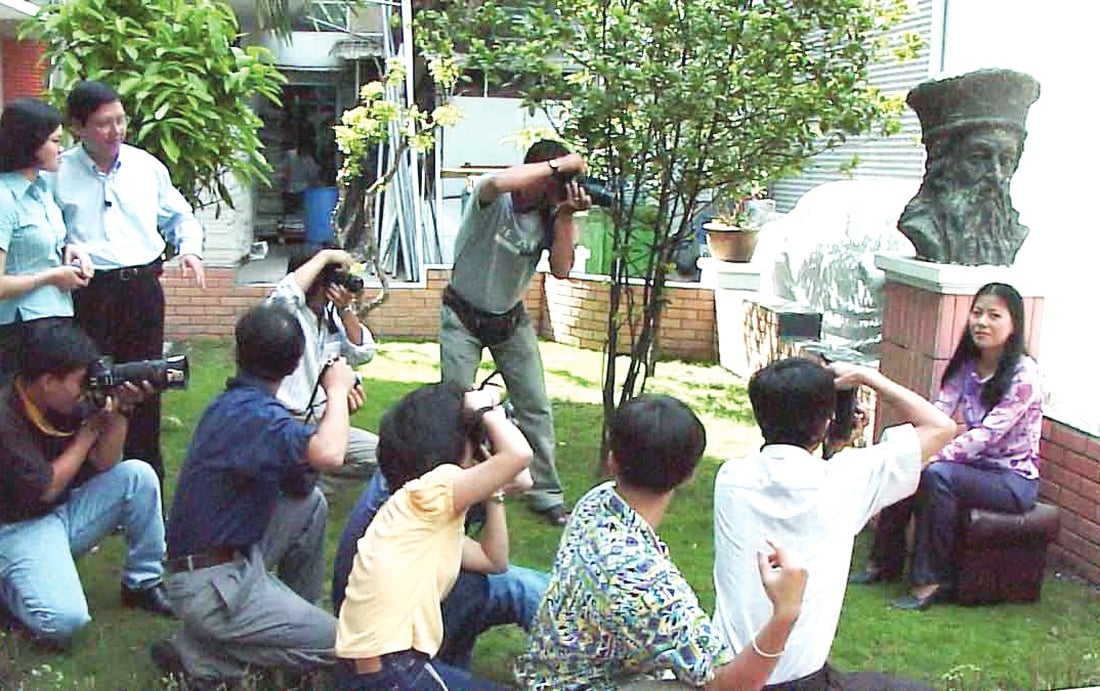
For a very long time, Tuoi Tre newspaper was published in the location of the statue of Alexandre de Rhodes - the man who left a legacy of the Vietnamese script for the Vietnamese people (161 Ly Chinh Thang Street, Xuan Hoa Ward, Ho Chi Minh City). Photo: Nguyen Cong Thanh
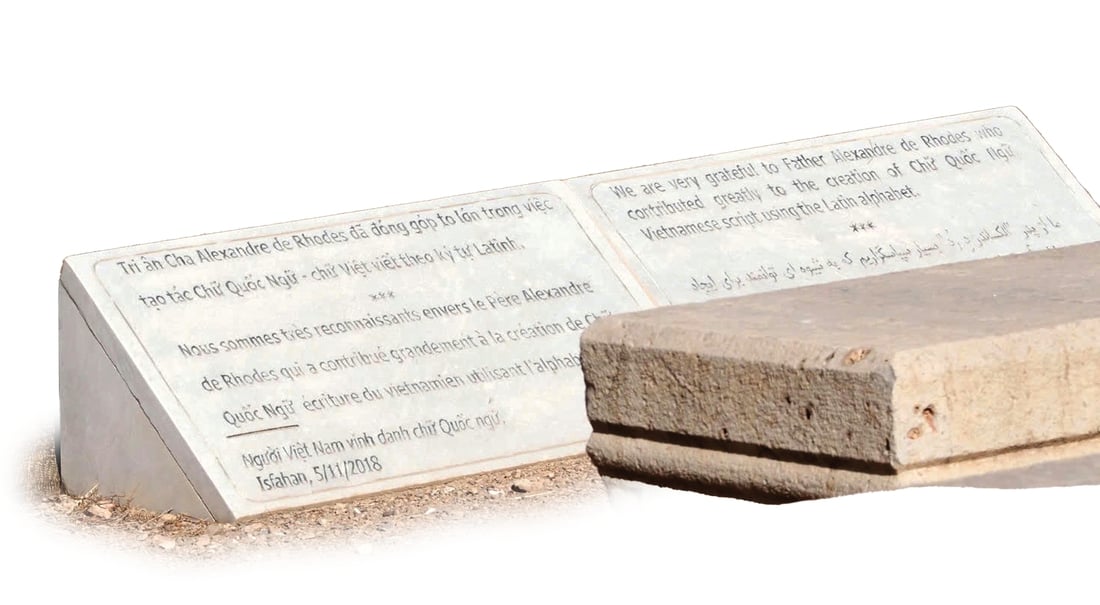
Along the tomb wall is another stone slab inscribed with text in four languages—Vietnamese, French, English, and Persian: "In gratitude to Father Alexandre de Rhodes for his immense contribution to the creation of the Vietnamese national script—the Vietnamese alphabet written in Latin characters."
This commemorative plaque was unveiled by a Vietnamese delegation led by Professor Nguyen Dang Hung, writer Hoang Minh Tuong, photographer Nguyen Dinh Toan, and historian Dr. Nguyen Thi Hau… on the 358th anniversary of Alexandre de Rhodes' death (November 5, 2018).
I placed flowers and two Vietnamese books on the grave, whispering words of gratitude to this ancestor who made such a great contribution to the Vietnamese language. Deep down, I also admired Alexandre de Rhodes for his miraculous journey, his masterful observation and data-recording skills, and his spirit of respect, profound understanding, and non-judgmental acceptance of local customs and cultures throughout his missionary life, from Europe to Asia, back to Europe, and then to Iran.
The fact that Alexandre de Rhodes spent his later years in a Muslim country further demonstrates the civilized spirit of non-discrimination between different religions throughout humanity.
The driver, Dariush, was very grateful to see me "adapting to local customs" by pouring water on the tombstone of Alexandre de Rhodes and using my hands to clean it as a way of showing respect to the deceased, according to the traditional Iranian custom of visiting graves. "Let me join you," Dariush said sympathetically, taking water to wash the tomb of the missionary who had a connection with both Vietnamese and Iranian people.
Mr. Tran Van Truong (a veteran tour guide at Hay Tour) said that in 2017, on the first day of the Persian New Year, Nowruz (March), he and some Vietnamese tourists "were fortunate enough to visit and lay flowers at the tomb of Alexandre de Rhodes, filled with overwhelming affection and joy."
In 2019, after visiting the tomb of Alexandre de Rhodes in Isfahan, actress Hong Anh expressed her wish that "this place would become a pilgrimage site included in the itineraries of Vietnamese travel companies and individuals visiting Persia."
For me, the moment of sitting quietly beside Alexandre de Rhodes' simple grave, turning the pages of a Vietnamese book amidst the tranquil cemetery, with the pine trees swaying in the breeze, will always be etched in my memory as I explore the world .
Throughout his life, Father Alexandre de Rhodes dedicated himself not only to religion but also entirely to language, scholarship, culture, field research, promoting humanistic dialogue, and contributing to bridging the gap between Eastern and Western civilizations, as well as the process of forming the modern intellectual identity of many localities, including Vietnam.
Surely, after nearly four centuries, Alexandre de Rhodes would be comforted to know that the Vietnamese script he created still exists and thrives among generations of Vietnamese people, and that Vietnamese people still travel far and wide to visit and remember him.
Alexandre de Rhodes was born on March 15, 1593, in Avignon (southern France) and died on November 5, 1660, in Isfahan (Iran). He was a linguist and a Jesuit missionary. He is often called "Father Dac Lo" by the Vietnamese, having made numerous missionary trips to Annam (Vietnam) in both the North and South during a period of 20 years (1624-1645).
He was the person who systematized, compiled, and oversaw the printing of the first Dictionarium Annamiticum Lusitanum et Latinum (Vietnamese - Portuguese - Latin Dictionary, abbreviated as Vietnamese - Portuguese - Latin Dictionary), printed in Rome (Italy) in 1651 with nearly 8,000 vocabulary words. This provided the Vietnamese people with, for the first time, a simple, effective writing system based on the Latin alphabet, which was easy to learn and use, demonstrating the creativity and flexibility of the Vietnamese people and promoting the development of culture, education, journalism, etc., during a turbulent transitional period in history.
As a cultural ambassador, Alexandre de Rhodes was also the author of *History of the Kingdom of Tonkin* (La histoire du royaume de Tunquin - 1652) in Europe; and his memoir *Divers voyages et missions*, which recounts his experiences and provides detailed information about the culture, beliefs, customs, traditions, laws, social context, and life of the Vietnamese people at that time to Western readers in the 17th century.

In the ancient Mang Lang church in Phu Yen (formerly, now part of Dak Lak province), there is a copy of Alexandre de Rhodes's book *Eight Days of Sermons* (Latin title: Catechismus), printed in Rome in 1651.

This is considered the first book written in the Vietnamese Quốc ngữ script, printed bilingually in Latin (left side of the page) and early Quốc ngữ script (right side of the page). "Phép giảng tám ngày" (Eight-Day Sermon) is a literary work recording the pronunciation of the Vietnamese language in the 17th century.
The first Vietnamese dictionary by Vietnamese people.
"...In the Christmas season of 1651, Rome was colder than usual. From the beginning of December, cold winds from the Alps had been blowing fiercely down upon Rome. Snow blanketed the treetops and rooftops."
Alexandre de Rhodes hadn't had time to prepare for Christmas. He spent all day at the printing press with the workers, and in the evenings he would review the proofs before falling asleep on the final printed pages. Alone, in pain, tormented, yet hopeful… it was more than a woman giving birth alone in the vast, freezing snow. Rhodes' blood flowed from all his orifices, blood trickled from his ten fingertips, his intestines burned, and his stomach rumbled and churned as he painstakingly created each page of text.
The first proof print of the Dictionarium Annamiticum Lusitanum, et Latinum - Vietnamese-Portuguese-Latin Dictionary has been completed.
Words cannot express the boundless joy of holding in my hands the newly born brainchild of Annam. Of the more than nine thousand entries in the dictionary, only 250 errors needed correction. An unexpected achievement.
Oh, how I wish I could ride the ocean waves to return to Annam and proclaim the Good News to all the people of Vietnam. A Lich Son Dac Lo's tears fell on every page of the book.
On each page, the rivers, mountains, seas, and countryside of the Southern and Northern regions of Vietnam appear, along with the faces of those so dear and familiar: Francisco de Pina, Francesco Buzomi, Gaspar d'Amaral, Antonio Barbosa, Prosecutor Tran Duc Hoa, Sai King Nguyen Phuc Nguyen, Loc Khe Marquis Dao Duy Tu, Minh Duc King's Consort, General Nguyen Phuc Khe, Empress Ngoc Van, Thai Bao Nguyen Danh The, Thanh Do King Trinh Trang, King Le Than Tong, Bento Thien, Raphael Rhodes Ut Ti, Andre Phu Yen…”
Hoang Minh Tuong (excerpt from the historical novel *Words and People 400 Years* - Vietnam Women's Publishing House - 2025)
Source: https://tuoitre.vn/doa-hoa-tri-an-alexandre-de-rhodes-20260202173931643.htm











































![[Video] Sunset at Lap An Lagoon – Where the sun sets over the fishing nets](https://vphoto.vietnam.vn/thumb/1200x675/vietnam/resource/IMAGE/2026/05/31/1780192137701_beach-landscape-sea-water-nature-grass-745871-pxhere-com.jpeg)



























Comment (0)