

 |
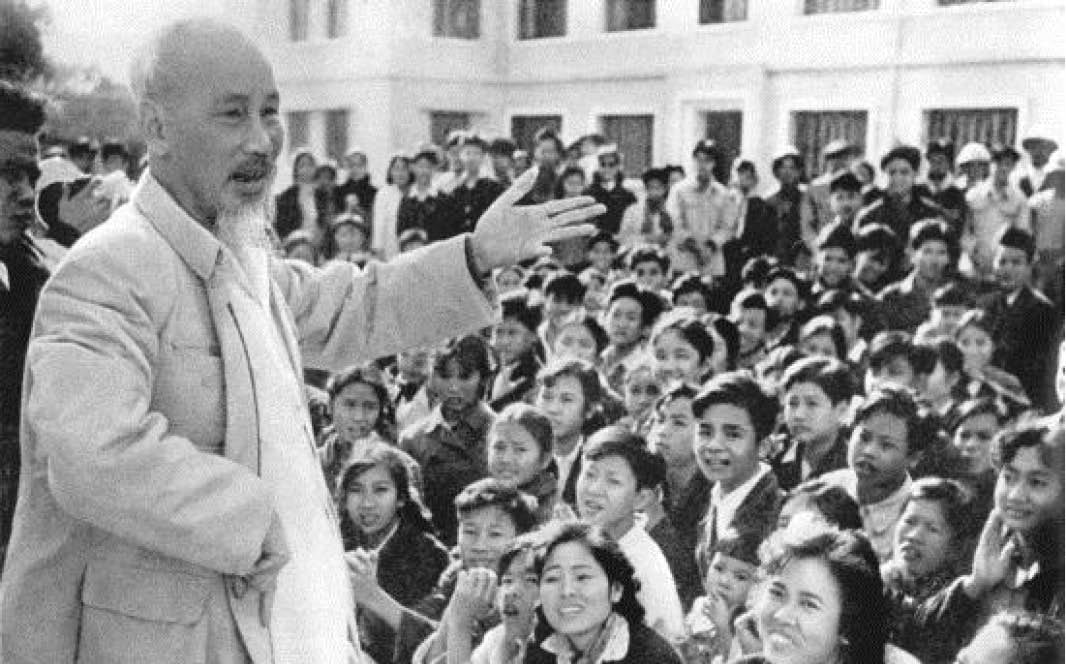
| President Ho Chi Minh always considered national unity as the guiding principle for all his actions. (Photo: Archival material) |
The idea of national unity is not something that has only been affirmed today. It is a value that has permeated the history of the Vietnamese revolution, from the founding of the nation to the defense and development of the country. However, what is special in the current context is that this spirit is not only being revived through tradition, but is being applied as a method of reorganizing society – a genuine governing capacity, not merely sentiment or slogan.
Changes in government structure, mergers of administrative units, implementation of a two-tiered local government model, reorganization of development space… not only require political vision but also leadership skills, the ability to operate synchronously, and above all, the ability to build deep consensus throughout society. Because any reform, no matter how well-directed, will be merely a superficial movement without unity and easily lead to a breakdown of trust.
General Secretary To Lam 's article not only highlighted the historical value of unity but also elevated this concept to a strategic requirement in the current period of institutional reconstruction. This is when streamlining the administrative apparatus is no longer an internal matter of state administration, but a test of the people's trust. When reorganizing administrative units, it's not simply a matter of "separation and merging," but a reorganization of social life, a change in political power at the grassroots level, and a redistribution of development resources. To achieve this, there must be ideological unity from the central to local levels, from leaders to the grassroots, from officials to the people. And unity in the new era, as the General Secretary analyzed, cannot be about passively enduring or about "pretending to agree while secretly disagreeing," but must be a conscious, shared commitment based on understanding, trust, and a common goal. Therefore, every official and Party member today needs not only to maintain unity as a virtue, but also to view it as a political skill and a requirement of public service.
From reorganizing the workforce and reassigning personnel to allocating budgets and selecting headquarters locations, all of these are challenges in social restructuring. Without coordination, listening, and sharing, not only will unity be lost, but disruption and instability are also unavoidable.
Another important message from the article is: Unity cannot be based solely on appeals to spirit, but must be ensured by fair, transparent, and effective implementation mechanisms. The General Secretary emphasized the role of clear policies for officials affected by the merger; demanded unbiased allocation of development resources between regions; and especially warned against parochialism and self-serving attitudes that could fracture national unity.
Here, solidarity is no longer merely consensus, but a political commitment in policy design. When local interests are harmonized, when contributions are recognized, and when the efforts of those working for the common good are rewarded promptly – that is the environment in which solidarity truly becomes a driving force for innovation.
The General Secretary also emphasized the need for cadres and Party members to set an example, especially during the "sensitive" period of restructuring. Unity does not spontaneously form from calls to action, but is formed from behavior, from the way disagreements are resolved, from an attitude of willingness to listen, dialogue, and persuade. Maintaining unity in the current context is not about "maintaining internal harmony," but about daring to confront differences, finding common ground, and acting responsibly. Those who can "sacrifice personal interests for the greater good" are the core of the new unity - unity through action, not just through commitments.
"Unity is invincible strength," as General Secretary To Lam affirmed. And that strength lies not in the number of people who agree, but in the quality of action of those who dare to be pioneers, dare to innovate, and dare to link power with responsibility.
Unity is a requirement of the times, a political strength, and a prerequisite for Vietnam to enter a new era, strong, sustainable, and with no one left behind.
Source: https://huengaynay.vn/chinh-polit-xa-hoi/xay-dung-dang/doan-ket-de-but-pha-155464.html


![[Image] A night of light, many layers of message](https://vphoto.vietnam.vn/thumb/1200x675/vietnam/resource/IMAGE/2026/03/10/1773158812907_hoa-nhac9-jpg.webp)















































Comment (0)