

When the strong east winds blow, turning the grass and trees everywhere yellow, and the rice plants begin to bear grain, it is also the time when the Giơ Lâng people prepare for the Ét Đông festival.
Worshiping the mole god
The Giơ Lâng ethnic group is a branch of the Ba Na ethnic group, concentrated in the communes of Tân Lập, Đăk Pne, Đăk T'Re and the town of Đăk R've (Kon Rẫy District, Kon Tum Province ).
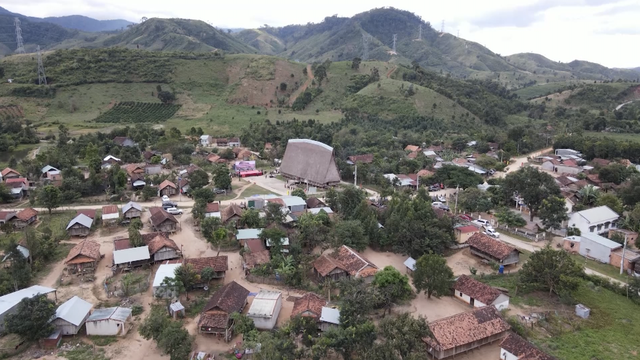
Kon Brăp Du village is a place where the traditional Ét Đông festival is regularly held. PHOTO: DUC NHAT
With their polytheistic beliefs and animistic lifestyle, the Giơ Lâng people have many festivals related to the life cycle of humans, plants, and animals, including the Ét Đông festival. This is a major festival for the Giơ Lâng people; for them, Ét Đông is considered the traditional New Year of the entire community.
According to the Giơ Lâng people, Ét Đông means the festival of the bamboo rat. This festival originated, existed, and developed in conjunction with the slash-and-burn farming activities and the traditional cultural beliefs of the village community.
Elder A Jring Đeng, village elder of Kon Brăp Du (Tân Lập commune), said that the Ét Đông festival is held annually at the end of September and beginning of October, when the rice plants begin to flower and bear grain. This is a particularly important ritual, expressing the community's reverence for the natural deities, especially Yàng Sơri, Yàng Đăk, Yàng Kong, Yàng Kră, and Yàng Kơđrang. The festival has been cherished and preserved by the people, promoting its value through many generations. Notably, only after the Ét Đông festival are the Ba Na people allowed to undertake major family events, such as building new houses, renovating old ones, weddings, buying buffaloes and cows, etc.
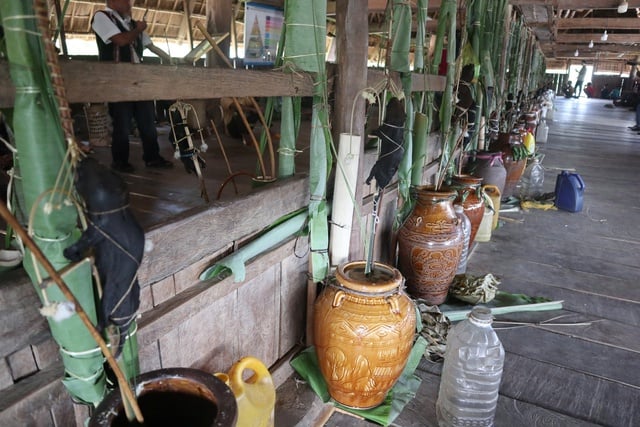
Villagers bring jars of wine to the communal house to perform rituals and offer sacrifices to the deities during the festival.
PHOTO: DUC NHAT
Elder A Jring Đeng recounted that since ancient times, the Giơ Lâng people worshipped the snake god, hence the snake festival. After observing the situation, the villagers realized that snakes sometimes have plenty to eat but other times are very hungry, lacking a consistent and stable food source. Meanwhile, the bamboo rat's food consists of roots, so it never lacks food year-round. Bamboo rats also don't destroy crops like field mice. Therefore, the villagers switched to worshipping the bamboo rat god. From then on, the bamboo rat became a sacred animal, a symbol of diligence and hard work, and a symbol of year-round prosperity for the Giơ Lâng community.
Et Dong marks the end of the old year and the beginning of a new year with new hopes and joys. Through this annual festival, the Giơ Lâng people want to educate their children to preserve traditions, remember their ancestors, be united and loving, and work diligently to have a prosperous and happy life.
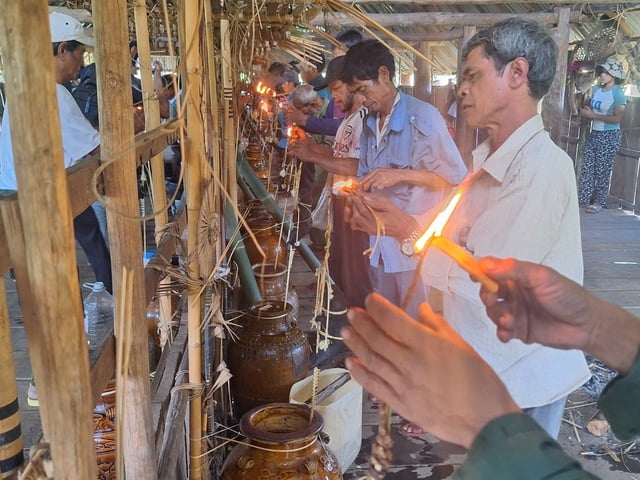
People light candles and pray for the gods to attend the festival. PHOTO: DUC NHAT
Community engagement
The Ét Đông festival takes place over three days with many traditional rituals. The ceremonies are performed in the sacred corners of each household, in the fields, and at the communal house. All follow the arrangements and guidance of the village elders. A few days before the festival, the village elders assign the young men the task of going into the forest to cut bamboo and reeds to make the ceremonial gate and the ceremonial pole.
On the first day, using bamboo and reeds that the young men had cut, the villagers erected a ceremonial gate on the road to the fields and set up a ceremonial pole at the gable of the communal house. Afterward, each family prepared offerings and performed rituals in the rice fields. They would invite Yang (the spirits) and their ancestors to celebrate the festival with their descendants. Each family would prepare offerings including: jars of wine, spools of thread, fresh banana leaves, bamboo tubes, peng (a type of forest leaf)... and carry them up to the communal house to perform the Ét Đông ceremony on a community scale.
On the second day, families perform the ritual of offering leftover rice seeds at home. PHOTO: DUC NHAT
After a long drum roll echoed from the communal house, the village elder was the first to place the precious wine jar in the center of the house, then decorate it and tie it to a pillar. Following the elder, the families successively brought their offerings to the communal house. They used fresh banana leaves to line the floor, then used peng leaves to wrap the rice. They wrapped as many grains of rice as there were people in the family.
When the families were ready, under the communal house, the village elder beat a long drum to begin the Yàng (spirit) summoning ceremony. The elder held a roll of thread tied to his own wine jar and passed it to each family, who then tied it to their own wine jar and pole. The thread was considered a common message from the villagers to the gods and ancestors, as well as a bond of unity among the families in the community.
On the second day, families perform a ritual offering of leftover rice seeds at home. The head cook (the oldest woman in the family) sits beside the leftover rice seeds from the previous harvest, praying to the spirits for a bountiful harvest in the coming season. Afterwards, the homeowner places intact rice grains cooked from the old seeds on top of their head. According to the Giơ Lâng people's beliefs, this is an expression of gratitude to the spirits and ancestors for granting them abundance and good health.
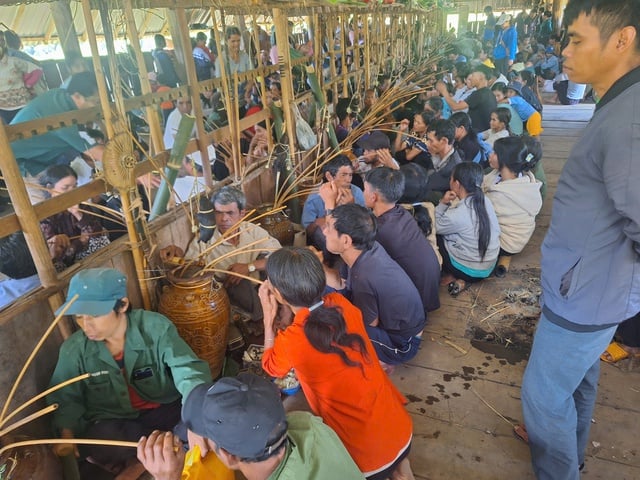
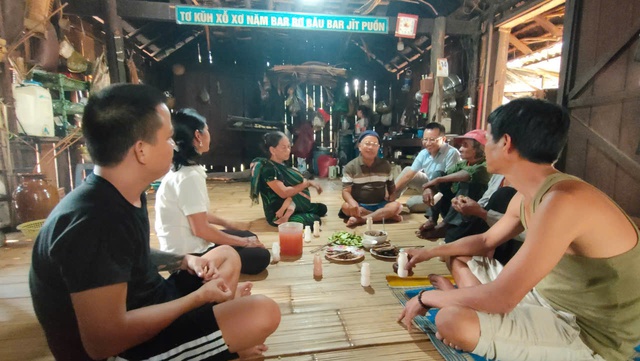
The festival is an opportunity for villagers to chat, share stories, and make wishes for the new year. PHOTO: DUC NHAT
The third day is the day to send the ancestors back to heaven. On this day, the villagers perform the ritual of offering sacrifices on the sacred altar in the communal house. After the sacrificial animal is taken down, its meat is butchered and shared among everyone. The community eats and drinks together, discussing preparations and repairs to their homes after the harvest or talking about arranging marriages for their children...
"Also on the third day, everyone goes to the communal house to check the quantity of rice grains placed under the wine jar to predict the future. If the package of rice grains is intact, it means that the family will have a bountiful harvest in the new farming season. Conversely, if the rice grains are chipped, or there is too much or too little, the family will encounter many misfortunes," said elder A Jring Đeng.
According to elder A Jring Đeng, the Ét Đông festival used to be celebrated by the Giơ Lâng people for 7 days. However, organizing the festival for an extended period was both time-consuming and wasteful, so the villagers shortened it to 3 days.
Mr. Pham Viet Thach, Head of the Culture and Information Department of Kon Ray District, said that in Kon Ray District, there are 6 villages of the Gio Lang ethnic minority that regularly maintain the Et Dong festival. In 2021, this festival was recognized by the Ministry of Culture, Sports and Tourism as a national intangible cultural heritage. (to be continued)


![[Photo] Prime Minister Pham Minh Chinh attends the Conference on the Implementation of Tasks for 2026 of the Industry and Trade Sector](/_next/image?url=https%3A%2F%2Fvphoto.vietnam.vn%2Fthumb%2F1200x675%2Fvietnam%2Fresource%2FIMAGE%2F2025%2F12%2F19%2F1766159500458_ndo_br_shared31-jpg.webp&w=3840&q=75)






























































Comment (0)