

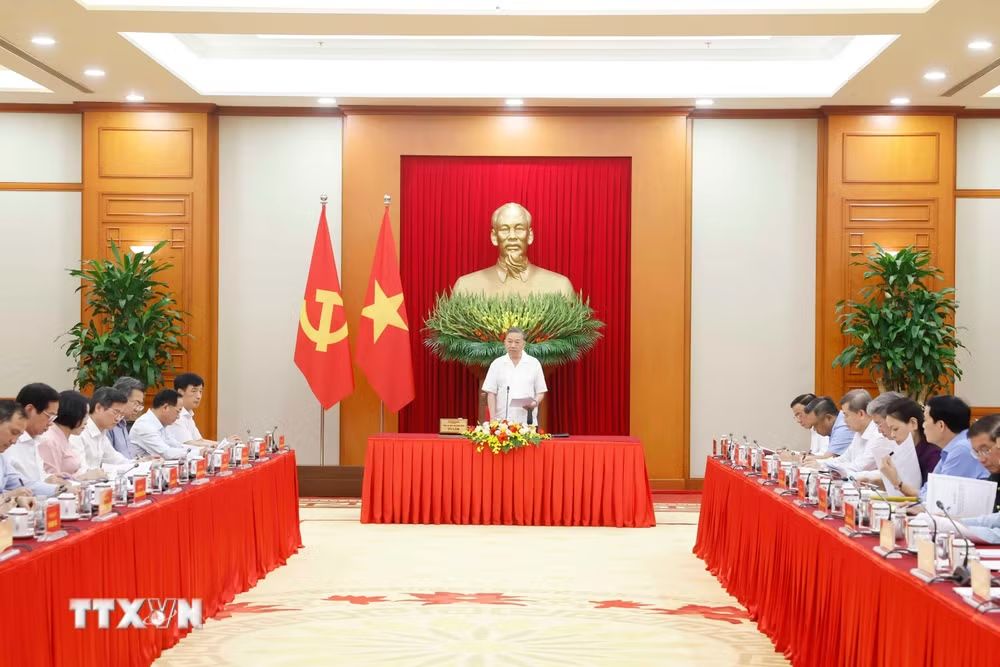
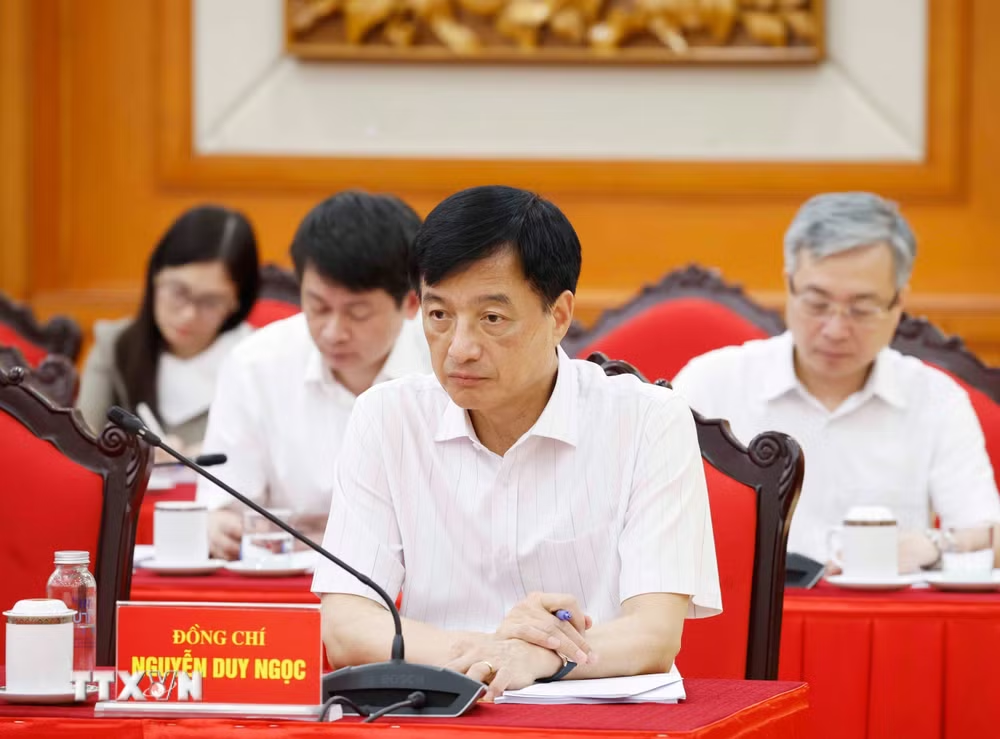
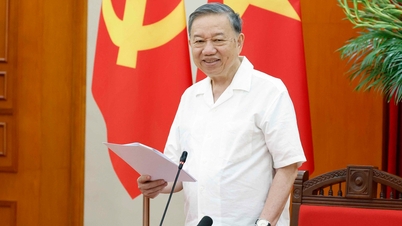
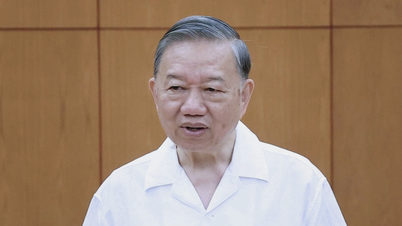
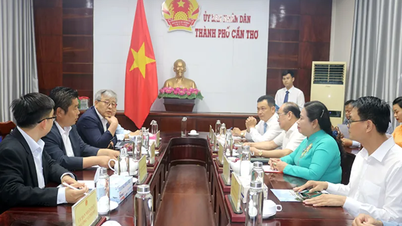
On the afternoon of June 3rd, in Hanoi , General Secretary and President To Lam chaired a working session with the Central Organizing Committee on the key tasks of Party building and organization in accordance with the spirit of the Resolution of the 14th National Congress of the Party.
Also attending the working session was Comrade Tran Cam Tu, Member of the Political Bureau and Standing Secretary of the Central Committee.
At the meeting, the leaders of the Central Organization Department presented a summary report on the key priorities of Party building work in accordance with the spirit of the Party's 14th National Congress Resolution.
After listening to the discussions and concluding the working session, General Secretary and President To Lam emphasized several key issues, namely the need for a unified understanding that, in the new development stage, Party building, organizational work, and personnel work are not only internal tasks of the Party, but also fundamental capabilities of national governance; they are decisive conditions for transforming guidelines into reality, resolutions into action, resources into development, and the people's trust into strength.
The Resolution of the 14th National Congress sets very high demands for innovation in thinking, including the requirement to innovate the Party's leadership methods in order to make the country strategically self-reliant and develop rapidly and sustainably.
These demands require the Party to constantly renew itself, rectify its shortcomings, and improve itself; to enhance its capacity for leadership in development, governance, forecasting, organization, implementation, and power control.
Party building in the new era is not only about building a clean and strong Party, but also about building a Party with sufficient courage, wisdom, prestige, capacity, and appropriate leadership methods to lead the country in the new era.
Party building must be closely linked to building the political system, building a socialist rule of law state, promoting socialist democracy, controlling power, and improving the quality of service to the people.
The General Secretary and President emphasized the need for a strong reform of the Party's leadership methods. Reforming leadership methods will strengthen the Party's and each Party member's connection with the political system and the people. The leadership role must not be neglected, nor should the Party overstep its boundaries or take over the responsibilities of the State, the Fatherland Front, and other organizations within the political system.
Innovating leadership methods means making the Party's leadership more accurate, more relevant, more thorough, and more effective; ensuring that the Party leads through guidelines, policies, strategic directions, personnel organization, inspection and supervision, setting an example, persuasion, and practical results.
Advisory work must shift strongly from reacting to and handling emerging issues to proactively forecasting and anticipating trends, preparing early and in advance for major issues related to organizational structure and personnel. Resolutions must be put into practice through concrete action programs; these action programs must clearly define who is responsible, what needs to be done, who is accountable, what resources are available, what deadlines are set, and what the expected outcomes are.
The capacity for implementation is a major bottleneck at many levels, in many sectors, and in many localities, and needs to be addressed; we must overcome the situation of talking a lot but doing little, holding many meetings but making little progress, and issuing many documents but with unclear final results.
Every major task must be quantified by concrete results; we must avoid a situation where tasks are vague, responsibilities are vague, and ultimately no one is held accountable.
Regarding the effective operation of the new organizational structure, the General Secretary and President emphasized that the Central Organization Department needs to continue to carefully review the functions, tasks, powers, organizational structure, and working relationships of agencies and units within the political system after the restructuring. The principle is that one agency can perform many tasks, but one task should only be assigned to one agency that is primarily responsible for it.
Decentralization and delegation of power must be implemented genuinely and synchronously. Decentralization must go hand in hand with delegation of power; delegation of power must go hand in hand with resources, tools, data, human resources, budget, and control mechanisms; and the grassroots level must be built up to be strong, capable, qualified, authoritative, and staffed enough to carry out its tasks. The restructured apparatus must be evaluated using practical measures.
Regarding fundamental reforms in personnel work, the General Secretary and President requested that in the new phase, cadres not only need firm political resolve, impeccable moral character, and exemplary lifestyles, but also strategic thinking, modern management capabilities, digital transformation capabilities, organizational and implementation capabilities, problem-solving abilities, the ability to engage in dialogue with the people, and a spirit of daring to think, daring to act, and daring to take responsibility for the common good.
Personnel management must be reformed from "following the correct procedures" to "the right person, in the right job, with the right skills, the right strengths, and the right product." Procedures are very important, but they cannot replace the quality of personnel.
A resume is essential, but it cannot replace the product of one's work. Qualifications, seniority, and positions cannot replace the ability to perform, reputation, and results of serving the people.
Cadre evaluation must be a breakthrough. Accurate evaluation leads to correct placement, utilization, training, protection, and screening. Incorrect evaluation prevents good people from being promoted, weak individuals from being replaced, and opportunists can infiltrate and rise to high positions, ruining work, damaging the organization, and eroding public trust. We need to shift strongly towards evaluating cadres based on their qualities, abilities, reputation, concrete products, results of task performance, work data, and the trust of the people.
Implement the principle of "in and out," "promotion and demotion" effectively; identify, train, cultivate, assign, and utilize young cadres, female cadres, ethnic minority cadres, scientific and technical cadres, cadres with outstanding abilities, and cadres who have grown from practical experience at the grassroots level.
The team of strategic-level and grassroots officials needs special attention; stronger mechanisms are needed to identify, attract, and utilize talent.
Internal political security in the new situation must be carried out proactively, rigorously, cautiously, and objectively, linked to the management of cadres and Party members, protecting Party and State secrets, preventing "self-evolution," "self-transformation," and complacency in cyberspace, but without prejudice, and without affecting good, capable, and innovative cadres for the common good.
The General Secretary and President emphasized the need for substantive reform in Party branch activities; the need to overcome formalistic, deferential, and confrontational activities lacking fighting spirit; and the need to focus on quality in Party member development, not quantity.
Focus on developing Party members in non-state enterprises, private businesses, remote areas, ethnic minority and religious communities, students, workers, intellectuals, and new forces in the digital economy. Strictly manage Party members, review and screen them, and promptly remove those who no longer meet the qualifications from the Party.
The General Secretary and President emphasized that power control must be implemented throughout the entire process: institution building, organizational structure, decentralization, delegation of power, planning, appointment, evaluation, utilization, rewarding, and disciplining of officials; and that there must be a resolute fight against corruption in appointments and promotions, vested interests, localism, favoritism, insularity, and short-term thinking.
All Party regulations must be implemented seriously and consistently, coupled with inspection, supervision, and strict handling of violations. Inspection and supervision work must shift strongly from passive to proactive; from handling violations after they occur to prevention and early warning.
The fight against corruption, waste, and negative practices must continue resolutely, persistently, and without interruption, without any forbidden areas or exceptions. But along with fighting corruption and negative practices, we must also combat stagnation, avoidance, shirking responsibility, and indifference to the legitimate demands of the people.
The purpose of controlling power is not to slow down innovation, but to ensure that power is used appropriately, within the proper authority and responsibility, for the benefit of the nation and the legitimate interests of the people.
The General Secretary and President proposed accelerating digital transformation in Party building work, shifting from digitizing records to creating live data to serve strategic planning, leadership, inspection, supervision, and evaluation of cadres; it is necessary to build a unified, synchronized, updated, interconnected, secure, and confidential database of cadres, Party members, and organizational structures.
Accurate, transparent, and interconnected data leads to more objective personnel management; more proactive inspection and supervision; stricter management of Party members; and clearer identification of responsibilities, tasks, timelines, and results in implementation.
Digital transformation within the Party must be linked to digital government, digital economy, digital society, and digital citizens; it must directly serve to enhance the Party's leadership capacity, the State's management efficiency, and the quality of service to the people.
Regarding implementation and recommendations, the General Secretary and President requested the Central Organizing Committee to fully incorporate the feedback, finalize the report, and submit it to the Politburo in a more concise, insightful, focused, and actionable manner.
Source: https://www.vietnamplus.vn/doi-moi-phuong-thuc-lanh-dao-cua-dang-de-lam-cho-dat-nuoc-phat-trien-ben-vung-post1114347.vnp

![[Photo] Secretary of the National Assembly Party Committee, Chairman of the National Assembly presides over the meeting of the Standing Committee and Executive Committee of the National Assembly Party Committee.](https://vphoto.vietnam.vn/thumb/1200x675/vietnam/resource/IMAGE/2026/06/03/1780480353201_ndo_br_bnd-2585-jpg.webp)

![[Photo] First session of the 14th Congress of the Vietnam Trade Union](https://vphoto.vietnam.vn/thumb/1200x675/vietnam/resource/IMAGE/2026/06/03/1780465947883_ndo_br_img-3852-jpg.webp)
![[Photo] General Secretary and President To Lam presides over a meeting with the Central Organizing Committee.](https://vphoto.vietnam.vn/thumb/1200x675/vietnam/resource/IMAGE/2026/06/03/1780482764658_a1-bnd-4741-3342-jpg.webp)




































![[Video] Sunset at Lap An Lagoon – Where the sun sets over the fishing nets](https://vphoto.vietnam.vn/thumb/1200x675/vietnam/resource/IMAGE/2026/05/31/1780192137701_beach-landscape-sea-water-nature-grass-745871-pxhere-com.jpeg)



























Comment (0)