

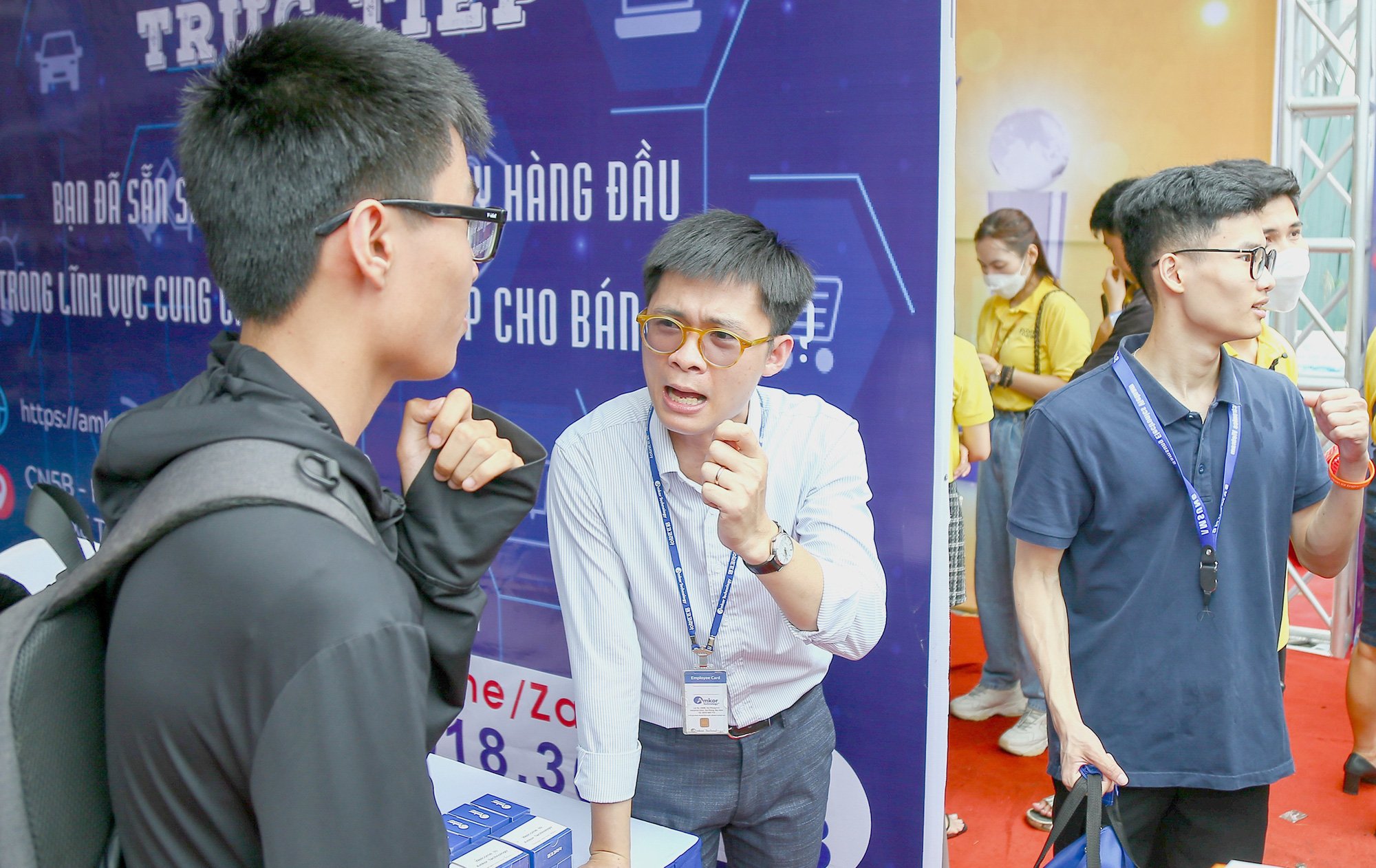
Companies interview graduating students with many questions requiring the use of foreign languages - Photo: HA QUAN
Mr. Do Quan, Human Resources Director of Luxshare-ICT Vietnam Co., Ltd. (Van Trung Industrial Park, Bac Giang ), said that the company has implemented various training programs for its personnel, especially senior Vietnamese managers, as part of its talent localization policy.
"This is a long-term development strategy in Vietnam, helping to increase the proportion of high-quality labor annually, and it is now over 80%," Mr. Quan said.
Localization of Vietnamese human resources
In Q1 2024, the company plans to recruit 1,000-2,000 new employees. This includes 300 positions for project development officers and engineers, with requirements for experience and foreign language skills (English or Chinese).
The company uses multiple channels for recruitment, from posting job advertisements and rewarding employees for referring new hires to live streaming on TikTok, and especially collaborating with schools to build a pool of potential employees.
Assessing the competitive landscape, the unit collaborates with many schools in the North, placing orders, providing tuition support, and awarding scholarships to outstanding students.
"We also send Vietnamese officials to China for 1-3 months of training to prepare them for key positions. Recently, the percentage of Vietnamese people holding high-level positions has increased rapidly," Mr. Quan said.
This unit has "orientation classes" located in schools, training key Vietnamese personnel with specialized skills, technical expertise, and foreign language proficiency, usually lasting about a year. From these classes, the company has produced 300-500 high-quality personnel over the years. This group of employees enjoys attractive benefits and policies, along with a clear career progression and development path.
According to Mr. Quan, the company works closely with schools to adjust training content to meet the company's requirements. For example, students learn about machinery and automated equipment, allowing them to get early exposure to modern equipment. The company also provides teaching equipment to schools or sends students to the company for internships. Some outstanding students are even sent abroad for practical training and experience.
Spending billions of dong to send Vietnamese workers abroad.
Having received training in China, Ms. Cam Thi Nam, head of administration and human resources at Desay Battery Vina Co., Ltd., said that the cost of sending employees for overseas training can reach hundreds of millions of VND, but she is confident that she can perform her job just as well as foreign employees.
"As a partner of many corporations such as Apple, Oppo, Huawei, and Google, we need key personnel with high skills in related fields, and one of the requirements for engineers is proficiency in Chinese," Ms. Nam said.
Mr. Ou Yang Yi Feng, Deputy General Director of Desay Battery Vina Co., Ltd., said that the company has recently sent several groups of workers to China for training. This helps workers improve their skills and become familiar with new products, technologies, and machinery. Furthermore, the company's partners also hope that when investing in Vietnam, they will use Vietnamese people as the core workforce.
He said that when the factory starts operating, experienced leadership is needed, but later it can be managed remotely, and tasks that can be done on-site will be prioritized for Vietnamese people.
"Vietnamese personnel, especially young people, lack in-depth professional skills and have knowledge in a piecemeal fashion. Not to mention their unprofessional work style, shyness, and reluctance to respond to superiors promptly and efficiently, resulting in low work performance – these are issues that need to be addressed," he pointed out.
Mr. Marvin Yan, General Director of Sunwoda Vietnam Co., Ltd., said that due to the desire to expand smartphone battery production, the company needs 300-500 employees in 2024, with technical workers accounting for about one-third. The starting salary for skilled workers is relatively good, with allowances, and additional pay for those with foreign language skills.
The company collaborates with universities and specialized training institutions to recruit recent graduates. Outstanding employees are sent abroad for further training, skill development, and professional development. Upon returning from their studies, these employees are considered for promotion to key positions, including departmental management.
It is entirely possible to replace foreign personnel.
According to the Department of Employment ( Ministry of Labour, Invalids and Social Affairs ), working alongside foreign workers provides domestic workers with more opportunities to access and learn expertise, technology, methods, and work discipline. This allows them to improve their professional skills and gradually replace foreign workers in Vietnam.
In the context of global economic integration, the recruitment of highly skilled foreign workers into businesses and organizations in Vietnam is a growing trend. Therefore, to increase their job opportunities, Vietnamese workers in FDI enterprises need to further develop their professional knowledge, teamwork skills, and foreign language proficiency.
Workers need to change their mindset.
Ms. Dang Ngoc Thu Thao - Director of Outsourcing and Labor Leasing Services, Small and Medium-sized Enterprise Sector (ManpowerGroup Vietnam) - said that many companies, when building factories in Vietnam, bring in teams from abroad for both management and operations. These businesses often have specific regulations regarding the percentage of employees who can use foreign languages, typical of companies in the semiconductor industry.
"There is still a segment of the workforce that prefers working nearby, even reluctant to go to other provinces for work, and prefers simple jobs with few constraints or high disciplinary requirements. Vietnamese workers, especially young workers, need to raise their awareness of the job market and change their mindset about work and work habits," Ms. Thao analyzed.
Source
























































































Comment (0)