

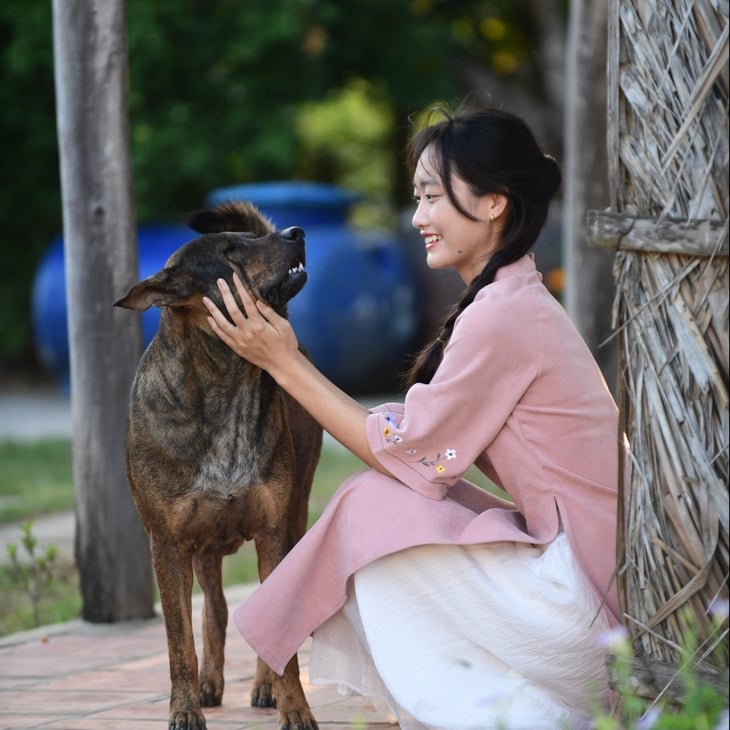
Illustration photo: QUANG DINH
The wife's voice echoed from the kitchen, boasting that they had bánh lọc (a type of Vietnamese dumpling) today, a dish everyone in the family loved. Then the children left to start their careers in Saigon, and the house became a place they returned to after each Tet holiday. The eldest son busied himself helping his father carry the potted apricot blossom tree into the house, while the daughters sat in the yard wiping banana leaves.
The pots of marigolds that my father had planted earlier were carried along the path leading to the house… Laughter and playful banter filled the sun-drenched courtyard. They were once again the innocent, carefree children of their younger days.
When the real estate boom swept through the neighborhood, arguments and conflicts began, turning people against each other. Siblings became enemies over land. Mr. Hai was relieved that his family hadn't fallen into that situation yet. But lately, his children have started complaining:
- The altar room, which takes up a third of the house, looks so old-fashioned!
The youngest child was no less impressive.
- Our yard is so big, Mom, it's such a waste!
The children no longer praise their mother for her skillful vegetable gardening or for eating clean, safe vegetables. The daughter-in-law is gentle and refined.
- Mom, you're getting old, you should rest. There are plenty of organic vegetables for sale.
They thought no one would bother giving up thirty or forty square meters of land just to plant a few clumps of chives and mint for their children and grandchildren to treat coughs. Lemongrass and mustard greens were cheap and readily available; there was a market just a few steps away.
No matter how many reasons his wife offered, the children had just as many arguments to dismiss what they considered unnecessary. Their goal was to divide the house in two. They wanted to sell the land to avoid wasting it, and for their parents, it meant giving a portion of their ancestral property to strangers.
Family gatherings during the three days of Tet (Lunar New Year) suddenly had more common topics to talk about. They no longer asked their mother the secret to keeping spring rolls crispy even when cold, or how to cook stuffed bitter melon until tender yet still green. The eldest son forgot to compliment his mother on how skillfully she had plucked the leaves from the apricot blossom tree for the past three years, saying the flowers bloomed precisely on the morning of the first day of Tet.
The others forgot to ask their parents if they've been having backaches or general aches lately. They all share the same concern: selling the land. For these children, land is a priceless asset, but their parents are so outdated, turning an asset into a liability. A house is just a place to rest your head. Money must generate more money…
The story they told, even the grandparents understood, because it's been happening every day since the land ceased to be just land and turned into gold and diamonds. Knowing this, my nose still feels salty and stinging. It feels like the earth has absorbed enough of life's storms and is becoming soft and crumbling, even the deep bonds of affection are crumbling.
When Mr. Hai sold all his land to help his children establish themselves in Saigon, he had the thought that he was creating favorable conditions so that his children wouldn't have to struggle and compete with each other in life. The ultimate goal of parents is their children, so no matter how hard they try, it's always directed towards their children. Just like how his parents came here to start their lives in the past.
From desolate, uninhabited forests teeming with wildlife to vast vegetable and flower gardens, countless hours of hard work have been shed. The house he lives in now was also pieced together by his parents from small planks of wood, 20m, 30m, 50m, 100m... and so on, expanding a little every few years when they had a good vegetable harvest.
He could remember every month and every year his house was renovated. The last time was before he got married, when his parents borrowed money and pulled strings to build a really big house for their son to be proud of. His parents even inscribed the number 1980 to mark the anniversary. But what was special was that no matter how dilapidated the house was, his parents always reserved the most important room to worship their ancestors.
When he was a child, every time he went to light incense and offer prayers at the ancestral altar, looking at the restored painting, he always felt that his grandparents were still watching over, supporting, and protecting him. Every time he encountered a problem and then luckily overcame it, his mother would say, "Thank you, grandparents, for protecting my foolish son."
Later, after his parents passed away, his wife maintained her mother-in-law's habit of lighting incense and calling out his parents' names to express gratitude whenever something happened. No matter how big or small the task, she would light incense and pray for things to go smoothly and for success in her endeavors. Even when she had severe stomachaches in the middle of the night, she would offer a cup of water and ask for their blessings.
No one knows or can verify these miraculous events, but his wife firmly believes that their ancestors are always in the house to support their descendants. No matter what they do during Tet, on the thirtieth day of the lunar month, they light incense and burn sandalwood to invite their ancestors home. During the three days of Tet, wherever his mother goes, she always remembers to return on time to cook three meals as offerings to their ancestors, keeping the ancestral altar always filled with the smoke of incense.
For the couple, their home was not just a shelter from the rain and wind; it was a sacred gateway connecting the realms of life and death. Their ancestors remained there, never leaving, for generations to come, to support their descendants. Although his wife recited the Amitabha Sutra about the Western Pure Land for their ancestors every night, when she stopped reciting the sutra, she always kept in mind that no matter where they went, this was still their home to return to.
If the house is sold, where will the grandparents go? If the house is cut in half, will they return to find only strangers? Will they be angry and leave? The incense will fade, the smoke will grow cold. Therefore, the garden land can be sold, but the house cannot. From then on, the children could no longer accept their grandparents' outdated views.
With their reasoning, science, and market economy , they felt powerless in the face of the two old-fashioned people's thinking. The older one, frustrated that his repeated attempts to reason with them had failed, finally exploded.
My parents are both selfish and old-fashioned.
The mother slapped her son. From then on, the grandson and daughter-in-law called less often. The youngest son didn't say anything, but secretly supported his older brother. Every Tet holiday, fearing his wife would be upset, he would secretly go outside to call his children.
- I'm busy with an unfinished project, Dad!
One of them apologized:
Dad, we've already booked tickets for the whole family to go to Japan to see the cherry blossoms.
Since when did the spacious house become so empty, with only the elderly couple and their deceased ancestors remaining? It was no longer a place for the children to return to. Besides the offerings for the ancestors, the grandmother still cooked braised jackfruit with soy sauce, a dish the eldest son loved.
The youngest child always likes to eat young artichokes stewed with bones, so the grandmother has to ask around everywhere for them. A basket of tapioca dumplings is always ready for the grandchildren to come and pick up and eat as a snack. But none of them ever come home, leaving the two of them with a cold meal.
The incense smoke billowed on the altar, making her eyes sting and redden. Earlier, while lighting incense for her parents-in-law, she had confided her feelings, hoping they would give her some advice or perhaps change the ways of her children. She wondered if they had heard her, as the incense sticks still held a silent prayer. Her husband looked at her, his heart aching.
- Mom and Dad probably won't blame us. Let's sell some of the land, Grandma.
She remained silent for a long time, then her lips contorted and her voice trailed off.
- Just wait until I die. I'll fulfill my filial duty to my parents, then you can do whatever you want.
Tears welled up from nowhere, overflowing the wrinkles of time. That New Year's Eve dinner was so bitter it choked my heart. The sobbing of my grandparents mingled with the incense still rising from the ancestral altar. He didn't know what would happen after they were gone. Where would his parents, grandparents, and ancestors go during the New Year holidays?
His children have doctors and pharmacies for everything, whether minor or serious, so there's no need for ancestral worship. They are independent and self-confident, so they have their own reasons for everything they do and where they go; they don't need to light incense for their ancestors. Home is just a place for them to return to for a night's sleep before leaving again in the late afternoon; it's not a bridge connecting the present and the past.
We invite readers to participate in the writing contest.
A warm spring day
As a special treat for the Lunar New Year, Tuoi Tre newspaper, in partnership with INSEE Cement Company, continues to invite readers to participate in the "Springtime Home" writing contest to share and introduce your home – your warm and cozy haven, its features, and unforgettable memories.
The house where your grandparents, parents, and you were born and raised; the house you built yourself; the house where you celebrated your first Tet (Lunar New Year) with your small family... all can be submitted to the competition to introduce to readers nationwide.
The article "A Warm Spring Home" must not have previously entered any writing competition or been published in any media or social networks. The author is responsible for copyright, the organizing committee has the right to edit, and the author will receive royalties if the article is selected for publication in Tuoi Tre publications.
The competition will take place from December 1, 2025 to January 15, 2026, and all Vietnamese people, regardless of age or profession, are welcome to participate.
The article "A Warm Home on a Spring Day" in Vietnamese should be a maximum of 1,000 words. Including photos and videos is encouraged (photos and videos taken from social media without copyright will not be accepted). Entries will only be accepted via email; postal mail will not be accepted to avoid loss.
Entries should be sent to the email address maiamngayxuan@tuoitre.com.vn.
Authors must provide their address, phone number, email address, bank account number, and citizen identification number so that the organizers can contact them and send royalties or prizes.
Staff and employees of Tuoi Tre newspaper and their family members may participate in the "Warm Home in Spring" writing contest, but they will not be considered for prizes. The organizing committee's decision is final.
The Springtime Shelter Award Ceremony and the Launch of the Youth Spring Special Edition
The judging panel, comprising renowned journalists and cultural figures along with representatives from Tuoi Tre newspaper, will review and award prizes based on the preliminary entries.
The awards ceremony and launch of the Tuoi Tre Spring special issue are scheduled to be held at Nguyen Van Binh Book Street, Ho Chi Minh City, at the end of January 2026.
Prize:
1st prize: 10 million VND + certificate, Tuoi Tre Spring issue;
1 second prize: 7 million VND + certificate, Tuoi Tre Spring issue;
1 third prize: 5 million VND + certificate, Tuoi Tre Spring issue;
5 consolation prizes: 2 million VND each + certificate, Tuoi Tre Spring issue.
10 Readers' Choice Awards: 1 million VND each + certificate, Tuoi Tre Spring Edition.
The voting points are calculated based on interaction with the post, where 1 star = 15 points, 1 heart = 3 points, and 1 like = 2 points.
Source: https://tuoitre.vn/nha-tu-duong-20251223132029714.htm


![[Photo] Golden season of organic farming under the canopy of the vast Mang Den forest.](/_next/image?url=https%3A%2F%2Fvphoto.vietnam.vn%2Fthumb%2F1200x675%2Fvietnam%2Fresource%2FIMAGE%2F2026%2F01%2F24%2F1769247398190_ndo_br_cam-15-jpg.webp&w=3840&q=75)


![[Video] Two valuable reliefs discovered at Duong Long Tower, the tallest brick tower complex in Southeast Asia.](/_next/image?url=https%3A%2F%2Fvphoto.vietnam.vn%2Fthumb%2F402x226%2Fvietnam%2Fresource%2FIMAGE%2F2026%2F01%2F24%2F1769272306570_720-jpg.webp&w=3840&q=75)


Comment (0)