

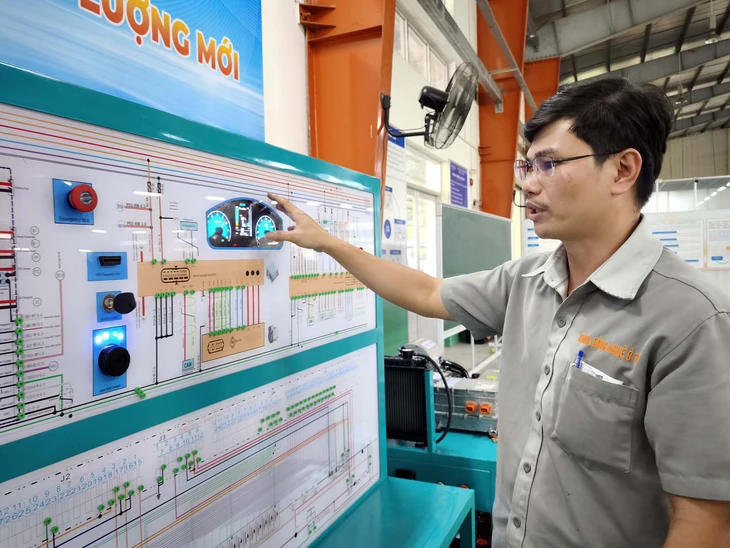
The actual electric vehicle controls are displayed on a whiteboard for students to easily learn and operate - Photo: TRONG NHAN
Recently, a group of teachers from Dong An High-Tech College (Ho Chi Minh City) developed a model of an electrical control system and high-voltage battery for electric vehicles (cars) to allow students to observe, operate, and diagnose faults more visually and safely.
A visual overview of every detail of the electric vehicle.
This model has just surpassed hundreds of other models to win second prize overall in the Ho Chi Minh City 2025 Self-Made Training Equipment Competition organized by the Ho Chi Minh City Department of Education and Training. This is also the first competition since the unification of Ho Chi Minh City, and it is the largest in scale.
MSc. Nguyen Vinh Hiep - Head of the Automotive Department, Dong An High-Tech College (Ho Chi Minh City), and head of the author team - introduced the special feature: instead of a general simulation, the model utilizes real components dismantled from the original Wuling EV50 electric van to maintain authenticity, but rearranged on a model board so that learners can see the internal structure and take measurements conveniently.
If we liken an electric vehicle to a living organism, the high-voltage battery is the "energy source," the control system is the "brain," and the electric motor is the "heart" that generates traction. The team's model is also divided into three main blocks connected by high-voltage wires, signal wires, and connectors that are easy to disassemble and safe to use.
Regarding the high-voltage battery pack, this is often a "forbidden zone" on real vehicles due to the high voltage and the need for strict handling. On the model, the battery uses LiFePO4, housed in a metal box with a transparent mica lid to allow learners to observe the inside.
The battery comes with a Battery Management System (BMS), which monitors the voltage, temperature, and current of each cell, balances the cells, and protects the battery in case of abnormalities.
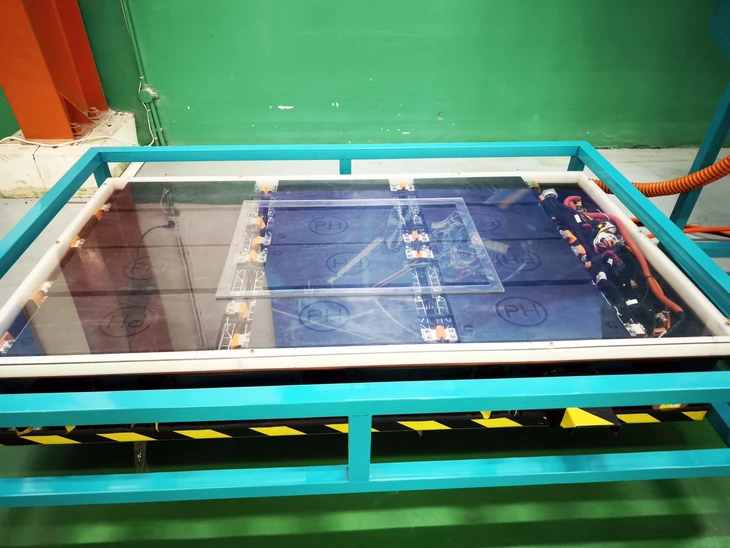
The electric vehicle's battery pack is arranged "openly" in the model so that students can easily observe and operate it.
The equipment model is where learners can see how electric vehicles convert electricity from the battery into motion. Here, an MCU is responsible for converting DC current from the battery into three-phase AC to control motor speed and torque, and performing the reverse action during regenerative braking…
The third section is a test circuit and "pan" generator. This panel displays the status, circuit diagrams, test connectors, and includes the accelerator, brake, gear shift, and ignition switch, allowing learners to operate the controls as if they were sitting in the vehicle.
Specifically, teachers can proactively create faults by disconnecting a corresponding connector on the fault creation board. The model will fail to start, behave abnormally, or display an error code on the dashboard depending on the fault created.
This allows students to practice diagnostic procedures such as observing symptoms, reading fault codes, looking up their meanings, and then using meters and pre-set measurement points to pinpoint the cause.
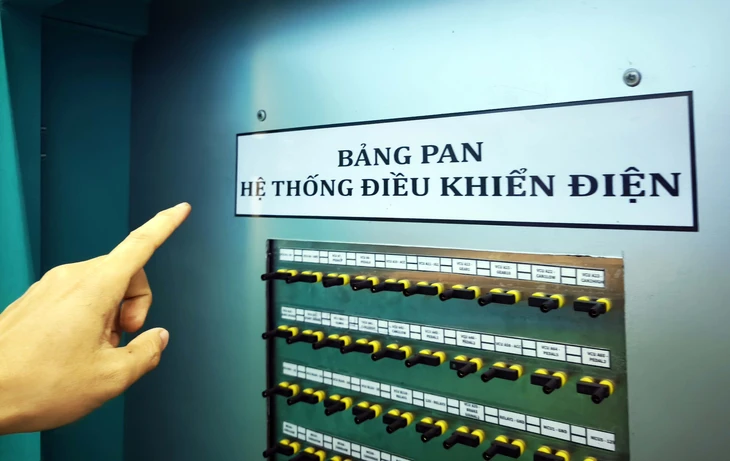
Teachers can mark errors on the whiteboard so students can learn how to find and correct them.
Students practice their skills by making mistakes.
The model was created by the school's instructors over a period of six months. According to Master's student Nguyen Vinh Hiep, in electric vehicle training, theoretical knowledge often fades quickly if learners don't get hands-on experience with the actual system, especially the high-voltage part, which is difficult to practice on a complete vehicle due to risks and costs.
This model focuses on three things that electric vehicle technicians must be able to do: operate according to proper procedures, adhere to high-voltage electrical safety regulations, and diagnose and troubleshoot faults using sound engineering logic.
The judging panel of the Ho Chi Minh City Self-Made Training Equipment Competition assessed that, with two operating states – normal for demonstration and malfunction for diagnostic training – the model creates a "skills gym" allowing students to repeatedly practice operations without the risk of operating on a real vehicle.
Furthermore, the model offers cost advantages compared to importing equipment or purchasing complete electric vehicles solely for teaching purposes, while also optimizing operating costs and facilitating easy replacement and maintenance. The majority of the main components are salvaged from a Wuling EV50, and the battery still has over 75% efficiency, contributing to sustainable development.
Source: https://tuoitre.vn/giao-vien-dua-bo-ruot-xe-dien-len-bang-thuc-hanh-20251219100009605.htm





























![[Photo] Reception to welcome General Secretary and President To Lam and his wife on their State visit to the Philippines](https://vphoto.vietnam.vn/thumb/1200x675/vietnam/resource/IMAGE/2026/06/01/1780295488620_vna-potal-chieu-dai-chao-mung-tong-bi-thu-chu-tich-nuoc-to-lam-va-phu-nhan-tham-cap-nha-nuoc-toi-philippines-8798060-7855-jpg.webp)




























































Comment (0)