

According to the 1954 Geneva Accords, the provisional military demarcation line was chosen to coincide with the Ben Hai River in Vinh Linh District, Quang Tri Province. The demilitarized zone, established on both banks of the Ben Hai River, was the result of an agreement between the major powers at the 1954 Geneva Conference.

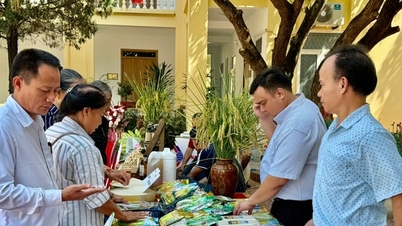
Trung Hai commune, Gio Linh district, introduces mechanization into agricultural production for high efficiency - Photo: TRAN TUYEN
From glorious memories...
Following the 1954 Geneva Accords, the Ben Hai River, located at the 17th parallel, became the dividing line separating the country into two regions: the Vinh Linh area on the north bank of the Ben Hai River was completely liberated along with the North transitioning to socialism, while the Quang Tri area on the south bank of the Ben Hai River, along with the South, became a new type of colony of the United States. From then on, the Ben Hai River witnessed the painful division of the country for over 20 long years.
Given its exceptionally important strategic location, the US declared that its border extended to the 17th parallel, thus building the strongest defense line in Indochina and determined to seize it at any cost. Therefore, at that time, Quang Tri province was like a microcosm of Vietnam, two regions with two different social systems, simultaneously pursuing two revolutionary strategies: the national democratic revolution and the socialist revolution.
Driven by patriotism, bravery, and unwavering determination, the soldiers and people on both sides of the demarcation line skillfully and resolutely fought against the insidious schemes and tactics of the enemy, readily sacrificing their lives and property to hold onto their land and protect their villages, contributing to the great victory of Spring 1975. The Hien Luong Bridge over the Ben Hai River truly deserves the title of "a magnificent monument in the years of war" - a beautiful symbol of Vietnamese revolutionary heroism.
According to Le Van Son, Deputy Secretary of the Party Committee and Chairman of the People's Committee of Trung Hai commune, Gio Linh district, the task for Quang Tri was to resolutely fight to force the opposing side to implement the Geneva Agreement, while maintaining legitimacy and ensuring the common interests of the entire region, especially Zone V.
In compliance with the central government's directives, the provincial Party committee adopted the working motto "three reasons, four little things" (three reasons: for protecting the North, for showing consideration to the South, for protecting peace; four little things: a little later, a little slower, a little more skillful, a little less harsh in armed struggle), which was entirely reasonable and was persistently implemented, accepting sacrifices to achieve victory.
Trung Hai commune, located in Gio Linh district, was situated on the southern bank of the Ben Hai River, and along with the South, it became a new type of colony of the United States. During this period, Trung Hai became a place where the enemy concentrated its forces to build the most solid outer "anti-communist" defense line, considering it a key target for attacking our bases. Meanwhile, most of the commune's revolutionary forces had relocated to the North.
The struggle of cadres, Party members, and the people of Trung Hai and the entire province in the early period was primarily political , creating conditions for the revolutionary movement throughout the South to develop and ensuring the North-South corridor. Therefore, this was a particularly arduous and fierce period, but through these trials, patriotism, the aspiration for independence and freedom, and the unwavering faith in the leadership of the Party and the people at the southern border bridgehead shone even brighter...
Towards a powerful revival
It's hard to imagine that, during the war against the US, the lives of the people on both banks of the Ben Hai River were not only difficult and lacking in material necessities, but they also had to face countless insidious tactics from the enemy. Separated by a small river only about 100 meters wide, the people on both sides were unable to visit each other.
That painful separation was described by the poet To Huu in his poem "A Thousand Miles of Land and Water": "The Ben Hai River, one side eroding, the other building up / Hien Luong Bridge, one side remembering, the other longing / Separated for eighteen long years / When will the road to and from be reconnected?" Yet, today, along both sides of the Ben Hai River, trees are flourishing, villages are bustling, and tourists from all over the world flock to witness the powerful rebirth of this once "dead land".
Ms. Dinh Thi Van, 60 years old, whose house is located north of Hien Luong Bridge, said that when she was a child, she and her family evacuated to Tan Ky District (Nghe An Province) to live. After liberation, she settled in Hien Luong village, Hien Thanh commune, and opened a small shop near the foot of Hien Luong Bridge to make a living. At that time, the area was very poor, there weren't as many houses as there are now, and there were few tourists visiting the Hien Luong - Ben Hai National Special Monument.
Over the past 15 years or so, the economic conditions of the people have improved significantly, many houses have sprung up, all of them beautiful houses, and the National Special Monument of Hien Luong - Ben Hai has also attracted more and more tourists from near and far, so the people are very happy and proud of their homeland's rich revolutionary traditions.
Nguyen Duc Thang, Secretary of the Party Committee and Chairman of the People's Council of Hien Thanh commune, Vinh Linh district, could not hide his joy as he shared that these achievements were thanks to the leadership of the Party Committee, the government, the entire political system from the central to local levels, the efforts of the people, and the support of friends from all over the world, which has led to the daily development of Hien Thanh commune in particular and localities along the Ben Hai River in general.
Currently, in addition to traditional crops such as rice, peanuts, corn, taro, cassava, and ginger, Hien Thanh commune has developed over 184 hectares of pepper, with a yield of 30 quintals/hectare, and 346.86 hectares of rubber, with a latex yield of 5.5 tons/hectare. The commune has also promoted aquaculture, reaching 110 hectares annually, including 38.3 hectares of freshwater fish, 21 hectares of whiteleg shrimp, and 49.6 hectares of tiger shrimp. With this approach, the lives of the people have improved rapidly. Currently, the commune has only 20 poor households, accounting for 1.17%, and 44 near-poor households, accounting for 2.58%. The goal is for Hien Thanh commune to complete all criteria for achieving advanced new rural commune status by the end of 2024.
Sharing the joy of the renewal of his hometown, Le Van Son, Deputy Secretary of the Party Committee and Chairman of the People's Committee of Trung Hai commune, Gio Linh district, said that currently the total cultivated area of the commune reaches 1,617.68 hectares, of which mainly rice cultivation accounts for 785 hectares, with a rice yield of 60 quintals/hectare and a production of 47,100 tons/year. The remaining area is used for growing corn, cassava, peanuts, vegetables, rubber, pepper, and aquaculture.
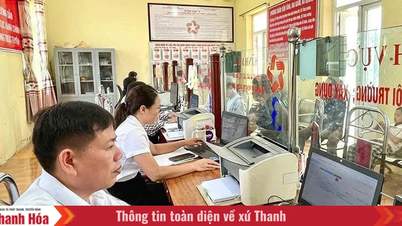
Currently, Trung Hai commune has completed the land inventory and is focusing on completing the Trung Hai Commune Construction Planning for the period 2025-2035; promptly resolving online applications at levels 3 and 4 and postal public services, achieving 100% success rate. The total number of poor households in the commune is now 68, accounting for 5.2%.
Implementing the National Target Program for building new rural areas and civilized urban areas, the commune has so far achieved 16 out of 19 criteria for advanced new rural areas. The goal is for Trung Hai commune to achieve advanced new rural area status by 2025 and model new rural area status by 2027, in accordance with Resolution No. 22 dated August 26, 2021, of the Executive Committee of the Commune Party Committee, 19th term.
Nguyen Vinh
Source: https://baoquangtri.vn/doi-thay-doi-bo-ben-hai-187010.htm

![[Photo] Secretary of the National Assembly Party Committee, Chairman of the National Assembly presides over the meeting of the Standing Committee and Executive Committee of the National Assembly Party Committee.](https://vphoto.vietnam.vn/thumb/1200x675/vietnam/resource/IMAGE/2026/06/03/1780480353201_ndo_br_bnd-2585-jpg.webp)
![[Photo] First session of the 14th Congress of the Vietnam Trade Union](https://vphoto.vietnam.vn/thumb/1200x675/vietnam/resource/IMAGE/2026/06/03/1780465947883_ndo_br_img-3852-jpg.webp)
![[Photo] General Secretary and President To Lam presides over a meeting with the Central Organizing Committee.](https://vphoto.vietnam.vn/thumb/1200x675/vietnam/resource/IMAGE/2026/06/03/1780482764658_a1-bnd-4741-3342-jpg.webp)


































![[Video] Sunset at Lap An Lagoon – Where the sun sets over the fishing nets](https://vphoto.vietnam.vn/thumb/1200x675/vietnam/resource/IMAGE/2026/05/31/1780192137701_beach-landscape-sea-water-nature-grass-745871-pxhere-com.jpeg)


















![[Infographic] Over 1.2 million candidates registered for the 2026 High School Graduation Exam](https://vphoto.vietnam.vn/thumb/402x226/vietnam/resource/IMAGE/2026/06/03/1780496872518_w_20260603205412.jpeg)






Comment (0)