

According to Dr. Tran Thang Long, Deputy General Director of BIDV Securities Joint Stock Company (BSC), current developments show that the market is entering a much more selective phase compared to the 2021-2022 period. Capital flows are no longer spreading widely but are concentrating on businesses with strong fundamentals, high liquidity, and the ability to lead the market.
This is happening against the backdrop of less abundant liquidity in the financial system than before. Interest rates tend to inch upwards due to supply and demand pressures, making investors increasingly cautious and prioritizing stocks with clear "stories" such as public investment, corporate restructuring, market upgrades, or policy expectations. Meanwhile, midcap and smallcap stocks have not attracted as much capital as in previous periods.
Another noteworthy point is the significant shift in the market's cash flow structure. While previously speculative individual capital dominated, the proportion of transactions by domestic institutional investors is now increasing. According to Dr. Tran Thang Long, institutions are now focusing more on businesses with strong fundamentals, high liquidity, and long-term leadership potential. This reflects the market's growing maturity in valuing businesses and adapting to policy cycles rather than relying solely on short-term speculative sentiment.
 |
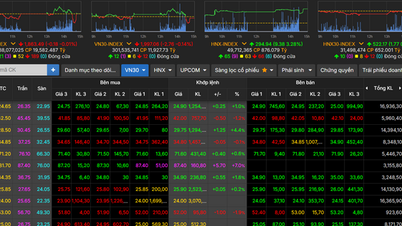
| Cash flow is concentrated in businesses with strong fundamentals. high liquidity and the potential to lead the market. |
The flow of money is no longer "easy."
The strong divergence in the market is also seen by Mr. Le Quang Chung - Deputy General Director of Smart Invest Securities Joint Stock Company (AAS) - as a consequence of increasingly "strict" capital flows. According to him, current capital flows are no longer as "lenient" as in the 2021-2022 period, but are mainly concentrated in the banking sector and large-cap stocks to maintain market momentum.
Mr. Chung believes that when cash flow is no longer abundant, institutions and foreign investors will prioritize businesses with solid fundamentals, high liquidity, and attractive valuations. Meanwhile, many speculative stock groups or sectors facing business cycle difficulties continue to correct or trade sideways despite the overall market increase.
This is why many investors feel like "the VN-Index is rising, but their accounts aren't." While blue-chip stocks are driving the index up, most other stocks are trading much less actively. This reality shows that money is no longer flowing in a "buy the entire market" fashion, but is instead carefully selecting specific sectors and individual companies.
According to Dr. Tran Thang Long, although GDP in the first quarter of 2026 increased by approximately 7.8% and after-tax profits across the entire market increased by 39%, or about 22% if the exceptional profits from the Vingroup group are excluded, the market remains highly polarized. This indicates that business results are no longer the sole factor determining short-term stock price fluctuations.
Data from the first four months of the year also shows that many sectors experienced positive profit growth, but their stock prices rose very weakly or even declined. Conversely, some groups whose profits were not yet truly positive still saw their stock prices increase due to future expectations. According to experts, current cash flow reflects more of the expectations surrounding policy, public investment, market upgrades, and the cyclical recovery potential of businesses.
This indicates that the Vietnamese stock market is entering a new phase, where capital flows prioritize quality companies with leadership potential and long-term prospects, rather than broad speculation as before.
The market is entering a more challenging phase.
Besides facing internal pressure and differentiation, the Vietnamese stock market is also confronting numerous risks from the international financial environment.
According to Dr. Tran Thang Long, the renewed inflationary pressure from March 2026 will mainly stem from escalating energy prices due to conflicts in the Middle East. Meanwhile, increasing exchange rate pressure is narrowing Vietnam's room for monetary policy easing, as the US Federal Reserve's interest rate cut trajectory becomes more unpredictable.
Notably, global stock markets are under significant downward pressure as inflation in the US rises to its highest level in nearly three years, triggering a sell-off in global bond markets. According to a report by MBS Research, the yield on 30-year US Treasury bonds has risen to 5.12%, its highest level since May 2025, while the yield on 10-year bonds has increased to 4.59%, its highest level in almost a year.
Not only in the US, but government bond yields in many major economies such as Japan and the UK have also risen sharply under pressure from inflation and political instability. This makes the prospect of maintaining high interest rates for an extended period a major risk for emerging markets, including Vietnam.
Against this backdrop, the prolonged net selling trend by foreign investors continues to be one of the major pressures on the market. According to Mr. Long, this is not just a phenomenon unique to Vietnam but reflects a global "risk-off" defensive trend as international capital is prioritizing major technology markets such as the US, Japan, Europe, and China – places that strongly benefit from the global AI and semiconductor wave.
Furthermore, the portfolio restructuring process of investment funds following FTSE Russell's announcement of upgrading the Vietnamese stock market to a secondary emerging market has also created additional short-term net selling pressure. In principle, frontier market funds will proactively sell Vietnamese stocks before the upgrade, while emerging market funds will disburse funds in stages after the official upgrade takes place.
Nevertheless, many experts believe that the long-term trend of the market remains upward as bottlenecks related to market upgrades, institutional reforms, and capital market development are gradually resolved. However, unlike previous periods, capital flows are no longer accepting high risks across the board but are entering a more selective phase, where the quality of businesses, growth potential, and long-term leadership capabilities will become the decisive factors in attracting capital to the stock market.
Source: https://thoibaonganhang.vn/dong-tien-dang-chon-doanh-nghiep-co-chat-luong-182411.html




![[Photo] The General Secretary, President and his wife lay flowers at the Ho Chi Minh Monument in Manila.](https://vphoto.vietnam.vn/thumb/1200x675/vietnam/resource/IMAGE/2026/05/31/1780219759477_anh-man-hinh-2026-05-31-luc-16-29-07.png)














![[Video] Sunset at Lap An Lagoon – Where the sun sets over the fishing nets](https://vphoto.vietnam.vn/thumb/340x192/vietnam/resource/IMAGE/2026/05/31/1780192137701_beach-landscape-sea-water-nature-grass-745871-pxhere-com.jpeg)













































































Comment (0)