

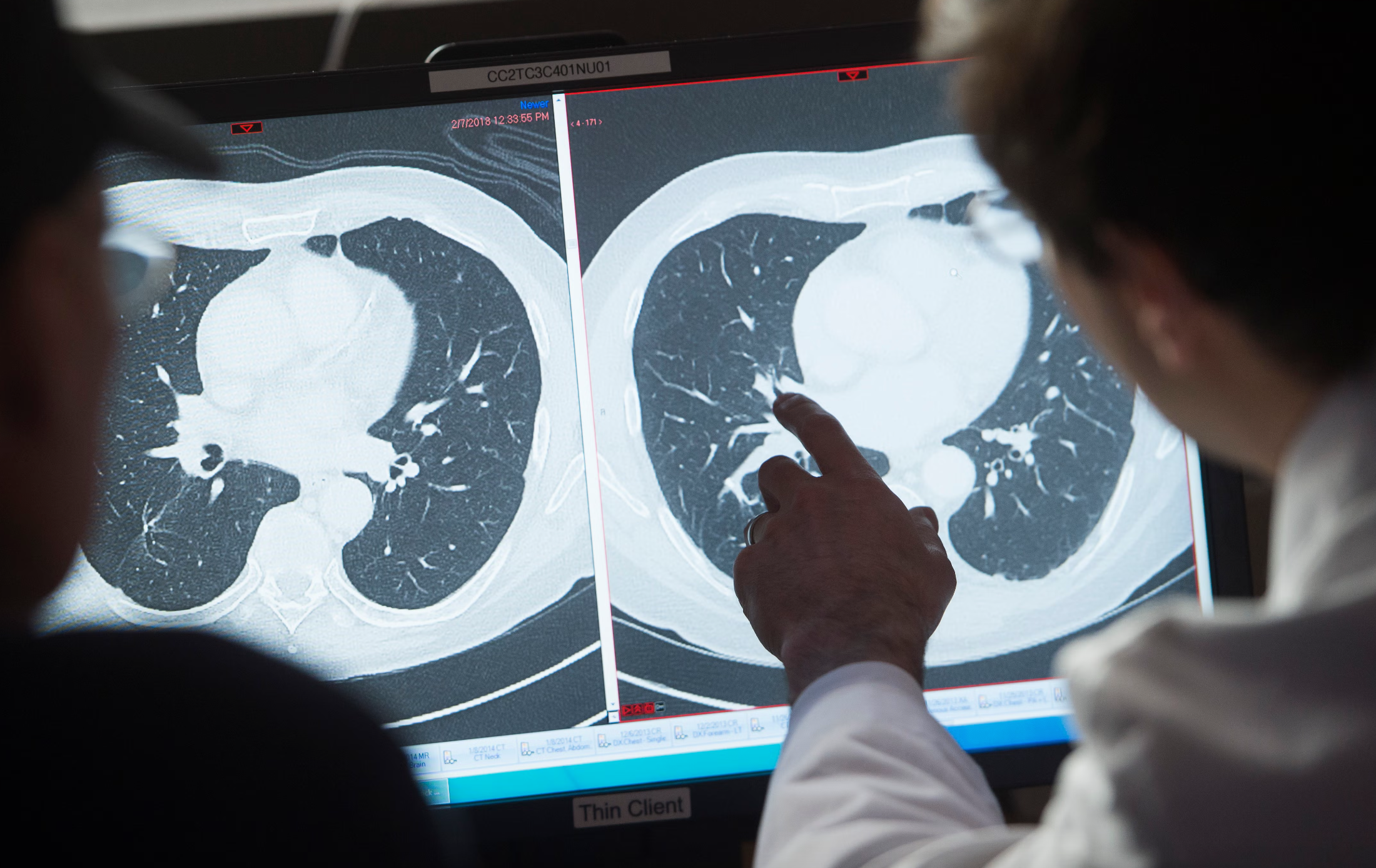
At the annual meeting of the American Society of Clinical Oncology (ASCO) in Chicago, researchers recently announced the results of a clinical trial for the injectable drug amivantamab, a new treatment for patients with metastatic or recurrent cancer who no longer respond to chemotherapy or immunotherapy.
The results showed that this drug helped shrink tumors in more than one-third of the patients participating in the study. Notably, in some cases, doctors observed that the tumors disappeared completely after only a short period of treatment.
Professor Kevin Harrington, an expert in biological cancer therapy at the Institute for Cancer Research (ICR) in London, commented that these were "unprecedentedly strong" treatment responses in a group of patients who had become resistant to both chemotherapy and immunotherapy.
"These are patients who have very few treatment options. So, seeing this level of response is truly impressive," he said.
According to Harrington, if proven effective in further studies, this treatment could benefit tens of thousands of patients each year.
Positive results in the group of difficult-to-treat patients.
In an international trial conducted in 11 countries, 102 patients with head and neck cancer were treated with amivantamab. This is the sixth most common type of cancer in the world and often has a poor prognosis when the disease progresses or recurs.
Following treatment, the tumors shrank or disappeared completely in 43 patients. Of these, 28 reported a significant reduction in tumor size, while 15 patients showed no trace of tumor.
Researchers say similar results have been seen in some lung cancer patients participating in other studies on amivantamab.

Developed by Johnson & Johnson, amivantamab is currently being evaluated in approximately 60 clinical trials worldwide. In addition to lung and head and neck cancer, the drug is also being studied for colorectal, brain, and stomach cancer.
The unique aspect of amivantamab lies in its multi-targeted mechanism of action. The drug simultaneously blocks EGFR—a protein that promotes cancer cell growth—and MET, a pathway that allows many cancer cells to evade treatment. In addition, it activates the immune system to recognize and attack tumors.
The ability to simultaneously affect multiple biological mechanisms is believed to be the reason why the drug is effective in patients for whom previous treatments have failed.
From chemotherapy failure to a normal life.
One of the first patients to benefit from the new therapy is Carl Walsh, 56, who lives in Birmingham, England.
He was diagnosed with tongue cancer in May 2024 and joined a trial at the Royal Marsden Hospital starting in July 2025 after both chemotherapy and immunotherapy proved ineffective.
“I had undergone chemotherapy and immunotherapy but they were unsuccessful. Then the doctors suggested I participate in the trial. I am now in my 17th treatment cycle and am very pleased with the progress I have made,” he said.

Unlike many current cancer treatments that require long-term intravenous infusions, amivantamab is injected directly under the skin. This significantly shortens treatment time, reduces the burden on hospitals, and facilitates outpatient treatment for patients.
According to researchers, most side effects of the drug are mild or moderate. The percentage of patients who have to discontinue treatment due to side effects is less than 10%.
Mr. Walsh said that before participating in the trial, he had great difficulty speaking and eating due to the tumor causing severe swelling and pain.
"Since starting treatment, the swelling has significantly decreased and the pain has improved considerably. I no longer experience the severe side effects I had with chemotherapy," he said.
He recounted that during the worst period of his illness, his daily diet consisted only of soup, porridge, canned noodles, and egg dishes, along with various medical nutritional supplements. His weight dropped significantly.
“After two treatment cycles, my diet started to return to normal. After about six months, I could eat completely as before. What made me happiest was being able to enjoy a big steak again,” he shared.
Currently, his ability to speak has fully recovered, and he is able to work normally.
Hope for thousands of patients
A notable finding of the study is that the participating patients primarily had head and neck cancers unrelated to HPV. This group of cancers is often more difficult to treat than HPV-related cancers.
According to scientists, achieving a high response rate in this patient group is particularly important because they often have a poor prognosis and limited chances of effective treatment.
Research data shows that the median survival time of patients treated with amivantamab reached 12.5 months from the start of treatment. This is an encouraging result for a group of patients with low survival rates after standard treatments have failed.
Professor Kristian Helin, CEO of the Institute for Cancer Research London, stated that the research has demonstrated the potential of next-generation therapies in improving cancer treatment outcomes.
"This study demonstrates that drug development efforts through structured cancer research can produce truly significant advances, even for patients who have virtually no other treatment options."
"Achieving high tumor response rates and encouraging survival outcomes in a group of very difficult-to-treat diseases is a significant step forward in the fight against cancer," he emphasized.
Although more large-scale studies are needed to confirm its long-term effectiveness, the initial results of amivantamab are offering new hope for patients with advanced-stage cancer, especially those who have failed current treatments.
Source: https://daibieunhandan.vn/dot-pha-dieu-tri-ung-thu-nhieu-benh-nhan-het-sach-khoi-u-sau-tiem-thuoc-10418963.html











































































































Comment (0)