


Vietnam's port system is under significant pressure due to limitations in public infrastructure. Many ports, despite modern investments, cannot operate at full capacity as they are "waiting" for waterways, connecting roads, and supporting infrastructure.
Given that seaports have become a cornerstone of the national logistics chain, these bottlenecks must be addressed promptly with appropriate public investment resources.
Infrastructure is holding back seaports.
With the highest container throughput in the country, Cat Lai Port ( Ho Chi Minh City) receives approximately 20,000 vehicles daily for cargo handling.
Inside the port, thanks to the acceleration of digital transformation, the handling process has been streamlined. However, the reality outside is quite the opposite. At times, ships have to wait 4-5 days before being able to enter the berths. Meanwhile, on the Phu My - My Thuy - Dong Van Cong - Mai Chi Tho - Vo Chi Cong routes, the traffic is densely packed, turning the entire area into a "hot spot" for congestion.

Digital transformation helps goods move through ports more quickly.
In an effort to alleviate pressure on Cat Lai, Ho Chi Minh City invested early in dredging the Soai Rap channel, aiming to develop Hiep Phuoc into a satellite port cluster. However, after more than two decades, Hiep Phuoc has yet to fulfill its expected role.
According to Mr. Tran Van Sanh, Head of Hiep Phuoc Representative Office, Ho Chi Minh City Port Authority, the cause stems from a "double bottleneck": the Soai Rap channel silts up rapidly, preventing large ships from entering and exiting, while the road network is frequently congested at the Nguyen Van Linh - Nguyen Huu Tho intersection, failing to attract container cargo.
Sharing the current operational situation, Mr. Nguyen Anh Hao, Acting General Director of Saigon Hiep Phuoc Port, said: The channel depth of 9.5m was once considered the "key" for Hiep Phuoc to connect to the entire region's logistics axis, but now many sections are only 6.6-6.7m deep. Large ships cannot enter, causing the entire port cluster to operate at only about 30% capacity, with 70% of the potential remaining... waiting for the Soai Rap channel dredging solution.
The paradox is that ports are in place, cargo is readily available, but connecting infrastructure hasn't kept pace, forcing many investors to change their function. A typical example is the Saigon Central Container Port (SPCT), which, shortly after receiving its first container ship in 2009, had to switch to operating RoRo vessels specializing in transporting automobiles.
Mr. Nicolas Tronel, General Director of SPCT, said: "Receiving RoRo vessels is only a 'last resort'; in the long term, we still hope that the State will soon prioritize funding for dredging the Soài Rạp channel and upgrading the connecting road so that Hiệp Phước can fulfill its proper role."

The Soài Rạp channel's depth does not meet standard regulations, preventing many ports in Hiệp Phước from receiving container ships.
Connectivity infrastructure bottlenecks
In recent years, relocating and developing seaports towards the river mouth has been one of the key policies to alleviate infrastructure bottlenecks. At Cai Mep-Thi Vai, 22 modern berths have been established, attracting many major shipping companies to open direct routes. However, after 16 years, the rapid growth of the port cluster is now outpacing the capacity of the connecting infrastructure.
Mr. Nguyen Minh Tuan, Director of Operations at Tan Cang-Cai Mep International Port, said that the shipping channel, after dredging, has reached a depth of 14-15.5m. However, the global trend is shifting towards mother vessels with drafts of 16m or more, requiring proactive maintenance to maintain the port's attractiveness.
In addition, the increase in cargo volume has led to a rapid increase in the number of inland waterway vessels unloading goods at the port cluster, posing a potential risk of congestion and maritime safety hazards.
In reality, the Inland Container Depot (ICD) system around Ho Chi Minh City has a natural advantage with its dense network of rivers and canals, with approximately 95% of the market dependent on barge transport. However, according to many businesses, this advantage has not been fully exploited due to limited waterways and bridge clearance. In addition, key projects such as the Bien Hoa-Vung Tau expressway, Highway 991B, and other inter-regional routes are behind schedule, causing mother ships to unload quickly but containers to become congested due to delays in clearance.
Following the merger, the Ho Chi Minh City Port Authority manages a vast waterway, including a seaport system accounting for approximately 65% of the country's container throughput. According to Vo Minh Tien, Director of the Ho Chi Minh City Port Authority, this presents an opportunity to expand development space but also creates significant pressure due to the lack of synchronized connecting infrastructure.
“Many waterways, such as Soài Rạp and Sài Gòn, are experiencing rapid sedimentation, with depths constantly changing. Although the Maritime and Inland Waterways Administration has a maintenance plan, implementation is difficult due to a lack of siltation sites – a task that falls under the jurisdiction of local authorities. Meanwhile, the road network is constantly overloaded, making shipping companies hesitant to bring large vessels into Ho Chi Minh City,” Mr. Tiến said.
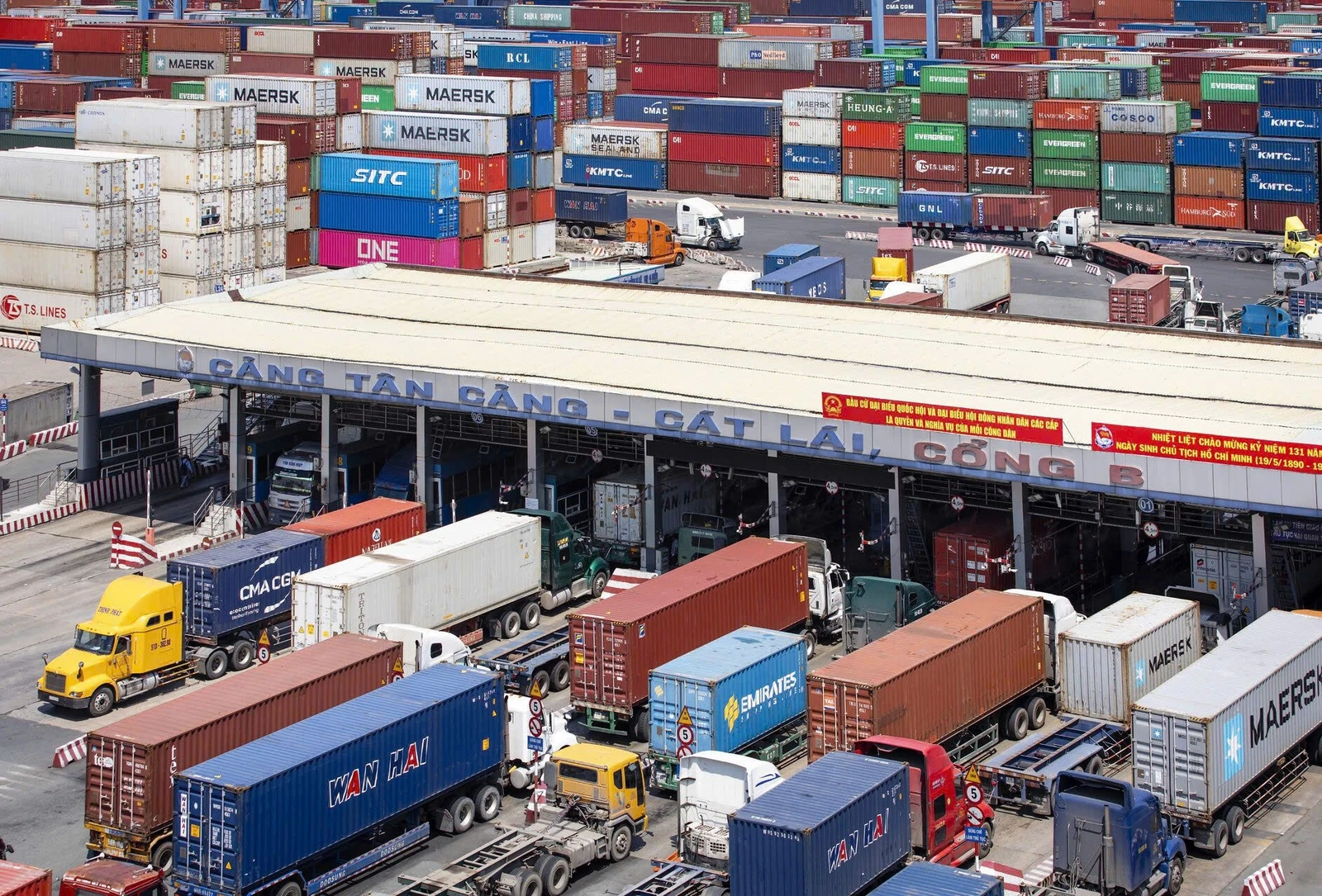
Traffic congestion before and after the Cat Lai New Port has been ongoing for many years.
Lieutenant Colonel Nguyen Phuong Nam, Deputy Commander of the 20th Army Corps and Deputy General Director of Saigon Newport Corporation, stated: The current bottleneck lies in the lack of synchronization between port infrastructure, primarily invested in by businesses, and the connecting transportation system implemented by the State. The logistics chain can only operate efficiently when the infrastructure connecting before and after the port is invested in synchronously. To ensure the capacity to receive large-tonnage vessels, priority should be given to dredging and maintaining the waterway system. Furthermore, handling the large volume of goods through the port requires rail and waterway transport to play a leading role, reducing pressure on road transport.
What can businesses do to proactively participate?
The modernization of seaports has helped Vietnamese goods reach European and American markets directly, reducing dependence on transshipment ports in the region. In the North, the Lach Huyen deep-water port has quickly become a strategic link, with a steady growth rate of 12-15% annually. However, practical operation has also revealed a significant gap between the development speed of the port and the public infrastructure.

Overloaded infrastructure is making traffic management at Hai Phong seaport very difficult.
Pointing out specific bottlenecks, Deputy Director of Hai Phong Maritime Port Authority Le Van Thuan said that the Hai Phong maritime channel section through the Ha Nam canal is 80m wide, only usable in one direction, and is rapidly silting up, causing the depth to not meet standards. The VTS maritime traffic control system has also deteriorated, making traffic regulation difficult.

During peak hours, ships entering and leaving Hai Phong seaport frequently experience congestion due to the limited number of turning basins.
Meanwhile, the entire Lach Huyen area has only one turning basin designed for 100,000 DWT vessels, but it has to serve ships up to 165,000 DWT. Each turning cycle takes 45 minutes, causing congestion for ships entering and leaving Hai Phong seaport.
"The pressure is further increased as cargo clearance remains dependent on frequently congested road transport, while waterway transport has not yet been fully utilized and railway connections are lacking. Without early investment, Hai Phong's seaport system will struggle to keep pace with the growth rate of the northern key economic region," Mr. Thuan emphasized.
Several businesses in Hai Phong have proactively invested capital to address bottlenecks in public infrastructure. From 2024 to the present, Gemadept Joint Stock Company (GMD) - the unit managing and operating Nam Dinh Vu Port - has twice invested its own capital to dredge and maintain nearly 10 km of channel from the port to the Lach Huyen turning basin. After lowering the channel depth from 7m to 8.5m, the company handed over the infrastructure to the Department of Maritime Affairs and Inland Waterways for management without requiring reimbursement.

Dredging the channel at Hai Phong port.
Mr. Doan Trung Nguyen, Deputy Director of Nam Dinh Vu Port, said: The channel depth has increased by 1.5m, allowing ships to enter and exit the port without being dependent on tides, eliminating the 5-7 hour waiting time per day, and saving 15,000 to 20,000 USD per day in costs. The amount of cargo handled has also increased by 4,000-5,000 tons per trip, thereby improving operational efficiency and lowering transportation costs.
Private capital is demonstrating its advantages in terms of progress, quality, and operational capacity. From the Nam Dinh Vu port, upstream businesses have joined forces to dredge the Dinh Vu-Lach Huyen channel, expanding the total length of the renovated route to over 16km. After the upgrade, the berths in the Dinh Vu area can now accommodate ships of 55,000 DWT with reduced load.
At the Lach Huyen port complex, while the berths are operational but the road construction is still incomplete, Hateco Hai Phong International Container Port (HHIT) has invested in nearly 1km of connecting road for container trucks. These are very encouraging achievements. To replicate this, specific mechanisms and policies are needed to encourage private sector participation in investing in public infrastructure.
Currently, the proportion of budget allocated to maritime and inland waterway transport accounts for only about 2-4% of total transportation investment, which is far too modest compared to the role and potential of the sector. Many experts believe that this level of investment is no longer appropriate in the context where seaports have become a pillar of the logistics chain. The infrastructure bottlenecks revealed today are a test of the planning vision and coordination capacity of the entire system.
The government needs to continue taking the lead in investing in public infrastructure, creating a synchronized connectivity framework to unleash the capacity of seaports. Then, private capital and FDI will once again flow strongly into logistics projects, inland ports, and terminals, as in the previous period.
Source: nhandan.vn
Source: https://baophutho.vn/dot-pha-ha-tang-cang-bien-nang-tam-vi-the-quoc-gia-244749.htm
![[Photo] The General Secretary, President and his wife begin their state visit to the Philippines.](https://vphoto.vietnam.vn/thumb/1200x675/vietnam/resource/IMAGE/2026/05/31/1780230559452_anh-man-hinh-2026-05-31-luc-19-28-11.png)


![[Photo] Solemn bathing ceremony and Buddha procession in Hue](https://vphoto.vietnam.vn/thumb/1200x675/vietnam/resource/IMAGE/2026/05/31/1780228263543_1-jpg.webp)
![[Photo] Admire the coral "masterpiece" amidst the million-year-old heritage of Dak Lak province.](https://vphoto.vietnam.vn/thumb/1200x675/vietnam/resource/IMAGE/2026/05/31/1780221235105_anh-man-hinh-2026-05-31-luc-16-53-27.png)










![[Video] Sunset at Lap An Lagoon – Where the sun sets over the fishing nets](https://vphoto.vietnam.vn/thumb/340x192/vietnam/resource/IMAGE/2026/05/31/1780192137701_beach-landscape-sea-water-nature-grass-745871-pxhere-com.jpeg)







































![[Photo] Admire the coral "masterpiece" amidst the million-year-old heritage of Dak Lak province.](https://vphoto.vietnam.vn/thumb/402x226/vietnam/resource/IMAGE/2026/05/31/1780221235105_anh-man-hinh-2026-05-31-luc-16-53-27.png)

































Comment (0)