

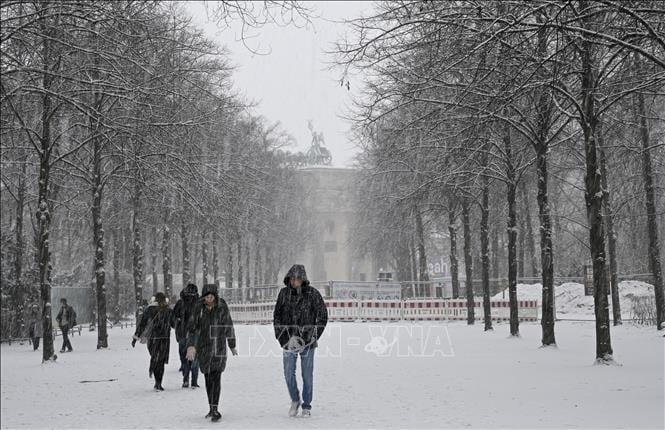
The German Meteorological Service (DWD) said that storm Elli, heading straight towards Central Europe, is the focal point of the current weather instability, bringing heavy snowfall and widespread frost.
This phenomenon stems from the collision of two air masses over German territory. In the north and east, strong easterly winds continue to bring in cold air, causing rain – in some places heavy – to almost completely turn into snow. The DWD forecasts a new snow band of about 10 cm thick will form from the North Sea extending eastward, while some areas may experience snowfall up to 20 cm.
Conversely, milder weather is forecast in the south and west thanks to strong winds carrying warm air from the Atlantic. However, this also increases the risk of hail and freezing temperatures, even in high-altitude areas. According to the DWD, these contrasting weather patterns could create significant temperature differences across Germany, potentially lasting until January 11th.
Forecasts for January 9th indicate that the highest temperatures will range from -5°C in the Northeast to around 10°C along the upper reaches of the Rhine River. On January 10th, the cold air mass will continue to spread southward, causing rain to gradually turn into snow in the Southwest, with a significant risk of snowfall, especially in mountainous areas.
The severe cold spell is expected to end on January 11th, but the weather remains cold. In the North, strong winds could blow away the snow cover, posing a serious risk of disruption to road and rail transport.
Source: https://baolamdong.vn/duc-doi-mat-voi-dot-thoi-tiet-cuc-doan-do-bao-elli-416829.html



































![[Photo] Reception to welcome General Secretary and President To Lam and his wife on their State visit to the Philippines](https://vphoto.vietnam.vn/thumb/1200x675/vietnam/resource/IMAGE/2026/06/01/1780295488620_vna-potal-chieu-dai-chao-mung-tong-bi-thu-chu-tich-nuoc-to-lam-va-phu-nhan-tham-cap-nha-nuoc-toi-philippines-8798060-7855-jpg.webp)





































































Comment (0)