

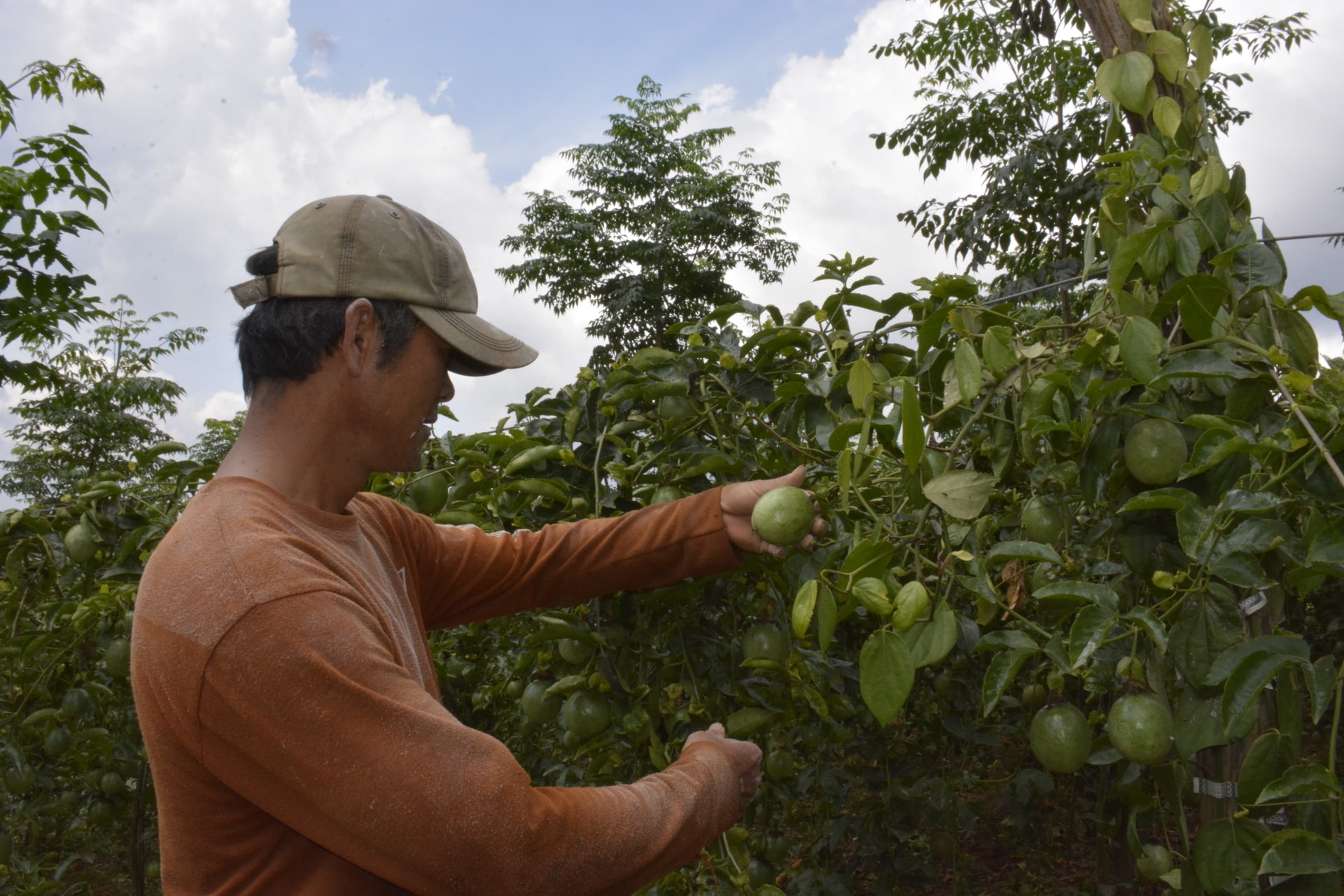
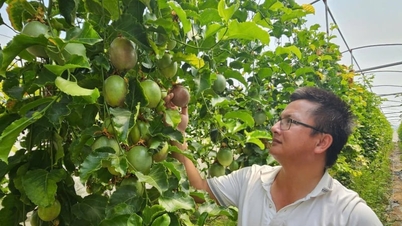
Mr. Cao Bá Tuyền's family, residing in residential area 3, Đắk Ha, Bắc Gia Nghĩa, currently owns nearly 1 hectare of passion fruit. Mr. Tuyền stated that despite years of experience in cultivating this crop, his orchard is still affected annually by diseases caused by viruses, bacteria, and nematodes, such as root rot, wilting, and hardening of the bark. These are diseases for which there are no specific treatments. To prevent these problems, he focuses on implementing an integrated pest management process, which includes regularly pruning the tops and leaves to improve air circulation around the passion fruit vines; applying the correct and sufficient amount of lime; and only using pesticides from the list of approved pesticides for safe use on vegetables and fruits. However, the family's passion fruit garden quickly deteriorated, and the quality of the fruit was not high, specifically during the harvest periods at the end of 2025 and the beginning of 2026. This affected the family's selling price, which was only 15,000 VND/kg for fresh passion fruit (passion fruit from which the juice is extracted), a decrease of about 5,000 VND/kg compared to the middle of the year.
The unsatisfactory quality and quantity of raw materials have forced some passion fruit purchasing and processing facilities and businesses to temporarily shut down their factories and machinery due to low or no profit. A representative from a passion fruit purchasing and exporting company in Bac Gia Nghia ward stated that from the beginning of January 2026 to February 25th, their company temporarily suspended purchasing and processing passion fruit. The reason was the poor quality of the raw materials.
According to a representative of a business involved in purchasing, processing, and exporting passion fruit in Phu Xuan residential area, Dong Gia Nghia, the company has a huge demand for locally sourced raw materials for processing and export. Recently, however, there have been periods when the supply has been insufficient, and the quality has somewhat declined, forcing them to purchase from other locations for processing.
According to a report by the Department of Agriculture and Environment, the development of passion fruit cultivation in the western part of the province has been unstable in recent years. Specifically, in 2019 and 2020, the area under passion fruit cultivation was approximately 1,700 hectares, with a production of about 33,000 tons per year. In recent years, the area under passion fruit cultivation has decreased to only about 800-1,000 hectares, with a production of about 25,000 tons.
For the past two years, passion fruit prices have been quite high, fluctuating between 10,000 and 20,000 VND per kilogram of fresh passion fruit. This is considered an opportunity for the passion fruit industry to restructure towards improving productivity and quality, and forming sustainable linkages. However, observations show that at times, purchasing and processing facilities still face shortages of raw materials or the raw materials do not meet expectations, forcing them to temporarily suspend operations. This is regrettable, as people and businesses in the region have not fully taken advantage of the opportunity to boost exports, especially to large markets such as China, the Middle East, and Asia. The western part of the province currently has about 15 businesses involved in purchasing and processing passion fruit, and several export businesses.
To ensure the sustainable development of passion fruit cultivation and meet export standards, the agriculture and environment sector recommends that farmers and businesses strengthen production linkages towards a commodity-based approach, ensuring food safety and agricultural product quality to increase value. Relevant agencies and localities need to actively implement solutions regarding plant varieties, growing areas, and disease prevention and control to stabilize this crop.
Source: https://baolamdong.vn/dut-hang-chanh-day-426673.html

![[Photo] First session of the 14th Congress of the Vietnam Trade Union](https://vphoto.vietnam.vn/thumb/1200x675/vietnam/resource/IMAGE/2026/06/03/1780465947883_ndo_br_img-3852-jpg.webp)
![[Photo] General Secretary and President To Lam presides over a meeting with the Central Organizing Committee.](https://vphoto.vietnam.vn/thumb/1200x675/vietnam/resource/IMAGE/2026/06/03/1780482764658_a1-bnd-4741-3342-jpg.webp)
![[Photo] Secretary of the National Assembly Party Committee, Chairman of the National Assembly presides over the meeting of the Standing Committee and Executive Committee of the National Assembly Party Committee.](https://vphoto.vietnam.vn/thumb/1200x675/vietnam/resource/IMAGE/2026/06/03/1780480353201_ndo_br_bnd-2585-jpg.webp)































![[Video] Sunset at Lap An Lagoon – Where the sun sets over the fishing nets](https://vphoto.vietnam.vn/thumb/1200x675/vietnam/resource/IMAGE/2026/05/31/1780192137701_beach-landscape-sea-water-nature-grass-745871-pxhere-com.jpeg)
























Comment (0)