


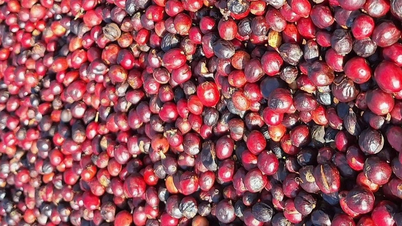
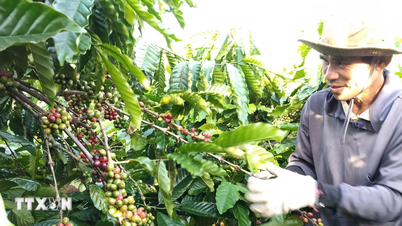
On May 30th alone, coffee prices in the Central Highlands region dropped sharply by 1,800 VND/kg in line with world coffee prices. However, by the end of last week, coffee prices in the Central Highlands fluctuated between 86,800 and 87,400 VND/kg, a decrease of 600-700 VND/kg compared to the previous week.
Specifically, in Lam Dong , a decrease of 600-700 VND/kg was recorded, bringing the purchase price down to 86,800-87,400 VND/kg, but it is still the locality with the highest price in the region.
Coffee prices in Dak Lak also decreased by 700 VND/kg, while in Gia Lai they fell by 600 VND/kg, with both localities currently trading at 87,300 VND/kg.
Coffee trading in Vietnam was subdued last week due to increasingly tight supply and weak demand. Farmers continued to limit sales in anticipation of a stronger price recovery, while export businesses closely monitored harvest developments in Indonesia and Brazil before increasing purchases.
One trader noted that rainfall has been unevenly distributed across coffee-growing regions, raising concerns about yields in the upcoming crop year. Additionally, coffee exports are projected to increase at a moderate rate, while domestic consumption continues to grow.
Globally, coffee prices fell sharply at the close of trading this weekend due to profit-taking pressure and new weather forecasts. On the London exchange, the July 2026 Robusta contract fell by $78 (2.19%), to $3,476 per ton. On the New York exchange, the Arabica contract for the same period plummeted by 8.65 cents (3.15%), to 265.60 cents per pound.
The main reason for the price drop is the latest forecast indicating that the weather in Brazil's key coffee-growing regions will soon become dry again next week. This information raises expectations that harvesting activities will soon return to normal, thereby alleviating concerns about short-term supply shortages.
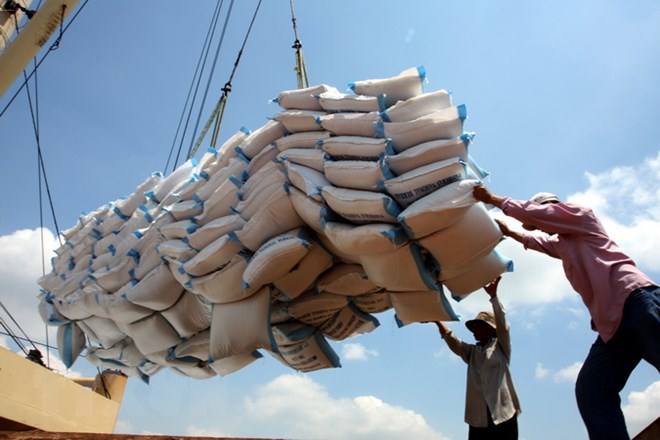
Regarding the Asian rice market, there were positive developments last week as prices rose in many major exporting countries.
In India, export rice prices continued their upward trend due to stronger demand and the rupee recovering from record lows. 5% broken parboiled rice was offered at $337-345 per ton, up from $336-343 last week. 5% broken white rice also saw a slight increase from $336-343 per ton to $338-344 per ton.
One trader said demand from African customers is improving, mainly due to Indian rice being more competitively priced compared to other suppliers.
In Thailand, the price of 5% broken rice also increased from $440-465/ton last week to $450-460/ton. Traders said demand from the Philippines and Africa is increasing. They also predicted that Thai rice prices will remain high in the near future as exporters are still actively purchasing.
Conversely, Vietnamese 5% broken rice is being offered at $405-410 per ton, a slight decrease from $410-415 a week earlier.
A trader in Ho Chi Minh City said there was information that the Philippines might restrict imports of Vietnamese rice in June and July. Traders were also not very optimistic about the agreement to export 1.5 million tons of rice from Vietnam to the Philippines due to concerns about the price ceiling imposed by the country.
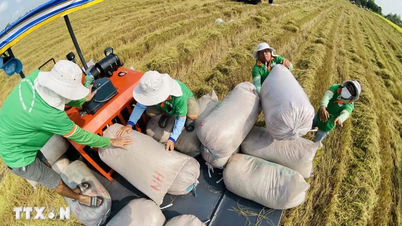
Domestically, the supply of early summer-autumn rice is limited, the market is relatively calm, and rice prices are showing little fluctuation.
In An Giang, many rice varieties have seen a slight price increase. Specifically, high-quality rice varieties such as OM 18 and Dai Thom 8 are priced at 6,400 – 6,500 VND/kg, an increase of 200 VND/kg; OM 5451 fluctuates between 5,700 – 5,800 VND/kg, an increase of 100 VND/kg; IR 50404 also increased by 100 VND/kg, reaching 5,500 – 5,600 VND/kg; and OM 34 remains at 5,100 – 5,200 VND/kg.
However, domestic raw rice prices remain stable. Specifically, OM 5451 raw rice fluctuates between 9,550 and 9,650 VND/kg; IR 50404 remains at 8,400 to 8,550 VND/kg.
Regarding raw rice, most varieties remained unchanged compared to last week, such as Dai Thom 8 raw rice ranging from 9,200 - 9,400 VND/kg; OM 18 at 8,700 - 8,850 VND/kg; and OM 380 and Soc Thom both ranging from 7,500 - 7,600 VND/kg. For finished IR 50404 rice, the current price is around 10,750 - 10,090 VND/kg.
In the by-product group, the price of broken rice ranges from 7,500 to 7,600 VND/kg, while the price of bran is at 7,150 to 7,250 VND/kg.
According to the Ministry of Agriculture and Environment, as of May 25th, localities in the Mekong Delta had planted 705,000 out of 1.243 million hectares for the 2026 Summer-Autumn crop, reaching 56% of the planned area. Approximately 16,000 tons have been harvested with a yield of about 69.30 quintals/hectare, resulting in an estimated total rice production of 115,000 tons.
Regarding the US grain market, prices of grain commodities on the Chicago Board of Trade (CBOT) fell across the board at the end of the week due to pressure from the upcoming harvest in the Northern Hemisphere.
At the close of trading on May 29, the May 2026 wheat contract fell 0.5% to $6.2075 per bushel. The corn contract declined 0.2% to $4.55 per bushel, while the soybean contract rose 0.3% to $11.9775 per bushel. (1 bushel of wheat/soybeans = 27.2 kg; 1 bushel of corn = 25.4 kg).
Observers believe wheat prices are under downward pressure as traders adjust investment plans ahead of the harvest in the Northern Hemisphere – the region that produces most of the world's wheat. Although the US crop has been affected by drought, many other countries in the Northern Hemisphere are forecast to have bumper harvests.
Another factor attracting attention in this session was the news that China would reduce tariffs on US grains. Previously, US officials indicated that China would purchase an additional $17 billion worth of agricultural products from the US, although there has been no confirmation from China.
In addition, grain prices on the CBOT exchange were also influenced by developments in the US-Iran peace talks. The prospect of an agreement cooled oil prices, putting pressure on biofuels and other inputs, and opening up the possibility of improved fertilizer supplies from the Gulf region.
Source: https://baotintuc.vn/thi-truong-tien-te/gia-ca-phe-mat-da-tang-gao-viet-chiu-them-ap-luc-20260531113932136.htm


![[Photo] The General Secretary, President and his wife lay flowers at the Ho Chi Minh Monument in Manila.](https://vphoto.vietnam.vn/thumb/1200x675/vietnam/resource/IMAGE/2026/05/31/1780219759477_anh-man-hinh-2026-05-31-luc-16-29-07.png)
















![[Video] Sunset at Lap An Lagoon – Where the sun sets over the fishing nets](https://vphoto.vietnam.vn/thumb/340x192/vietnam/resource/IMAGE/2026/05/31/1780192137701_beach-landscape-sea-water-nature-grass-745871-pxhere-com.jpeg)








































































Comment (0)