

Domestic market prices remained unchanged; iron ore prices are heading for a weekly decline as hopes for a Chinese stimulus package fade.
World market
At the close of trading on August 1st, August futures prices for rebar on the Shanghai Futures Exchange fell 1.12% (36 yuan) to 3,170 yuan/tonne. On the Dalian Commodity Exchange, August iron ore futures rose 0.63% (5 yuan) to 793.5 yuan/tonne. Similarly, August iron ore futures on the Singapore Exchange (SGX) increased by $0.24 to $99.65/tonne.
Compared to last weekend, the prices of steel in Shanghai, iron ore in Dalian, and iron ore in Singapore changed by (-2.4%), (-0.9%), and (-3.3%), respectively.
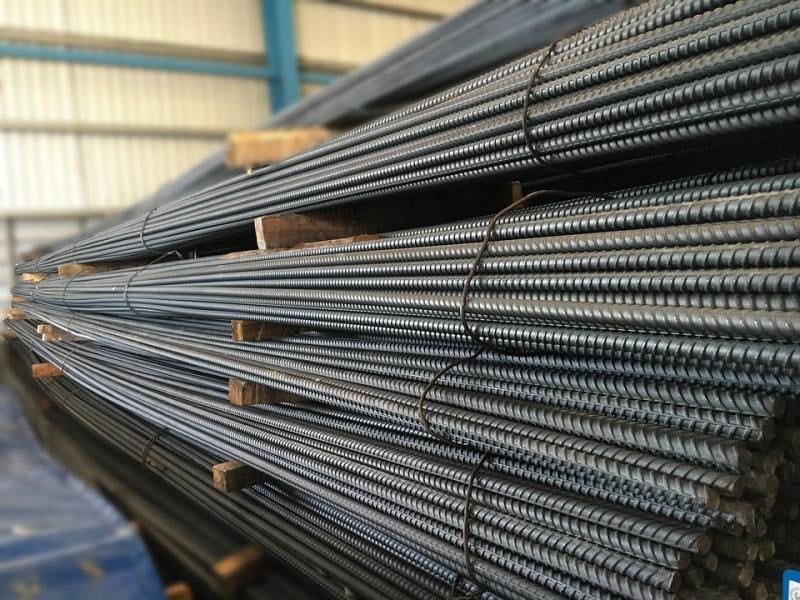
Steel futures prices in China plunged this week, reflecting market skepticism about the scale of fiscal support Beijing will implement amid weakening consumer spending and a prolonged real estate crisis.
Although the Chinese government has stated it will implement expansionary fiscal and monetary policies to boost spending, it has avoided announcing large-scale stimulus packages. The July Politburo meeting set economic direction for the second half of the year but did not provide specific relief measures for the real estate sector. Real estate is a sector with high demand for steel.
In the international market, the US imposition of tariffs on several major economies has led ArcelorMittal, the world's leading steel company, to lower its profit forecast and revise down global steel consumption (excluding China). However, the US has also exempted imported pig iron and ferro-alloy from Brazil from tariffs to ease the tariff burden on the steel industry.
Despite market pressures, steel futures prices in the third quarter remained 5% higher than the previous quarter, driven by expectations of infrastructure spending and potential supply cuts. Chinese policymakers have pledged to eliminate overcapacity in the construction materials sector. Baosteel, one of the country's largest steel companies, forecasts that domestic steel production could fall by more than 50 million tons in 2025.
Meanwhile, iron ore prices, a key raw material for steel production, showed little change on August 1st but were still on track to record weekly declines due to weakening expectations of new stimulus packages from China. At the same time, the July manufacturing PMI fell to 49.3, the lowest level since April, indicating continued weak domestic and international demand.
In a related development, Türkiye's steel exports surged in the first half of 2025, but domestic production and consumption continued to decline.
According to the Turkish Steel Manufacturers Association (TCUD), in the first six months of 2025, Türkiye's steel product exports reached 7.7 million tons, an increase of 18.6% compared to the same period last year. In terms of value, export turnover reached $5.2 billion, an increase of 8.8% compared to the same period in 2024.
In June alone, Türkiye exported 1.4 million tons of steel, a 21.5% increase compared to June 2024. Export revenue for the month reached $931.3 million, a 13.5% increase compared to the same period last year.
Conversely, Türkiye's steel imports in the first six months of the year increased by 12.6% year-on-year, reaching 9.3 million tons. In June, import volumes surged by 52.4% to 1.8 million tons.
The export/import coverage ratio, an indicator reflecting trade self-sufficiency, has decreased from 80.2% to 73.5%, indicating that the steel industry's trade balance is skewed towards a trade deficit.
Türkiye's domestic consumption of finished steel reached 18.6 million tons in the first half of the year, down 2.6% year-on-year. However, in June alone, domestic demand increased by 8.8%, reaching 3.1 million tons.
The country's steel production also recorded a decline. In the first six months of the year, Turkish steel mills produced a total of 18.3 million tons, down 1.7% compared to the same period in 2024. Production in June reached 2.9 million tons, down 3.5% compared to June last year.
Domestic market
Domestically, businesses are trying to stabilize construction steel prices. Specifically, Hoa Phat's CB240 steel is priced at 13,230 VND/kg; CB300 steel at 12,830 VND/kg. At Viet Y Steel, CB240 steel is priced at 13,130 VND/kg; D10 CB300 steel at 12,520 VND/kg. Viet Sing Steel recorded prices of 13,130 VND and 12,930 VND/kg respectively.
Steel prices in Northern Vietnam
According to SteelOnline.vn, Hoa Phat steel brand offers CB240 steel coils at 13,650 VND/kg; and D10 CB300 ribbed steel bars at 13,790 VND/kg.
Viet Y Steel brand offers CB240 steel coils at 13,890 VND/kg; D10 CB300 ribbed steel bars are priced at 13,990 VND/kg.
Viet Duc Steel offers CB240 steel coils at 13,550 VND/kg and D10 CB300 ribbed steel bars at 13,550 VND/kg.
Viet Sing Steel, with CB240 steel coils, is priced at 13,690 VND/kg; D10 CB300 ribbed steel bars are priced at 13,580 VND/kg.
VAS steel, with CB240 coiled steel at 13,740 VND/kg; D10 CB300 ribbed steel bar priced at 13,740 VND/kg.
Steel prices in Central Vietnam
Hoa Phat Steel, with its CB240 coiled steel, is priced at 13,530 VND/kg; D10 CB300 ribbed steel bars are also priced at 13,530 VND/kg.
At Viet Duc Steel, the current price for CB240 steel coils is 14,050 VND/kg; and for D10 CB300 ribbed steel bars, it is 14,000 VND/kg.
VAS steel, CB240 coil steel, is priced at 13,740 VND/kg; D10 CB300 ribbed steel bar is priced at 13,790 VND/kg.
Steel prices in Southern Vietnam
Hoa Phat Steel, CB240 steel coils, are priced at 13,790 VND/kg; D10 CB300 ribbed steel bars are priced at 13,740 VND/kg.
VAS steel, CB240 coil steel, is priced at 13,740 VND/kg; D10 CB300 ribbed steel bar is priced at 13,840 VND/kg.
Source: https://baolamdong.vn/gia-thep-hom-nay-3-8-tiep-da-giam-386222.html

![[Image] Hanoi's urban life under the challenge of a "scorching hot" environment](https://vphoto.vietnam.vn/thumb/1200x675/vietnam/resource/IMAGE/2026/05/25/1779706979265_nang-nong-t5-2026-minh-duy-7-4636-jpg.webp)





















































































Comment (0)