

Amidst the shortage of sand to meet construction deadlines, many transportation contractors are still trying to purchase from domestic commercial quarries and seeking alternative solutions, instead of importing sand from Cambodia.
Sand extraction is insufficient to meet demand.
As the year draws to a close, construction activity at the Chau Doc - Can Tho - Soc Trang expressway project is becoming increasingly intense.
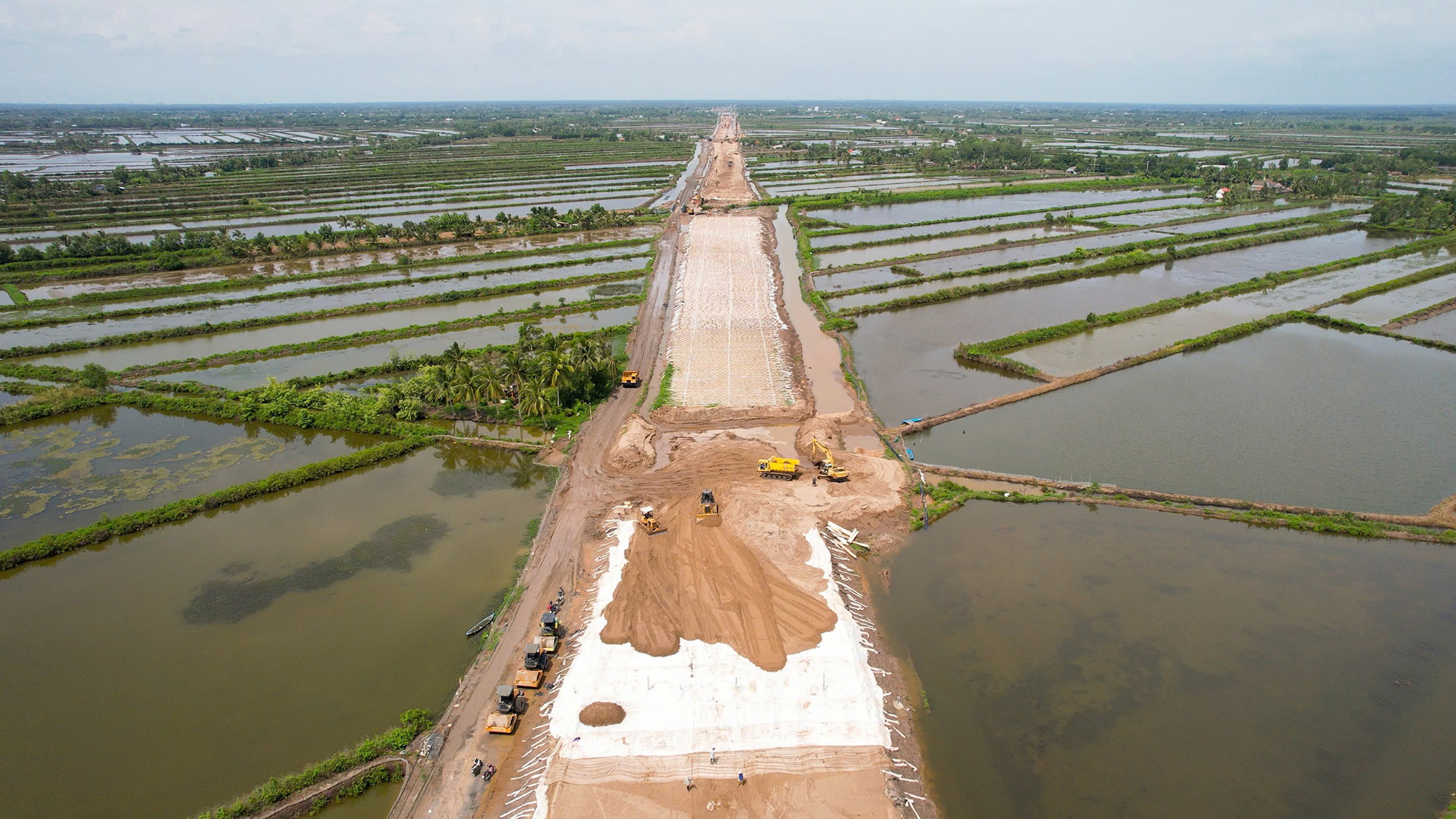
Due to high costs, many contractors have abandoned the option of buying sand from Cambodia and are seeking alternative solutions. (In the photo: Construction of the Can Tho – Ca Mau expressway). Photo: Le An.
Regarding the construction of nearly 18km of the main route in component project 3, the section passing through Hau Giang province, Mr. Vu Dinh Tan, Deputy Director of Trung Nam Construction and Installation Joint Stock Company (Trung Nam E&C), said that according to calculations, the sand requirement is approximately 3.4 million m3. In 2024 alone, the volume to be mobilized is nearly 1 million m3.
Currently, the contractor has been assigned two mining sites on the Ba Lai and Tien rivers by Ben Tre province for exploitation under a special mechanism.
While awaiting permits, with the investor's approval, the contractor purchased commercial sand (approximately 150,000 m3) for the construction of service roads, access roads, and site leveling.
From now until the end of 2024, the contractor needs to mobilize more than 200,000 m3 of sand. Meanwhile, the expected sand reserves to be exploited under the special mechanism only meet more than 50% of the demand.
"The contractor is actively purchasing commercial sand, including imported sand from Cambodia, even though it means incurring losses compared to the estimated unit price," Mr. Tan added.
For the construction of the 7km main section of the North-South Expressway project from Can Tho to Hau Giang, the 36 Corporation needs to mobilize approximately 1 million cubic meters of sand for embankment.
Lieutenant Colonel Nguyen Dang Thuan, Deputy General Director of Corporation 36, said that An Giang province has supported the granting of the Phu An sand mine with a reserve of approximately 700,000 cubic meters to the unit for exploitation.
To date, the remaining reserves are not substantial. With a shortfall of approximately 300,000 cubic meters, the unit is applying for permits for two sand mines in Ben Tre and requesting additional support from Vinh Long province.
"The option of purchasing sand from Cambodia was also considered by the unit, and approximately 30,000 cubic meters have been purchased."
However, the cost was too high, double the current price of sand, so we stopped buying it," Mr. Thuan informed.
Giving up because of the high price.
The leader of a contractor involved in the construction of the North-South expressway section from Can Tho to Ca Mau (who requested anonymity) admitted that the excessively high price is one of the main reasons why construction units are hesitant to consider purchasing imported sand from Cambodia.
The purchase price of sand at the construction site of expressways is only 180,000 - 200,000 VND/m3. However, for sand from Cambodia, the purchase price at the border is already 190,000 VND. When delivered to the construction site in the Mekong Delta and Ho Chi Minh City, the purchase price ranges from 280,000 - 300,000 VND/m3.
According to a representative of a company involved in the extraction and transportation of sand from Cambodia, if Vietnamese contractors purchase commercially through retail channels, they face exorbitant prices, and meeting the required volume is also very difficult.
To obtain large quantities, contractors must consider purchasing the right to mine a certain amount of sand from the mine owner in Cambodia and transporting it themselves from the mine to the construction site.
By doing this, the price of sand delivered to the highway construction site in the Mekong Delta is approximately 230,000 - 240,000 VND/m3. If purchased in smaller quantities, the price can reach 270,000 - 300,000 VND.
However, the biggest challenge is that the contractor will have to pay a very large sum of money to the mine owner (even a small mine costs around $1 million).
Furthermore, for transportation purposes, the Vietnamese contractor had to rent barges themselves at a cost of 300 million VND per month, along with a deposit of approximately 1 billion VND per barge.
If you rent 5-10 trucks, the initial cost is quite significant. "That's why construction companies rarely use imported sand," a company representative said.
Sand mines are shrinking due to over-exploitation.
In a report submitted to government leaders at the end of June, the Ministry of Industry and Trade stated that in the three years (2021-2023) and the first four months of 2024, the amount of sand imported from Cambodia was approximately 23.6 million cubic meters (more than 7 million cubic meters imported each year).
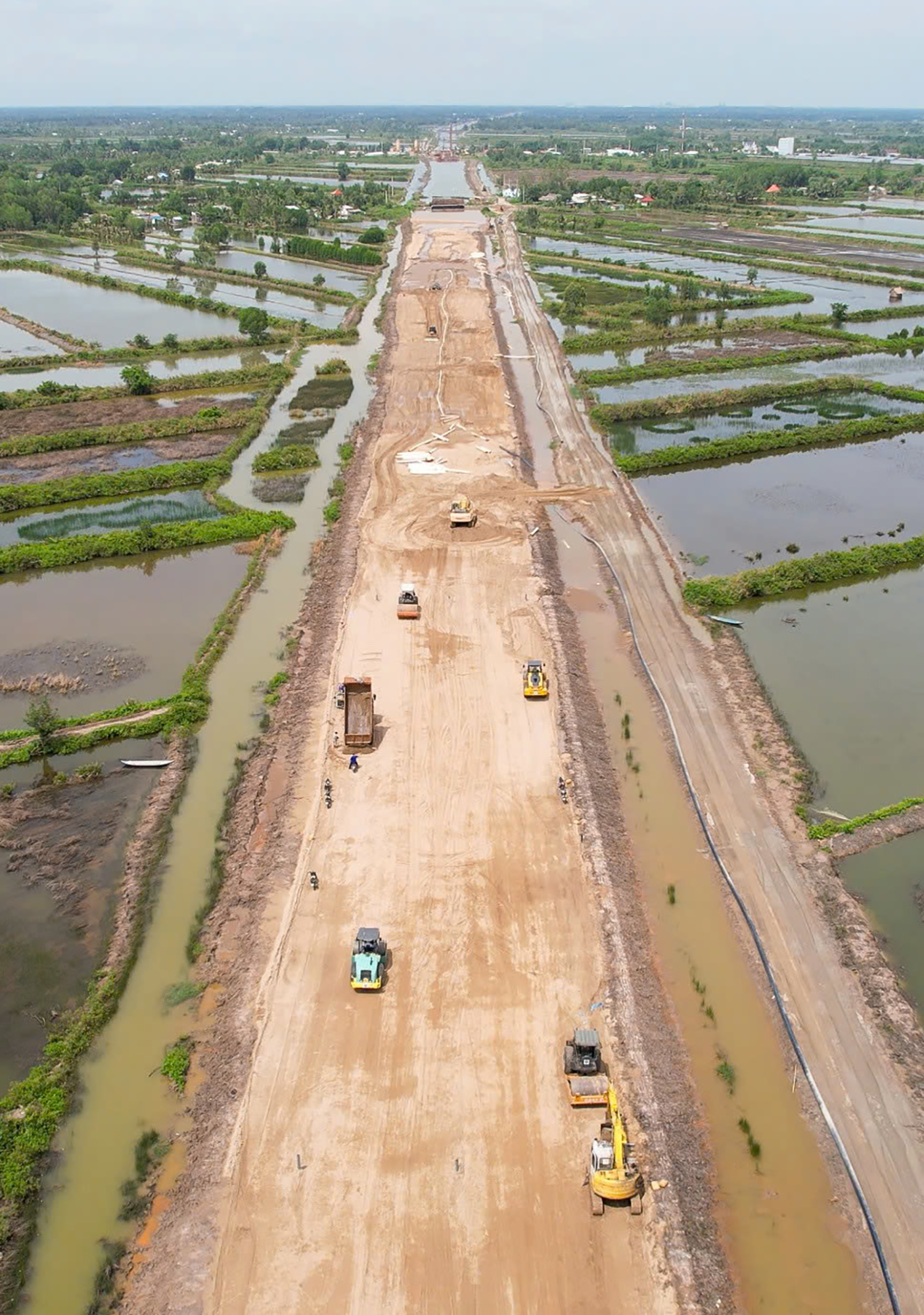
Contractors are actively mobilizing sand to complete the loading and treatment of weak soil foundations on the Can Tho - Ca Mau expressway. Photo: Le An.
According to the Ministry of Industry and Trade, construction sand and leveling sand are not on the list of prohibited imports and do not require a license for import. Businesses importing sand only need to have import and export functions.
The Cambodian government advocates for a free market, allowing businesses from both sides to proactively negotiate and sign contracts at agreed-upon prices.
Previously, in a report to the National Assembly on the research of solutions to diversify the sources of materials used for transportation projects, especially in the Mekong Delta region, the Ministry of Transport stated that, according to a report from the Ho Chi Minh City Real Estate Association, Cambodia has expressed willingness to export sand to Vietnam with a reserve of approximately 100 million cubic meters, with an extraction period of one year.
The association proposed that the Ho Chi Minh City People's Committee act as the liaison with the other party to carry out the procedures, and also assign a military enterprise unit in the South to act as the liaison for signing the distribution contract.
Recently, the Ministry of Industry and Trade also chaired and coordinated with relevant ministries, agencies, and organizations to organize a working group to Cambodia and report to the Prime Minister.
Accordingly, Cambodia has abundant sand reserves for land leveling and construction, sufficient to meet the immediate and long-term needs of the southern provinces. The supply of sand is not hampered by the policies of the two governments. This is considered a major source of supply for projects.
In Cambodia, previously only three companies were authorized by the government to export sand, and now only two remain.
Approximately 40 Vietnamese businesses signed contracts to purchase sand from Cambodia, but in reality, only about 10 businesses are operating due to low profit margins, or even losses.
A representative from a business stated that Vietnamese companies must proactively acquire the necessary means and equipment for extraction, such as ships and suction dredgers.
The mine owners in Cambodia don't have the equipment; they only sell the mining rights.
The sand mines in Cambodia are quite large, stretching for several tens of kilometers. Vietnamese businesses wanting to buy a specific type of sand (construction sand or leveling sand) can extract it from areas that have been surveyed and explored beforehand to determine the appropriate sand type.
Regarding the calculation method, when a dredging vessel is brought from Vietnam to Cambodia, the Cambodian registration authority will check the specific tonnage and volume before issuing a certificate.
Once the ship is full of sand, the mine owner's supervisor will level the surface of the hold to determine the exact amount of sand.
"My company has more than a dozen dredging vessels of various types operating in Cambodia. Small vessels cost around 10 billion VND, while larger ones cost about 50 billion VND. Each vessel has an extraction capacity of 700-3,000 cubic meters," this person stated.
Regarding procedures, Vietnamese sand importing businesses encountered some difficulties earlier this year due to Circular 04/2023 issued by the Ministry of Construction.
The regulations came into effect on January 1, 2024, forcing some sand barges to anchor at docks, resulting in additional costs. After some time, the issue was resolved.
Regarding costs, the price of sand sold from Cambodia to Vietnam is approximately 6 USD/m3. Businesses importing sand must place deposits ranging from 100,000 USD to several million USD, depending on the volume and conditions.
Previously, there were many sand mines in Cambodia, but they have now shrunk due to over-exploitation.
This leads to mining companies having to move further inland, incurring higher costs.
Furthermore, it's not easy to determine the correct type of sand. Supplying the wrong type to the contractor could result in contractual penalties.
"Some unscrupulous businesses often use the tactic of mixing up invoices to sell to individuals or companies involved in illegal sand mining within the country."
Businesses selling invoices only pay 60-70% of the price, thereby legitimizing the sand extracted through official channels, which allows them to sell it at a significantly lower price than us.
Another tactic is that some individuals and companies involved in illegal sand mining in Vietnam buy a small quantity of imported sand from Cambodia, mix it in, and then offer it for sale as imported sand from Cambodia," a representative of this business informed.
Request more mines, transfer materials.
Due to difficulties in importing sand, in order to meet the requirements for completing the dumping work in 2024, some contractors are considering mobilizing crushed stone aggregate to replace part of the missing sand volume for dumping.
At the same time, contractors and investors are actively working with Tien Giang and Ben Tre provinces to identify additional supply sources for the project.
Speaking with Giao Thong Newspaper, the leader of the My Thuan Project Management Board said that for the two component projects of the Can Tho - Ca Mau section, the demand for sand for embankment until the end of 2024 is approximately 15.5 million cubic meters.
Currently, the allocated reserves are sufficient to meet the project's needs. However, due to limited river sand extraction capacity and the fact that sea sand is only used for a portion of the route, daily sand mobilization only meets approximately 70% of the demand.
The provinces have completed the procedures to open up the supply for the project, adding 2.2 million cubic meters. Of this, An Giang coordinated 1.4 million cubic meters; Vinh Long completed the procedures for 3 mines with reserves of 0.8 million cubic meters; and Dong Thap increased the capacity of 2 mines.
The investor is continuing to coordinate with local authorities to complete the procedures for one mine in Tien Giang and two mines in Ben Tre.
Regarding the construction of the main section of the Chau Doc - Soc Trang - Can Tho expressway through An Giang, Mr. Nguyen Manh Tuan, the project commander of Phuong Thanh Investment and Construction Joint Stock Company, stated that the contractor has supplied more than 2.6 million cubic meters of sand for construction purposes.
While awaiting the issuance of a special mining permit, over 417 cubic meters of commercial sand were delivered to the construction site. Therefore, in 2024, the remaining sand shortage is approximately 600,000 cubic meters.
"To overcome the material shortage, we are actively mobilizing finances to obtain as much sand as possible from the Tan My mine on the Tien River, and we haven't considered importing sand yet," Mr. Tuan shared.
Similarly, Truong Son Construction Corporation - the contractor selected to construct package 1 of component 3 of the Chau Doc - Can Tho - Soc Trang expressway project - stated that the total volume of sand for embankment and surcharge loading for the entire project is over 2.5 million m3.
"Currently, we have been licensed and are operating three sand mines under a special mechanism granted for the Can Tho - Ca Mau north-south expressway."
"In this project, the loading work is expected to be completed by the end of November. The licensed reserves at the mines are still large, enough to supplement and reinforce the north-south expressway through Hau Giang," Mr. Tuan said.
Source: https://www.baogiaothong.vn/gia-tren-troi-nha-thau-cao-toc-kho-nhap-khau-cat-192241114230147507.htm
![[Photo] General Secretary and President To Lam presides over a meeting with the Central Organizing Committee.](https://vphoto.vietnam.vn/thumb/1200x675/vietnam/resource/IMAGE/2026/06/03/1780482764658_a1-bnd-4741-3342-jpg.webp)

![[Photo] First session of the 14th Congress of the Vietnam Trade Union](https://vphoto.vietnam.vn/thumb/1200x675/vietnam/resource/IMAGE/2026/06/03/1780465947883_ndo_br_img-3852-jpg.webp)

![[Photo] Secretary of the National Assembly Party Committee, Chairman of the National Assembly presides over the meeting of the Standing Committee and Executive Committee of the National Assembly Party Committee.](https://vphoto.vietnam.vn/thumb/1200x675/vietnam/resource/IMAGE/2026/06/03/1780480353201_ndo_br_bnd-2585-jpg.webp)




















































![[Video] Sunset at Lap An Lagoon – Where the sun sets over the fishing nets](https://vphoto.vietnam.vn/thumb/1200x675/vietnam/resource/IMAGE/2026/05/31/1780192137701_beach-landscape-sea-water-nature-grass-745871-pxhere-com.jpeg)































Comment (0)