

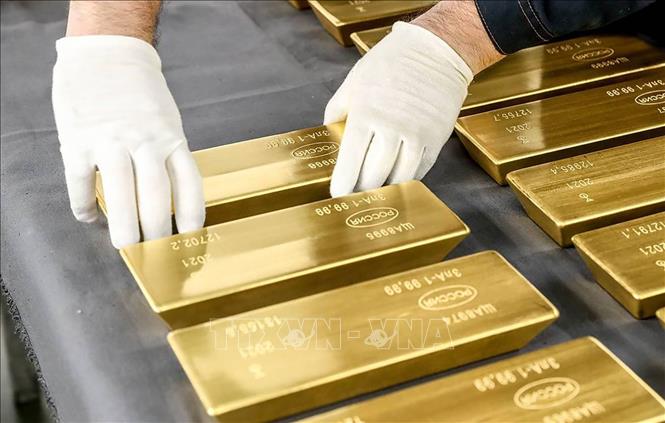
Gold is displayed at the Shchyolkovo plant of the Yuzhuralzoloto Precious Metals Group in Russia. Photo: TASS/VNA.
The main driving force comes from escalating US-China trade tensions and the weakening of the US dollar, leading investors to seek refuge in precious metals.
Gold prices started this week (April 7th) down more than 2%, as investors shifted to holding the US dollar as a safe haven asset after deep US tariffs raised concerns about a global recession. However, analysts remain optimistic about gold's outlook amid ongoing economic challenges.
In the following trading session (April 8th), gold reversed its downward trend and continued to rise until the end of the week. The increase in gold prices was driven by investment flows seeking safe-haven assets amid escalating US-China trade tensions.
On April 9, US President Donald Trump announced he would temporarily halt plans to impose retaliatory tariffs on trading partners, excluding China, for 90 days. Concerns that tariffs would fuel inflation and stifle economic growth led investors to withdraw capital from the stock and commodity markets and shift to gold.
Gold – often seen as a "safe haven" during times of political and financial instability – has risen 15% since the beginning of the year. Meanwhile, the US dollar index – a measure of the greenback's value against a basket of major currencies – has fallen, making gold cheaper for holders of other currencies.
Global gold prices rose nearly 3% to an all-time high on April 10th, as the US dollar weakened and the trade war between the US and China escalated.
By the end of the week on April 11th, gold prices surpassed the $3,200/ounce mark, as widespread recession fears spurred a strong influx of capital into the precious metals market as a safe haven.
Specifically, at 1:32 AM on April 12th, Vietnam time, the spot gold price rose nearly 2% to $3,235.89 per ounce, after earlier reaching a record high of $3,245.28 per ounce during the session. US gold futures also increased 2.1%, closing at $3,244.60 per ounce. Overall for the week, gold prices rose by more than 6%.
Nitesh Shah, a commodity strategist at WisdomTree, noted that gold is becoming a favored safe-haven asset amid President Trump's trade war that is disrupting the world. The US dollar is weakening, and US Treasury bonds are being sold off as confidence in the US as a reliable trading partner has declined.
In the latest development, China has increased tariffs on US goods to 125%, further escalating tensions between the world's two largest economies. The US dollar has depreciated against many major currencies, making gold – which is priced in USD – more attractive to investors holding other currencies.
In addition, the upward trend in gold prices is supported by a number of other factors, including strong buying activity by central banks, expectations that the US Federal Reserve (Fed) will soon lower interest rates, geopolitical instability, and inflows into gold ETFs.
Data released on April 11th showed that US producer prices unexpectedly fell 0.4% in March 2025, raising expectations that the Fed will have more room to cut interest rates to support the economy. Investors now predict the Fed will lower interest rates starting in June, with a total reduction of around 90 basis points before the end of the year.
Tai Wong, an independent metals trader, believes that while a minor correction may occur in the short term, the outlook for gold remains very positive.
However, several factors could limit the upward momentum of gold prices, according to analysts at UBS. These include the possibility of easing geopolitical tensions, a return to cooperative trade relations, or a significant improvement in the US economy.
In other precious metals markets, spot silver prices rose 3.2% to $32.18 per ounce, while palladium prices increased 0.7% to $914.87 per ounce. Conversely, platinum prices fell 0.2% to $936.36 per ounce.
According to Baotintuc.vn
Source: https://baohoabinh.com.vn/12/200091/Gia-vang-the-gioi-tang-6-tr111ng-tuan-qua.htm

![[Photo] General Secretary and President To Lam and the President of the Philippines hold talks.](https://vphoto.vietnam.vn/thumb/1200x675/vietnam/resource/IMAGE/2026/06/01/1780286997787_anh-man-hinh-2026-06-01-luc-11-09-43.png)


![[Photo] Reception to welcome General Secretary and President To Lam and his wife on their State visit to the Philippines](https://vphoto.vietnam.vn/thumb/1200x675/vietnam/resource/IMAGE/2026/06/01/1780295488620_vna-potal-chieu-dai-chao-mung-tong-bi-thu-chu-tich-nuoc-to-lam-va-phu-nhan-tham-cap-nha-nuoc-toi-philippines-8798060-7855-jpg.webp)














































































Comment (0)