My connection with macadamia trees and the first harvests of fruit.
There was a time when Mrs. Nguyen Thi Dung and Mr. Pham Van Ho (Van Du commune, Thanh Hoa province) were suspected by other farmers of exaggerating the yield and value of macadamia trees to sell seedlings. Without much explanation, they quietly tended to the trees, watering them until they bore fruit before expanding their cultivation. Each macadamia flowering, fruiting, and harvesting season brought in tens of millions of dong per hectare, a much higher and more stable income than growing sugarcane or acacia trees. From initial whispers, farmers in the surrounding area gradually contacted them to learn from their experience and switch to macadamia cultivation.
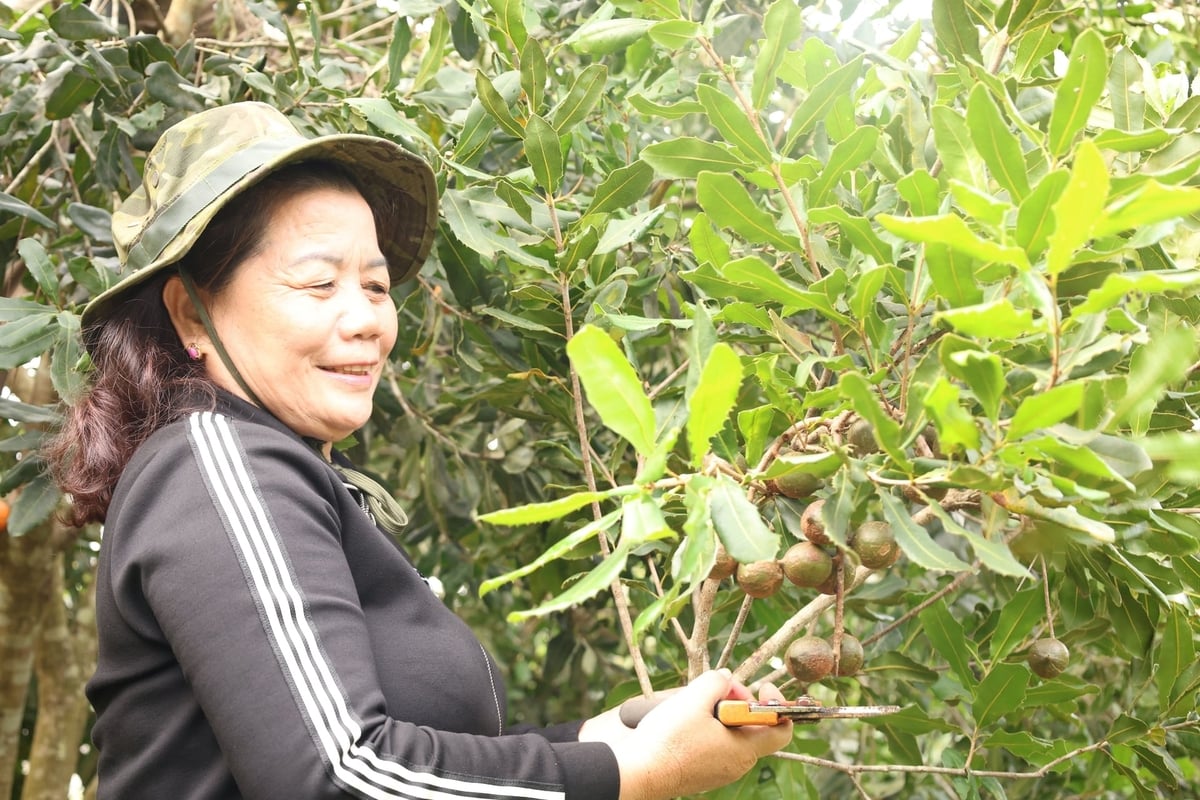
Ms. Dung stands beside clusters of macadamia nuts laden with seeds. Photo: Thanh Tam.
Mr. Pham Van Ho was formerly the Director of the Thach Thanh Protective Forest Management Board. In 2006, while still an employee of the Board, he had the opportunity to meet the late Deputy Prime Minister Nguyen Cong Tan during a visit to the experimental planting of 500 macadamia trees by Mr. Pham Huu Tu, Dong Luat Team, Thach Thanh Forestry Station. He still vividly remembers the late Deputy Prime Minister's words: "Macadamia trees are very suitable for the soil of Thach Thanh, where the soil layer is 50-70cm thick and very fertile; this is a million-dollar tree for farmers."
The opportunity arose again in 2012 when Mr. Ho attended a macadamia tree development workshop in Hanoi and met the late Deputy Prime Minister Nguyen Cong Tan. Seeing him, he eagerly approached, shook his hand, and shared the news: “We have successfully conducted trial planting of macadamia trees on the hills of Thach Thanh, sir. The trees are bearing fruit, the nuts are of excellent quality, and they can be harvested and sold immediately. This will be a potential crop to help farmers improve production efficiency.” He clearly remembered Mr. Tan's advice: “Not only sell fresh fruit, you need to research expanding the planting area and developing deep processing to increase its value; macadamia trees have enormous potential.”
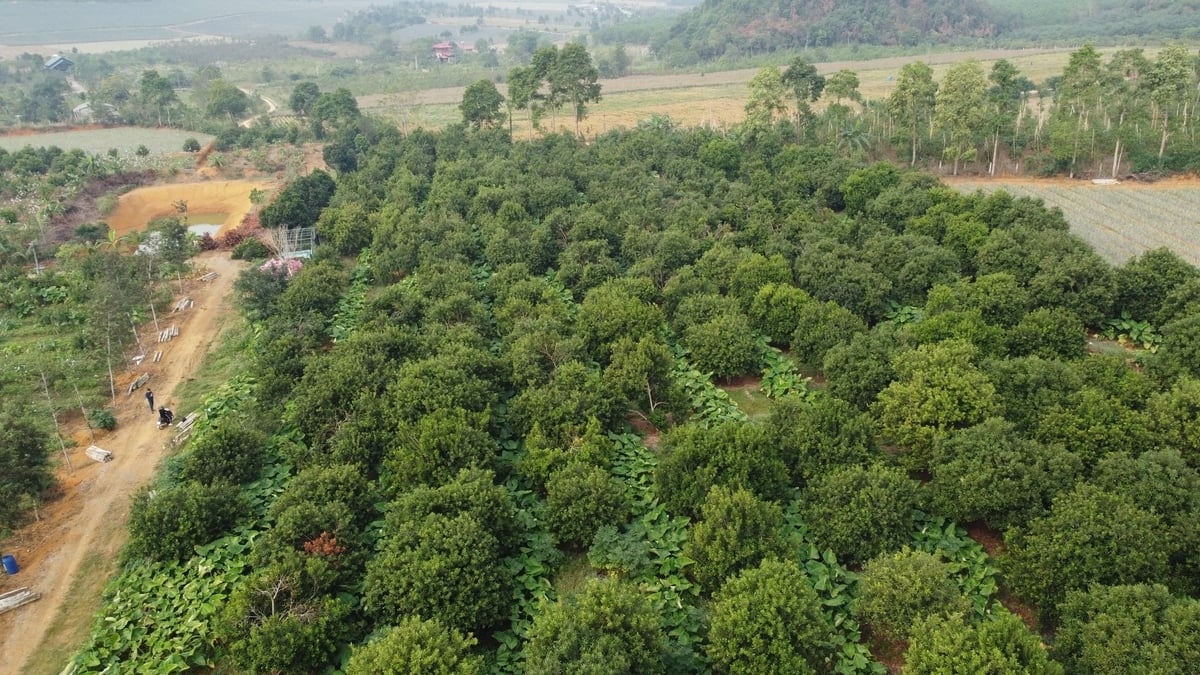
Remembering the advice of the late Deputy Prime Minister, Mr. Ho boldly cut down 1 hectare of acacia trees and switched to planting macadamia nuts. Photo: Thanh Tam.
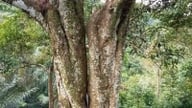
Remembering that advice, upon returning to Van Du (now Van Du commune, Thach Thanh district, Thanh Hoa province), Mr. Ho began searching for authentic macadamia seedlings. He then decided to cut down 1 hectare of acacia trees and improve the land to plant macadamia trees, hoping to prove that this truly is a "million-dollar tree." After four years, in 2016, his macadamia orchard yielded its first fruits, with clusters of fruit hanging heavily from the trees. He and his wife cherished each fruit, recalling the days of enduring the elements, tending to the trees, pruning, and pouring so much sweat into this land to reap the first harvest.
Expanding cultivation areas, linking farmers, and the aspiration for a "million-dollar crop."
Undeterred, he continued to expand the area to 10 hectares. In the early years, before the macadamia trees fully formed their canopy, he intercropped them with pineapples, guavas, and peanuts to generate short-term income while waiting for the trees to mature. This was the source of revenue that helped him maintain the employment of laborers to care for the macadamia orchard.
He shared: “Macadamia trees must be planted 8 meters apart. In the first six years, before the canopy closes, it's necessary to take advantage of planting short-term crops to both increase income and control weeds. I often plant peanuts, because legumes help fix nitrogen from the air and enrich the soil very well. After harvesting, the peanut stalks are kept and used as fertilizer for the macadamia trees, increasing fertility, improving soil, and retaining moisture effectively.”
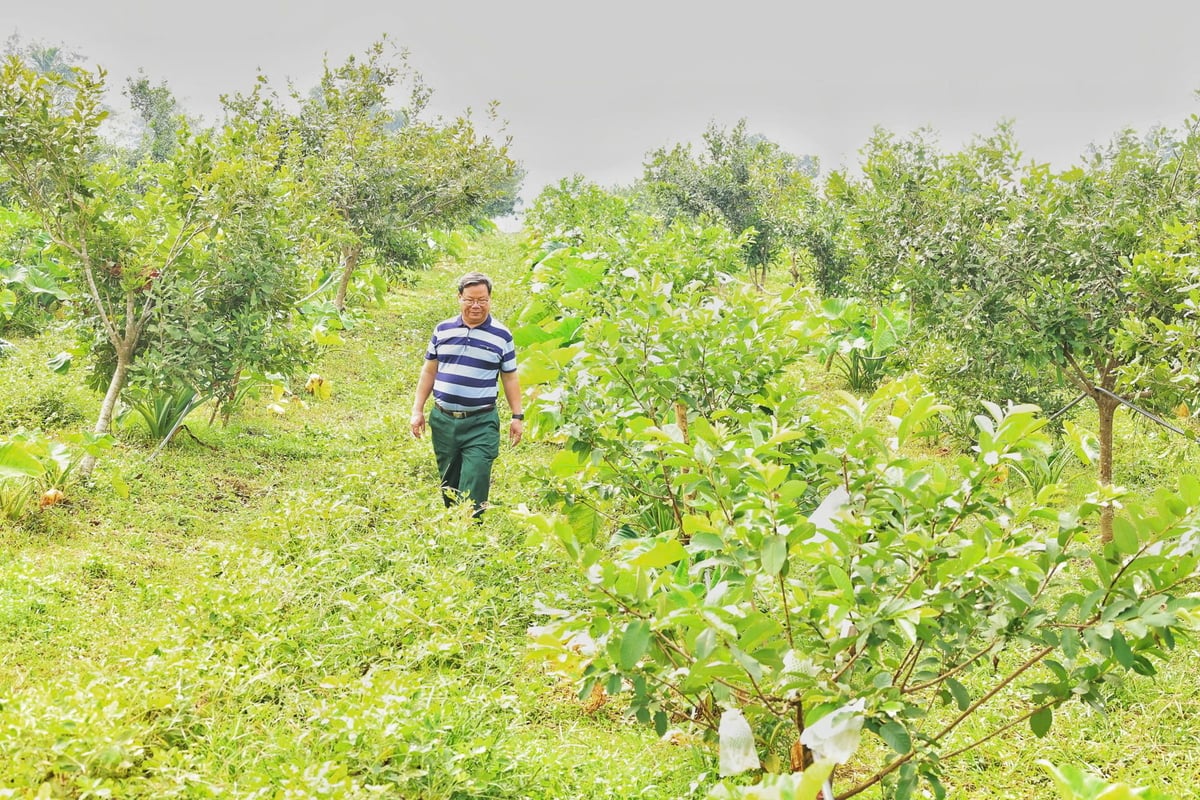
Between the rows of macadamia trees, he intercrops peanuts to retain soil moisture and guava trees to increase yield. Photo: Thanh Tam.
Having mastered the techniques, Mr. Ho collaborated with local households, expanding the planting area to 100 hectares. He was responsible for providing seedlings, technical support, and guaranteeing the purchase of fresh macadamia nuts from the farmers. According to his assessment, macadamia yields reach 2-2.5 tons/ha; the selling price of fresh nuts is approximately 23,000 VND/kg. Thus, each hectare generates an income of 40-50 million VND/year, much higher than planting acacia trees. Macadamia is also a long-term forestry tree with a long harvesting cycle, requiring little reinvestment; mainly just pruning and fertilizing when the trees flower and bear fruit.
From the process of planting and caring for the trees, Mr. Ho has accumulated experience: for newly planted trees, it is necessary to prune the suckers to allow the grafted buds to develop; annually, it is necessary to prune branches and reduce the canopy to prevent them from breaking or falling due to strong winds and storms. Instead of using inorganic fertilizers, he utilizes discarded fish, soaking and fermenting them for a year to make fertilizer that provides nitrogen to the trees.
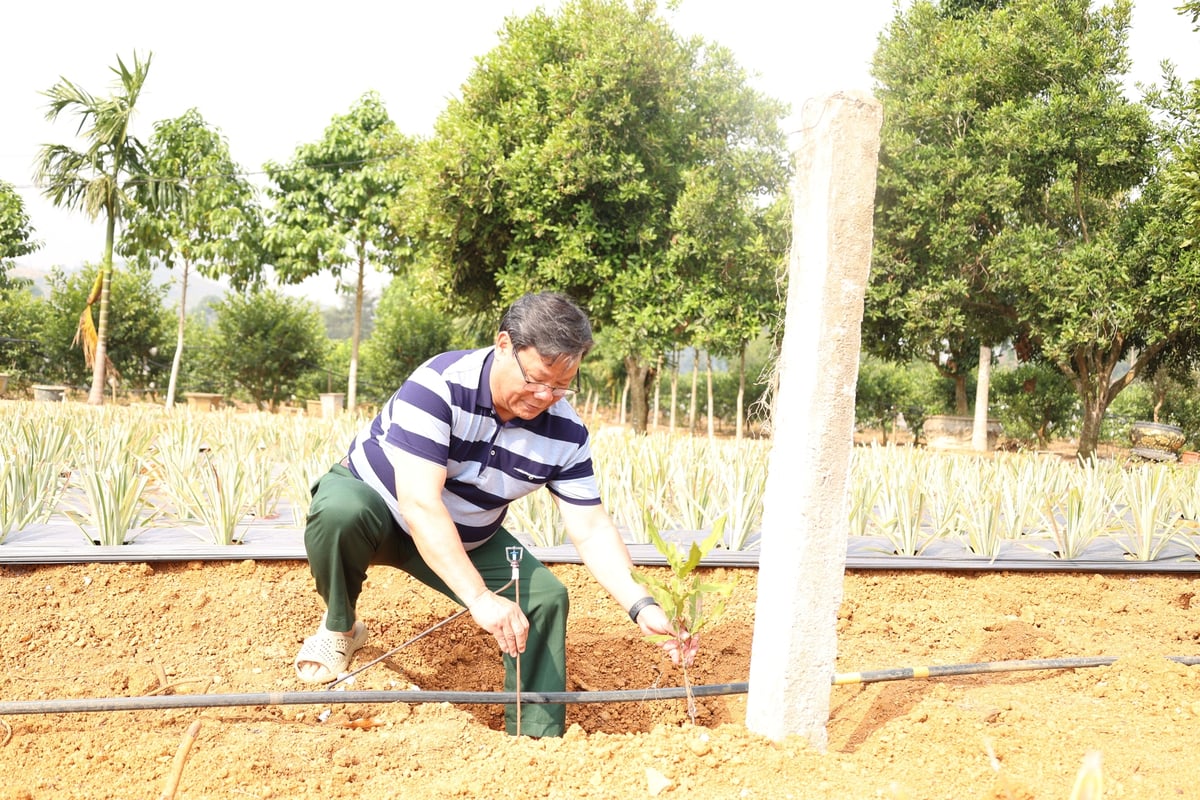
Mr. Ho used concrete pillars to secure the tree and protect it from strong winds and storms. Photo: Thanh Tam.


During the recent Typhoon No. 13, 600 of his macadamia trees, over a decade old, were blown down by the wind. Although regretful because these were his highest-yielding trees, he quickly cut them down and replaced them. Learning from this experience, he embedded concrete posts into each tree trunk to secure them, minimizing damage during storms.
Mr. Ho remains concerned and hopes to expand the cultivated area, connect more households, and make macadamia trees the main crop in the Thach Thanh hills, bringing high economic efficiency and truly becoming the "million-dollar tree" for farmers in Thanh Hoa province.
Source: https://nongnghiepmoitruong.vn/giac-mo-cay-trieu-do-บน-vung-doi-thach-thanh-d789193.html





























![The Essence of the Viet Bac Villages: [Part 3] The Precious Fragrance of Nghinh Tuong](https://vphoto.vietnam.vn/thumb/402x226/vietnam/resource/IMAGE/2026/05/29/1780020600366_5237-tinh-tuy-ban-lang-viet-bac-bai-3-chuyen-o-nghinh-tuong-050626_700.jpeg)
![The Quintessence of Northern Vietnam's Villages: [Part 2] The Famous Cassava Noodles of Kunming](https://vphoto.vietnam.vn/thumb/402x226/vietnam/resource/IMAGE/2026/05/28/1779937455892_3929-3144-mien-dong-15-nongnghiep-023138.jpeg)