


The global rise of industrial policy, driven by concerns about supply chain security and strategic competition, is raising a fundamental historical question: Why did Asian economic miracles, including Japan, South Korea, Taiwan, Singapore, and Hong Kong, thrive on industrialization in the latter half of the 20th century, while most other developing countries failed?
In a recent commentary on the East Asia Forum website (eastasiaforum.org), senior economists at the International Monetary Fund (IMF), Reda Cherif and Fuad Hasanov, offered a new perspective. They argued that the success of these economies stems from three common characteristics in their industrial policies, which have differentiated them from the rest of the developing world .
Three characteristics that make it different
The IMF economists point out that, unlike countries that failed in their import substitution industrialization strategies (which often only protected and subsidized closed domestic markets), the Asian "miracle" economies relied on the following three pillars:
First, export discipline and global competitiveness: Asian economies have forced domestic businesses to conform to the discipline of the global market instead of protecting themselves from it. They rely on "export discipline" to create sustainable and competitive industries.
Market signals from export markets are essential to forcing businesses to compete and innovate. Any government support comes with accountability, and failing businesses will eventually be restructured.
Conversely, most developing countries in Latin America, the Middle East, and South Asia have failed because they focused solely on protecting nascent industries and providing substantial subsidies to serve a closed domestic market. The lack of incentives to achieve economies of scale, build deep domestic value chains, and innovate has undermined their international competitiveness.
Secondly, developing capacity in complex industries: The sustained success of the aforementioned economies is a result of building capacity in complex or high-tech sectors such as electronics, automobiles, and machinery, rather than relying solely on natural resources or low-level industrial production. These sectors are crucial because they create powerful spillover effects throughout the economy, require highly skilled labor, stimulate learning through practice, and foster innovation.
The approach of leading Asian economies is to create domestic businesses that are at the forefront of advanced manufacturing, innovation, and technological development from an early stage, rather than relying solely on foreign direct investment (FDI) and hoping for technology transfer. Complex industries require a comprehensive policy package, not just market opening. Industry-specific policies such as coordinated investment in specialized skills, infrastructure, a suitable legal framework, export promotion, and strong investment in research and development (R&D) are crucial for business success.
Third, institutional structure: Appropriately tailored institutional structures are key. The success of Asia's "miracle" economies stems from a focus on a single governing body tasked with defining and implementing a complex array of policies. These bodies, modeled after Japan's Ministry of International Trade and Industry, share common characteristics that differentiate them from conventional policymaking bodies.
These organizations have ambitious goals targeting complex areas. Thanks to strong political backing and internal autonomy, they possess the capacity to pursue them. They rely on recruiting top talent and enforcing accountability, while adapting to changing technological and market conditions. These characteristics allow them to coordinate between government and industry, accumulate specialized knowledge, and deploy policy tools through continuous experimentation and market feedback to foster competitive industries.
Against a backdrop of rising protectionism, geopolitical fragmentation, and the current need for sustainable, inclusive growth, many countries are considering a revival of industrial policy. The current debate has equated industrial policy with "tough" tools such as tariffs, subsidies, and export bans, which often promote self-sufficiency or dominance in certain industries. But the experiences of Asia's "miracle" economies offer new perspectives on this debate.
Source: https://baotintuc.vn/phan-tichnhan-dinh/giai-ma-bi-mat-cua-nhung-phep-mau-kinh-te-chau-a-20251215151333492.htm
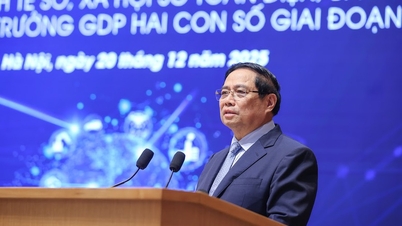
![[Photo] Prime Minister Pham Minh Chinh attends the Conference on the Implementation of Tasks for 2026 of the Industry and Trade Sector](/_next/image?url=https%3A%2F%2Fvphoto.vietnam.vn%2Fthumb%2F1200x675%2Fvietnam%2Fresource%2FIMAGE%2F2025%2F12%2F19%2F1766159500458_ndo_br_shared31-jpg.webp&w=3840&q=75)



























































































Comment (0)