

Innovating policy thinking to pave the way for educational development.
Mr. Pham Van Gieng, Vice Principal of the Secondary and High School of Pedagogy ( Hanoi University of Education 2), emphasized: Education is a special field because it is not only linked to the development of each individual, but also directly impacts the future of the entire nation.
Education is a field with a wide reach, affecting every family and social class; at the same time, it is influenced by many economic , cultural, and social factors. Therefore, in any socio-economic development strategy, education must always play a leading, constructive, and driving role.
The documents of the 14th National Congress of the Communist Party of Vietnam have set very high goals for education and training, especially in the context of the country aiming to become a developed nation by 2045 and with a 100-year vision. This requires us not only to improve in parts, but also to adopt a systemic and comprehensive approach.
According to Mr. Pham Van Gieng, it is necessary to continue reviewing institutional issues within the national education system to address remaining obstacles, rectify shortcomings, and further improve it in a modern, flexible, and integrated direction. This is considered a crucial foundation for developing high-quality human resources, contributing to enhancing the nation's competitiveness in the future.
This session of the National Assembly has received much attention from voters nationwide, and there are even higher expectations in the context of the country facing strong demands for reform. Keeping pace with the changing realities of the legal framework and policy mechanisms is extremely important. Mr. Pham Van Gieng hopes that the National Assembly, in its role as the legislative body, will make groundbreaking decisions, creating a transparent, stable, and long-term legal framework for the development of education.
To bring about significant changes in education and the teaching staff in the coming time, Mr. Pham Van Gieng - Vice Principal of the Teacher Training Secondary and High School, believes that the core issue is the need to change the approach in drafting laws and policies.
Specifically, there needs to be a strong shift from a managerial mindset to a constructive and development-promoting mindset. Previously, policy-making often focused on control rather than fully addressing institutional improvements within the legal documents themselves. This led to obstacles during implementation, requiring further guidance from subordinate legal documents, causing delays and reducing policy effectiveness.
In the current context, the law needs to play a pioneering role, unlocking resources and creating momentum for development, rather than merely regulating behavior.
In particular, a holistic approach to the education system is needed, based on three pillars: elite education, human resource training, and mass education. Each pillar has its own role and objectives, but they need to be designed as a unified whole, complementing each other, in order to both identify and nurture talent, raise the general level of education, and meet the human resource needs of the economy.
Another very important issue pointed out by Mr. Pham Van Gieng is ensuring equitable access to education across all regions, especially for remote, disadvantaged areas.
The gap in learning conditions, teacher quality, and facilities between regions remains quite large. Therefore, the National Assembly needs to pay more attention to developing priority policies and making targeted and sustainable investments to gradually narrow this gap, ensuring that all citizens have access to quality education.
For the teaching staff – the force that directly determines the quality of education – strong and timely policies are needed to ensure they can truly feel secure in their work and dedicate themselves to it.
In reality, many policies have been enacted with good intentions, but the implementation process has been slow, with a delay between formulation and execution causing the policies to lose their relevance and effectiveness. Therefore, in addition to enacting policies, special attention should be paid to the implementation mechanisms, shortening the process, and enhancing the flexibility and responsiveness of policies to the rapid changes in reality.
Furthermore, education needs to be viewed in close connection with science and technology, innovation, and digital transformation. The National Assembly needs to create the institutional conditions for educational institutions to be more proactive in innovating curricula, teaching methods, applying technology, and engaging in international cooperation. These are crucial factors in improving the quality of education and bringing Vietnamese education closer to international standards.
Dr. Vu Hai Anh - Deputy Head of the Law Department, Faculty of Law, Banking Academy, commented that the First Session of the 16th National Assembly - the first session of the new term - is of special importance in terms of politics, law, and practice, representing a transitional step with continuity and development of the State apparatus in the new period…
Dr. Vu Hai Anh expressed his hope that the session would give adequate attention to the field of higher education, not only from the perspective of state management, but also from the strategic level of developing high-quality human resources for the country in the context of digital transformation and deep international integration. Higher education today faces the need for strong reforms in terms of content, training methods, and operational mechanisms.
One of the things that the teaching staff hopes for is that the National Assembly will continue to improve the institutional framework for university autonomy in a substantive, comprehensive manner with accompanying guarantee mechanisms. Autonomy should not be limited to the right to make decisions about organization, finance, or academics, but needs to be placed within a transparent legal framework, with clear accountability and linked to independent quality accreditation.
Furthermore, the National Assembly is paying more attention to policies for developing the teaching staff – a key factor determining the quality of higher education. In practice, despite many sound policies, the remuneration, working conditions, and career development opportunities for lecturers still have certain limitations and are not truly commensurate with the increasing demands and pressures of the job.
Therefore, the State needs more groundbreaking policies regarding salaries, scientific research, international cooperation, as well as mechanisms to attract and retain talent in the field of education. For a higher education system to develop sustainably, it must first have a faculty with sufficient dedication, vision, and talent, and be provided with the necessary conditions to wholeheartedly contribute.
In the context of digital transformation, Dr. Vu Hai Anh expects the National Assembly to promote the development of a comprehensive legal framework for digital higher education, including online training, credit recognition, quality accreditation, and ensuring equity in access to education. This is not only an inevitable trend but also an opportunity for Vietnam to narrow the gap with advanced education systems around the world.
"However, without timely and systematic guidance from the policy level, this process could give rise to many problems regarding quality, management, and even social equity in education," said Dr. Vu Hai Anh.
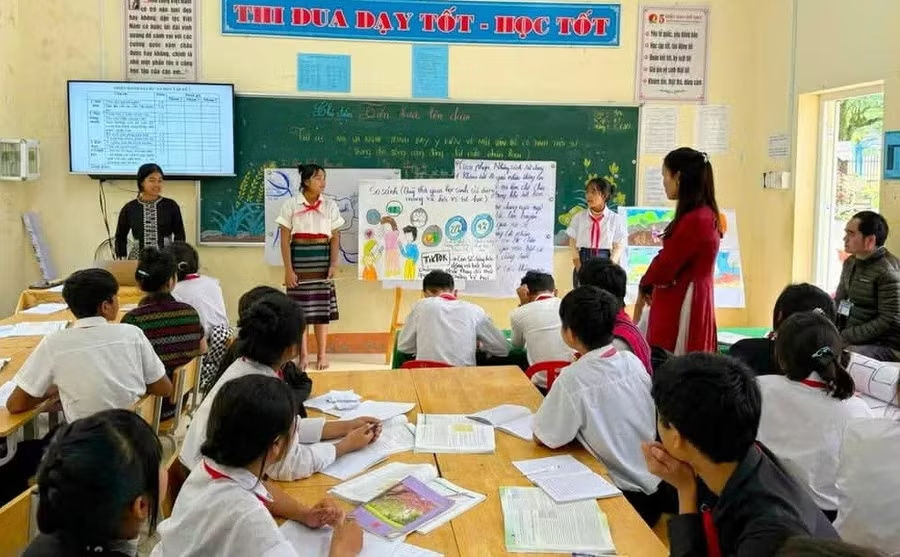
Developing education in the spirit of Resolution 71
At the First Session, voters expressed their desire for the 16th National Assembly to continue directing ministries and agencies to realize the objectives of Resolution 71.
Dr. Phan Thi Hang Hai - Principal of Kim Ngoc High School (Vinh Yen, Phu Tho), emphasized that the First Session of the 16th National Assembly is of special importance, not only in terms of organizational structure, but also in terms of strategic orientation for the entire 2026-2031 term…
In line with the spirit of Resolution 71 of the Politburo on breakthroughs in education and training development until 2030, with a vision to 2045, although the State strives to maintain 20% of the budget allocated to education, the majority is spent on recurrent expenditures (salaries, allowances), while the portion allocated to development investment and the purchase of technological equipment remains insufficient.
The issue of school network planning is also a bottleneck that needs to be addressed. In large cities like Hanoi or Ho Chi Minh City, land for education is hampered by the pressure of rapidly increasing population and a lack of long-term planning, leading to overcrowded schools and class sizes exceeding the standard.
“We expect the National Assembly to continue to concretize Resolution 71-NQ/TW with practical policies such as improving the quality of the teaching staff, promoting digital transformation, reforming examinations and admissions, and increasing autonomy for educational institutions. Most importantly, these policies must be put into practice and address current shortcomings,” Dr. Phan Thi Hang Hai expressed.
Ms. Dinh Thi Hong Van – a Chemistry teacher at Phan Dinh Phung High School, Ha Tinh province, and a representative of the 19th Provincial People's Council – expressed: At this session, voters in general and teachers in particular hope that the National Assembly will continue to innovate in its activities, improve efficiency, and better meet the requirements of development. Each National Assembly representative is expected to continue to train, improve their capacity and responsibility, and effectively implement the action program that has been set forth.
From a teacher's perspective, Ms. Van hopes that through the session, the National Assembly will make strong decisions to realize Resolution 71/NQ-TW. "In particular, the issue of student streaming after lower secondary school is of great concern to many teachers. In reality, implementation still faces some difficulties due to the uneven awareness of parents and the development conditions of vocational education in each locality," Ms. Van shared.
In addition, if given due attention, policies related to salaries, allowances, and professional title promotions will contribute to motivating teachers to work with peace of mind.
Beyond internal departmental policies, Ms. Dinh Thi Hong Van pays particular attention to social issues directly impacting students. School violence is becoming more complex, no longer isolated conflicts, but spreading and inciting through social media. Simultaneously, the uncontrolled access of teenagers to the internet poses numerous risks to their awareness and behavior.
Based on that experience, Ms. Van hopes that in the future, the National Assembly will have strong enough policies to control the online environment, while also strengthening coordination between schools, families, and society in educating and guiding students.
"The fact that the teaching staff are closely following the Session not only demonstrates civic responsibility, but also reflects their desire for educational policies to become increasingly practical, contributing to improving the quality of teaching and learning in the future," Ms. Hong Van expressed.
Mr. Nguyen Tuu, Principal of A Tuc High School (Quang Tri), said that Resolution 71 of the Politburo is opening up great expectations for education, especially in mountainous and border regions.
From prioritizing investment in infrastructure and building boarding schools for students in border areas to applying technology and perfecting the legal framework, many policies are considered to have created a fundamental shift in education.
According to Mr. Nguyen Tuu, these are important policies that contribute to promoting fundamental and comprehensive educational reform.
In particular, the Party and State's attention to the welfare of teachers and students in disadvantaged areas has created a sense of enthusiasm among the staff. Students receive financial support for their studies, and teachers receive additional allowances, helping to stabilize their lives and work with peace of mind.
Furthermore, perfecting the legal system, especially with the effective implementation of the Education Law, will create a clear legal framework for teaching and learning activities.
"With a legal framework in place, policies will be more synchronized, helping to make management and teaching more substantive and avoiding the scattered approach of the past," Mr. Tuu emphasized.
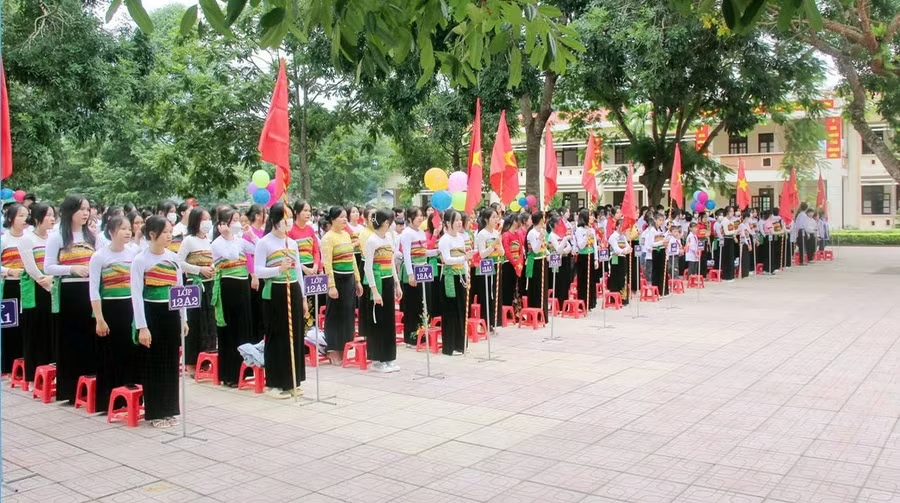
To make education truly a top national priority.
Teacher Nguyen Thi Van Hong - Principal of Chuong Duong Secondary School (Hong Ha, Hanoi), said that from the perspective of a teacher directly working in general education, she hopes that the new National Assembly and Government will pay more profound and substantive attention to the field of education and training, considering it a truly top national priority.
This includes continuing to improve the institutional framework related to the reform of general education, ensuring stability while maintaining flexibility and suitability to practical implementation at the grassroots level. There should be a comprehensive investment policy for teachers, not only in terms of income but also in terms of working environment, reducing administrative pressure, and creating conditions for teachers to focus on their expertise.
Promoting digital transformation and the application of artificial intelligence in education, coupled with retraining teachers to adapt, will help avoid a gap between policy and implementation capacity. Attention should also be paid to moral education, life skills, and students' mental health, issues that are increasingly prominent in the context of modern society.
"I expect the National Assembly's decisions to be thorough, highly feasible, and avoid situations where policies are sound but encounter many obstacles at the grassroots level during implementation," said educator Nguyen Thi Van Hong.
According to Ms. Van Hong, the planned increase in the basic salary from July 1, 2026, is certainly a positive sign, demonstrating the State's concern for the teaching staff. In the context of fluctuating market prices, this adjustment will contribute to improving living standards and provide additional motivation for teachers to work with peace of mind.
However, in reality, the increase in the basic salary, without accompanying support policies, has not truly created a breakthrough. Teachers currently still face many pressures due to inadequate income, a heavy workload, and the constant demands for innovation.
Therefore, Ms. Van Hong proposed establishing a special salary mechanism for teachers, in line with the spirit that "teachers are the key force in educational reform." This would reduce unnecessary paperwork, administrative requirements, and free up teachers' time to invest in their lessons and students.
Review regulations on tutoring and supplementary classes to ensure clarity and transparency, while effectively managing them and meeting the legitimate needs of learners. Strengthen support for the mental health of teachers and students, considering it an integral part of educational quality, not a secondary factor.
"Furthermore, the Government and the Ministry of Education and Training need policies to retain and attract talented teachers, especially in specialized subjects and disadvantaged areas. I believe that if these policies are given due attention and implemented synchronously, general education will see more positive and sustainable changes in the future," suggested Ms. Nguyen Thi Van Hong.
According to Dr. Vu Hai Anh, Deputy Head of the Law Department at the Faculty of Law, Banking Academy: The planned adjustment of teachers' salaries to the basic salary level from July 1, 2026, is a positive signal, demonstrating the Party and State's concern for the intellectual workforce in education.
Increasing salaries based on the base wage will contribute to improving the income of teachers, thereby creating more psychological motivation, strengthening confidence and commitment to the profession. This is also a step in line with the policy of reforming salary policies, aiming to ensure a decent standard of living for those working in the public sector, including education.
However, when placed in the context of constantly fluctuating and upward-trending market prices, this policy needs to be viewed comprehensively, acknowledging its significance while frankly assessing its limitations and practical impacts on the lives of the general public, and teachers in particular.
According to Dr. Vu Hai Anh, the current policy of increasing salaries based on the base salary does not fully reflect the differences in competence, work efficiency, and level of contribution of each individual in the education system.
In higher education—where there are high demands for scientific research, international publications, and innovative teaching methods—a salary mechanism that is not closely linked to output results will struggle to create healthy competition and encourage creativity. Therefore, adjusting only the base salary without deeper reforms to the salary mechanism based on job position and work performance will have limited positive impact.
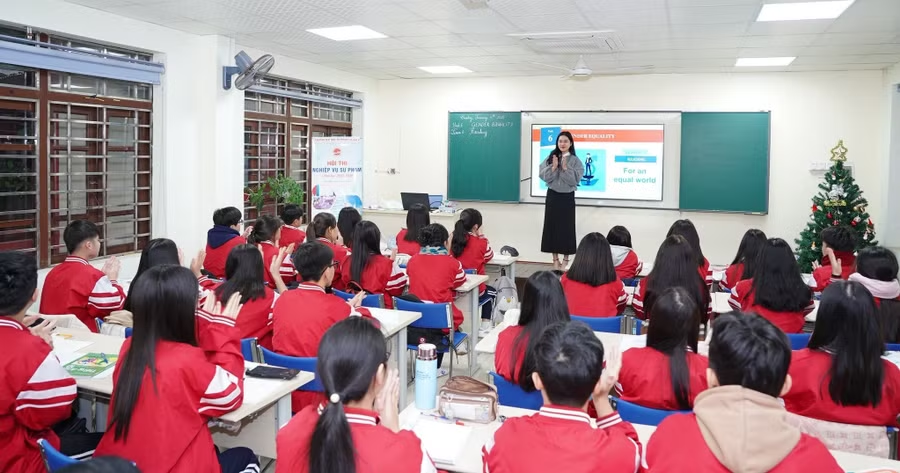
Making breakthroughs in education in disadvantaged areas.
From a practical perspective, Mr. Nguyen Dinh Sam – Principal of Huong Son Ethnic Boarding Primary and Secondary School (Huong Phung, Quang Tri), believes that in recent years, policies for education in disadvantaged areas have yielded positive results.
However, improving and enhancing the quality of education in mountainous areas and among ethnic minorities is a long-term process that requires policies that are sufficiently in-depth and more appropriate to the reality.
Mr. Sam expressed his hope that the State would continue to pay stronger attention to education in ethnic minority areas, while also improving preferential policies for school staff. In particular, he emphasized the need for more appropriate and effective investment policies to avoid waste.
When the Law on Teachers was enacted, teachers and staff nationwide, as well as school teachers, rejoiced. Many preferential policies for education received attention. However, currently, school staff such as librarians, accountants, school health workers, and office staff do not fully receive their professional allowances, despite their high-pressure work and low income.
Meanwhile, Mr. Nguyen Van Thong, Principal of Vinh O Ethnic Boarding Primary School (Ben Quan commune), argued that some current policies are not truly aligned with the working conditions of teachers in disadvantaged areas. In particular, after the administrative unit merger, there is a situation where teachers in extremely difficult areas receive benefits equivalent to those in more favorable areas, causing resentment among the teaching staff.
According to Mr. Thong, for the policy to be effective, there needs to be clear classification based on regional conditions, ensuring fairness and creating real motivation for teachers to stay in disadvantaged areas.
According to Ms. Ha Thi Thu, Principal of Ba Thuoc Secondary and High School (Thanh Hoa), the First Session of the 16th National Assembly is a time to look back on the fundamental and comprehensive reform of education in accordance with Resolution 29-NQ/TW of the Central Party Committee and to prepare for long-term progress in the context of digital transformation.
“I believe and expect that the new National Assembly delegates will continue to place education and training at the center of all development plans,” Ms. Thu expressed, affirming that this belief does not come from sentiment, but is based on practical decisions that the National Assembly has implemented in the past, such as: the Law on Teachers, Resolution No. 249/2025/QH15 on approving the investment policy for the National Target Program on modernization and improvement of the quality of education and training in the period 2026 – 2035; Resolution on some specific and outstanding mechanisms and policies to achieve breakthroughs in the development of education and training…
However, faced with the challenges of the new era, Ms. Thu expects even more groundbreaking mechanisms, especially the removal of the "bottleneck" in investment resources for educationally disadvantaged areas.
In the overall picture of the education sector, Mr. Chu Van Vu - Principal of Sung Tra Ethnic Boarding Primary School (Sung Mang commune, Tuyen Quang province), believes that the land border region is one of the areas that suffers many disadvantages but holds a particularly crucial strategic position.
The policy of building and expanding the system of multi-level ethnic boarding schools in border communes is not simply a matter of infrastructure, but a development strategy for education in the frontier regions of the country.
According to Mr. Chu Van Vu, in border areas, the distance from home to school is sometimes measured in a whole day's journey through the forest. Without boarding school models, the dream of literacy for ethnic minority students would remain unfulfilled amidst the farming seasons. Boarding schools are essentially a "second home," where children are cared for in every aspect, from meals and sleep to life skills.
Here, students not only acquire cultural knowledge but are also educated about border sovereignty awareness from a young age. "When students receive proper training and possess knowledge, they will become 'living landmarks' affirming territorial sovereignty," Mr. Chu Van Vu observed.
Despite numerous preferential policies, Ms. Tang Thi Ngoc Mai – a member of the 14th National Assembly – frankly acknowledges that education in border areas still faces unique challenges. She hopes that the 16th National Assembly will focus on discussing and finding solutions to three core issues:
Firstly, school network planning must be closely linked to security. The construction of boarding schools in border areas needs to be placed within the overall socio-economic development and national defense and security plan. The National Assembly needs to have separate resolutions to prioritize land allocation and medium-term public investment capital for school projects in particularly difficult border communes. Each school built should not only be an educational institution but also a cultural highlight, affirming the presence and strength of the political system.
Secondly, there needs to be a policy breakthrough for teachers in particularly disadvantaged areas. We cannot demand dedication without commensurate compensation. Here, teachers face the pressure of "three together" (eating together, living together, working together) with students and local people, but the allowance system is sometimes insufficient to ensure their long-term commitment.
Ms. Mai hopes that the National Assembly will consider and enact specific policies on salaries, incentive allowances, and especially public housing for teachers in border areas. When teachers are no longer burdened by worries about making ends meet, they will be able to devote all their efforts to their students.
Thirdly, digital transformation of education in disadvantaged areas. The digital divide is widening the educational gap between urban and mountainous regions. It is expected that the National Assembly will make strong decisions regarding telecommunications infrastructure and learning equipment for students in border areas.
"Education cannot change overnight, but the right decisions from the National Assembly can create historical turning points. We hope to see the 16th National Assembly act decisively for equity in education," Ms. Mai expressed.
“To create substantial and sustainable changes in education in the coming period, strategic decisions from the National Assembly are essential, especially in perfecting institutions, innovating policy-making thinking, and ensuring feasibility. When institutions are streamlined, resources are unleashed, and teachers are given better opportunities, education will truly become a crucial driving force for the rapid and sustainable development of the country,” Mr. Pham Van Gieng expressed.
Source: https://giaoducthoidai.vn/giao-duc-can-chinh-sach-di-vao-thuc-tien-post773340.html

![[Image] Hanoi's urban life under the challenge of a "scorching hot" environment](https://vphoto.vietnam.vn/thumb/1200x675/vietnam/resource/IMAGE/2026/05/25/1779706979265_nang-nong-t5-2026-minh-duy-7-4636-jpg.webp)

![[Image] Close-up view of the interchange connecting the two expressways and Long Thanh Airport.](https://vphoto.vietnam.vn/thumb/1200x675/vietnam/resource/IMAGE/2026/05/25/1779703378210_ndo_br_z7863716673926-224453a31600126cce10622af6290afd-4549-jpg.webp)








































































Comment (0)