

In that place, literacy is preserved through the persistent efforts of teachers, through shared school meals, and through policies that are becoming a pillar of support for students and teachers in disadvantaged areas.
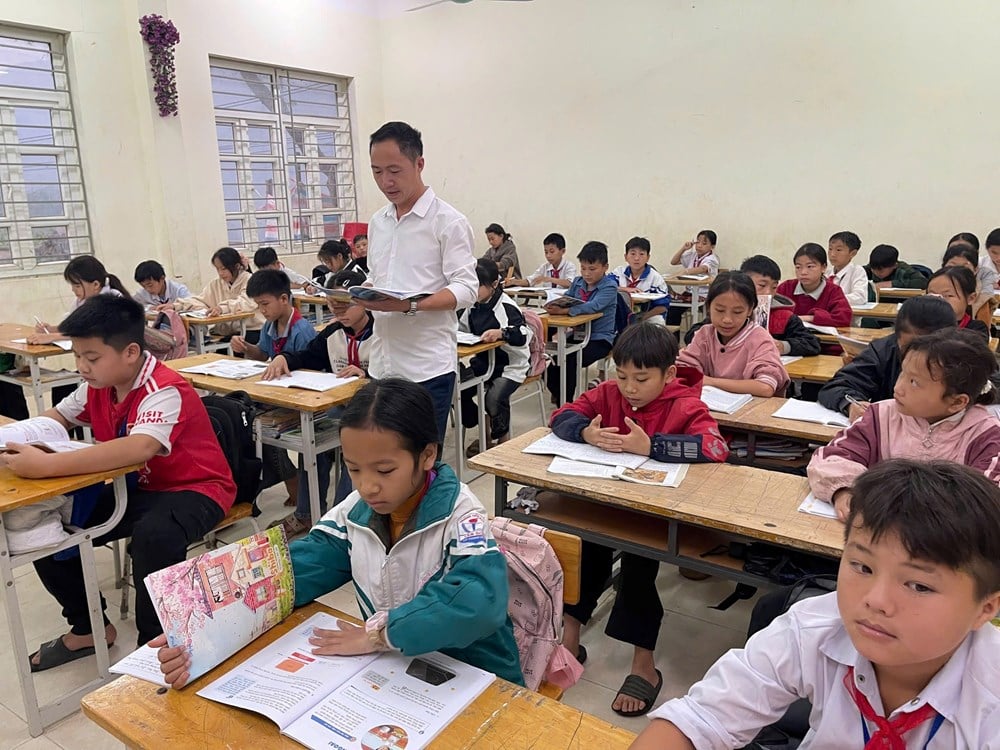
Those footsteps keep the game going.
Nearly two decades have passed, but the memories of those difficult times remain vivid in the minds of those who once ventured up to the border communes of Trung Lý, Nhi Sơn, and Mường Lý in the former Mường Lát district. Back then, the only road through the mountains was shrouded in mist year-round.
Along the slopes are makeshift huts made of bamboo and tarpaulin, where students from distant villages stay to attend school. Evening falls quickly in the highlands. Through the thick fog, the light from the wood-burning stoves emanates from the thin bamboo walls, enough to reveal that inside, children are still clinging to their dream of learning to read and write.
After school, the children cook their own meals, carry water, and light fires. Some only go home once a month. Independent living begins early, because pursuing education also means leaving home at a very young age.
Teacher Doan Van Son, former principal of Trung Ly Semi-Boarding Ethnic Minority Junior High School and now principal of Quang Chieu Junior High School, recalled: "Back then, very few Hmong students came to class, and female students were almost non-existent. To get students, teachers had to walk into each village to persuade them, while many families still thought that education alone wouldn't be enough to feed them."
Poverty meant that education took a backseat to farming and meals. The boarding school policy at the time was inadequate and fragmented, and students had to largely fend for themselves in terms of food and accommodation. Among the students whom teachers had encouraged to return to class was Thào A Pua, a Hmong boy from Pa Búa village, intelligent and eager to learn, but he was kept at home because he was the eldest child in a large family.
It took much persuasion, involving everyone from teachers to the village chief, before the family finally agreed to let Pua go to school. On his return to class, Pua still carried a sack of rice on his back, but this time it was to stay and pursue his dream of becoming a teacher.
Also in Trung Ly that year, there was Sung A Chai, a 12-year-old student who was forced to leave school by his parents to marry according to the custom of child marriage. Missing his school and his friends, A Chai decided to leave home and return to class. That determination, along with the encouragement of his teachers and villagers, helped him to continue his education.
Along with A Pua and A Chai, many other students quietly "nurtured their education" in makeshift tents around the school. At the beginning of the month, they carried rice down to class. At the end of the month, when the rice ran low, they shared it among themselves for each meal. The teachers contributed whatever they could, just to ensure the students didn't drop out. "Keeping a child in class at that time wasn't simply a responsibility. It was a long and arduous journey," said Mr. Son.
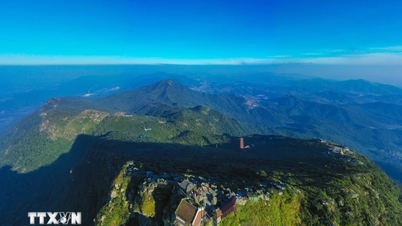
On the summit of Cao Son mountain in Co Lung commune today, the story of keeping students alive was once just as arduous. Nearly 20 years ago, the area between the Pha Chien, Pong Muu, and Pong Pa Co mountain ranges had no electricity, no telephone signal, and no roads; the classrooms were just a few thatched huts with bamboo walls and earthen floors.
In 2007, a unique "construction site" began in the heart of the mountains. Without machinery, the teachers and young people in the village carried stones up the mountains, and the women carried sand from the streams up the slopes. Even after the school was built, the teachers still had to go from house to house after the harvest season, after Tet (Lunar New Year), and after floods to encourage students to return to class.
When policy becomes the "pillar of support"
Today, many schools in the mountainous regions of Thanh Hoa province have changed. The dirt roads of the past have been paved, and sturdy school buildings are gradually replacing the thatched-roof classrooms in the mountains. Even so, the journey to keep students in school remains challenging. In the highlands, sometimes everything starts with a simple school lunch.
At Thanh Xuan Primary School in Phu Xuan commune, there was a period when the school's canteen had to temporarily suspend operations. The teachers' biggest worry was the dwindling number of students. They then went around soliciting donations for meals, with some contributing rice, others food, and parents adding a little extra money to ensure the mid-morning meal was provided. "Without the school meal, many children would drop out because the journey is too long," shared Mr. Dang Xuan Vien, the school principal.
It's not just students; many teachers in mountainous regions have also struggled with declining incomes. Some travel three bus journeys a week to visit their families, while others have considered transferring due to the pressures of life. But the majority choose to stay, supplementing their income by growing vegetables, working extra shifts on weekends, and accepting long periods away from home to reduce travel costs. This perseverance has kept the classrooms in these remote areas from collapsing.
Based on this practical experience, many new policies have been adjusted to better suit the lives of ethnic minorities. Decree 66/2025/ND-CP stipulates policies to support boarding students with money for meals, accommodation, and rice, while also supplementing mechanisms to support boarding activities in schools. Resolution No. 71-NQ/TW of the Politburo on breakthroughs in education and training development also opens up more hope for ethnic minority areas and remote regions.
What is truly remarkable is that a new generation of teachers is returning from those remote villages. Sung A Chai is now a teacher in his hometown. Thao A Pua also stands on the podium. "Looking at my students, I see myself from the past," A Pua confided. That simple statement evokes a long journey of poor children who once struggled to learn to read and write, then grew up, returned, and continued to light up dreams in their villages.
From classrooms nestled in the mountains, education in the highlands of Thanh Hoa province is entering a new phase. Today, literacy has the added support of new policies, modern schools, heartwarming school meals, and the aspirations for a better life of students who grew up amidst hardship.
Source: https://baovanhoa.vn/doi-song/gieo-chu-noi-may-phu-229030.html



































































Comment (0)