

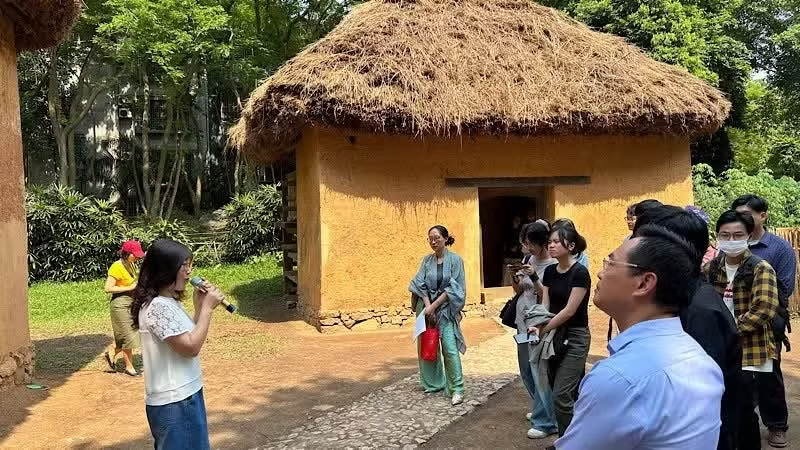
Faced with scarce natural resources and a dwindling number of skilled craftsmen, many traditional houses of ethnic minorities in our country have lost their original form… In this context, the preservation of folk architecture is adapting flexibly, both preserving community knowledge and passing it on between generations, while promoting the application of digital technology to preserve heritage values.
Recently, at the Vietnam Museum of Ethnology, five Ha Nhi artisans from Y Ty commune, Lao Cai province, completed the restoration and repair of a traditional house built more than 20 years ago. This original structure was built by the hands of previous generations of Ha Nhi artisans. Like many houses within the museum grounds, the restoration and repair were carried out with strict requirements regarding structure, materials, and construction techniques, aiming to preserve the traditional aesthetic value and durability over time.
Dr. Vi Van An, former Head of Research at the Vietnam Museum of Ethnology, who directly surveyed and worked with the Ha Nhi people since 1998 to build the Ha Nhi house at the museum, said: In 2004, museum staff, in coordination with the local community, went to Hoa Binh to select suitable clay to ensure the quality of the materials. More than 20 craftsmen participated in building the house, using about 150 cubic meters of earth, 14 cubic meters of stone, along with fresh bamboo, boulders, and about 1,800 bundles of thatch grass to complete the 81m² house with 45cm thick walls.
The traditional square-shaped house, with its thatched roof, built using clay mixed with soft stone, fresh bamboo, and rough stones, is the culmination of indigenous knowledge accumulated over generations. Currently, due to urbanization, almost no original traditional houses remain in Y Tý commune. Many houses only retain the traditional rammed earth technique but have been roofed with corrugated iron or fiber cement. The shortage of local materials has been evident for many years and is becoming increasingly apparent. Therefore, the houses of the Ha Nhi people in Hanoi are not only works of folk architecture but also places where knowledge converges, reflecting the cultural life of an ethnic group.
From the actual restoration of the Ha Nhi houses at the Museum, it can be seen that conservation efforts rely heavily on the role of the community. Most of the structures within the museum grounds were built by experienced artisans. After more than 20 years, many of the artisans who participated in building the houses are no longer alive. Today, the younger generation has inherited the traditional techniques and returned to restore the houses built by their ancestors. This restoration project includes the participation of young craftsmen such as Ly Xe Xa (born in 1990).
To ensure authenticity, the Vietnam Museum of Ethnology uses local or similar materials, maintaining regular contact with the community, especially the descendants of artisans. Each time repairs are carried out, the museum invites two generations of craftsmen to participate, with the older generation playing a leading role, guiding the younger generation in practice and skill acquisition.
Furthermore, as the search for clay, wood, bamboo, and thatch grass becomes increasingly difficult, proactive conservation efforts are being made to select appropriate solutions to preserve the essence of the heritage. To ensure authenticity, the Vietnam Museum of Ethnology uses local or similar materials, maintaining regular contact with the community, especially the descendants of the artisans. Each time repairs are carried out, the museum invites two generations of craftsmen to participate, with the older generation playing a leading role, guiding the younger generation in practice and skill acquisition. This continuity helps to preserve the knowledge of thatch roofing and plastering earthen walls.
Not only the Ha Nhi houses, but also the communal houses of the Ba Na people, and in the near future, the houses of the Tay people, have seen the participation of two generations of craftsmen in restoration and repair work to ensure the continuity of traditional craft knowledge. Along with on-site preservation and transmission through generations, digital transformation is being implemented in heritage preservation activities.
Each architectural structure at the museum has its own scientific record linked to digital data for research and exhibition purposes. Over the years, the museum has built a database of artifacts, implemented 3D exhibitions, and applied hologram technology. In the future, the entire exhibition space will continue to be digitized, aiming to create a virtual museum to serve research and showcase heritage.
Mr. Le Hai Dang, Director of the Vietnam Museum of Ethnology, said: "Each architectural structure at the museum has its own scientific record linked to digital data for research and exhibition. Over the years, the museum has built a database of artifacts, implemented 3D exhibitions, and applied hologram technology. In the future, the entire exhibition space will continue to be digitized, aiming to create a virtual museum to serve research and introduce heritage."
When separated from their native ecological environment and placed in a new context, traditional houses become unique cultural institutions, both preserving memories and serving as spaces for practicing and showcasing culture. Educational activities, exhibitions, and folk performances create opportunities for the public to directly access and experience vibrant community life.
The process of researching and deciphering folk knowledge in each layer of materials and roof structure will continue to clarify the value and diversity of the cultures of Vietnam's ethnic groups. The combination of scientific knowledge and practical experience of cultural subjects is contributing to shaping preservation methods with community participation, thereby enhancing the effectiveness of preserving traditional architecture. In addition, the application of digital technology is promoting expanded access and promotion of values, creating conditions for heritage to be sustainably present in contemporary life.
Source: https://nhandan.vn/giu-goc-noi-nghe-trong-nhip-song-so-post959854.html
![[Image] Hanoi's urban life under the challenge of a "scorching hot" environment](https://vphoto.vietnam.vn/thumb/1200x675/vietnam/resource/IMAGE/2026/05/25/1779706979265_nang-nong-t5-2026-minh-duy-7-4636-jpg.webp)

![[Image] Close-up view of the interchange connecting the two expressways and Long Thanh Airport.](https://vphoto.vietnam.vn/thumb/1200x675/vietnam/resource/IMAGE/2026/05/25/1779703378210_ndo_br_z7863716673926-224453a31600126cce10622af6290afd-4549-jpg.webp)










































































Comment (0)