

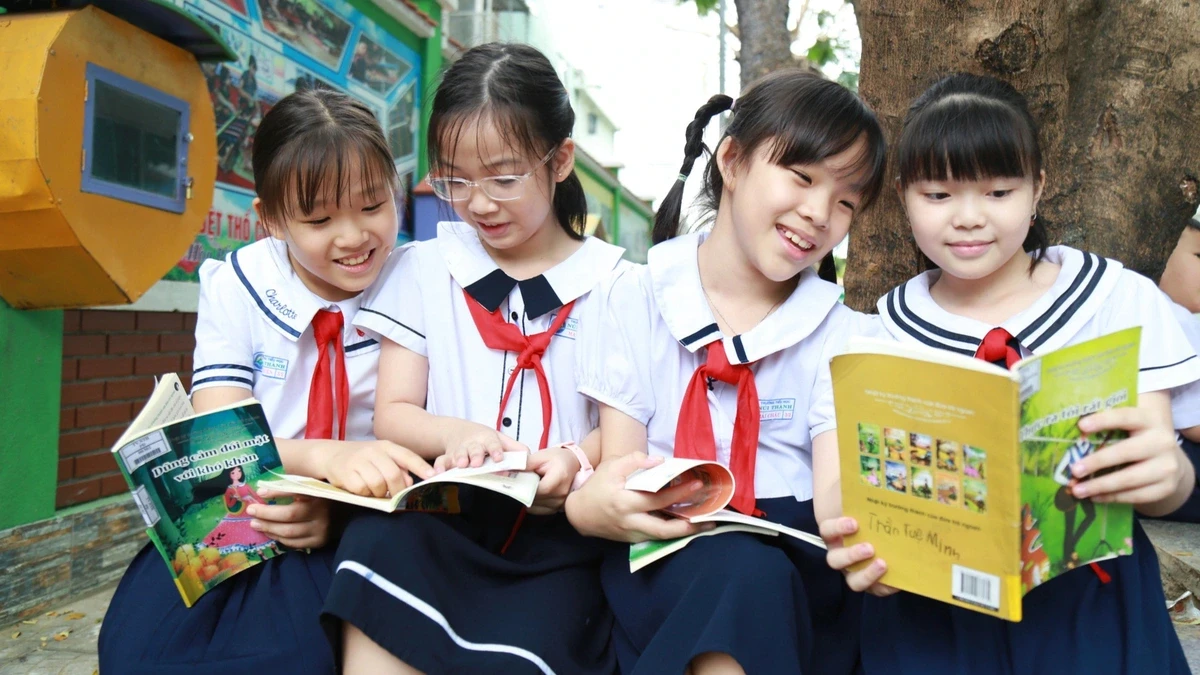
That spirit, exemplified by two great figures, Phan Châu Trinh and Huỳnh Thúc Kháng, still retains its inspiring value today.
Enlightenment
The biggest common ground between the two men was their shared understanding: to change society, one must first change people; to change people, one must begin with knowledge. And the shortest path to spreading knowledge is through reading and publishing.
For Phan Châu Trinh, "enlightening the people" was not merely a slogan promoting education. It was a strategy for social reform. He clearly saw the limitations of the old education system – where reading was confined to classical texts, serving examination purposes and reinforcing the old order. Therefore, he advocated bringing new knowledge, especially democratic, legalistic, and Western scientific ideas, to the broad masses through the Vietnamese Quốc ngữ script. Here, reading was no longer the privilege of a particular class, but became a right to access knowledge for the entire society.
If Phan Châu Trinh shaped the ideology, then Huỳnh Thúc Kháng was the one who realized that ideology through concrete actions. The founding and maintenance of the newspaper Tiếng Dân (Voice of the People) for many years was not merely a journalistic activity, but essentially a large-scale social education program. Through journalism, knowledge was disseminated, social issues were analyzed, and people gradually developed a habit of reading, thinking, and critically analyzing. In that context, reading was not a refined pleasure, but an act of enlightenment – a way for people to liberate themselves from backwardness and dependence.
A distinctive aspect of their thinking was that it went beyond encouraging individual reading, aiming to build a reading society. The Modernization Movement was not just about economic or educational reforms, but also about building a culture. Opening schools, organizing lectures, and establishing reading clubs were the first steps in forming a learning community. From this perspective, journalism and publishing were seen as an "open school," where all citizens could access knowledge without being limited by space or time. This was a very modern way of thinking: learning didn't just take place in schools, but spread throughout society.
It can be said that, from a very early stage, our ancestors laid the first bricks for the idea of a "learning society" - a concept that we are still continuing to refine today.
Suggestions for building a reading culture today.
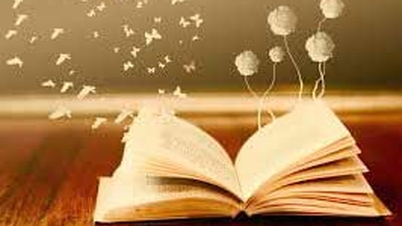
Entering the 21st century, visual culture, with its advantages of intuitiveness and speed, is gradually overshadowing traditional reading culture. The habit of reading at length and in depth – which is the foundation of critical and creative thinking – is showing signs of decline, especially among young people.
This raises a thought-provoking question: if Phan Châu Trinh and Huỳnh Thúc Kháng lived in today's era, what would they do to continue their mission of enlightening the people? Perhaps the answer lies not in reminiscing about the past, but in how we inherit their spirit in a completely new context.
The spirit of these two elders suggests at least three important approaches for us.
First, we need to restore the social significance of reading. Reading is not just about accumulating information or serving personal needs, but also about understanding society, understanding people, and developing civic responsibility. When reading is connected to the big questions facing society, it truly becomes an intrinsic need.
Secondly, higher education institutions need to play a leading role in building a reading culture. Beyond simply providing textbooks, universities must create an academic environment that encourages reading, discussion, and critical thinking. Faculty members should not only be transmitters of knowledge but also role models of self-learning and a reading culture.
Third, a harmonious blend of tradition and technology is necessary. Printed books still have their own value, but the increasing role of e-books, digital libraries, and open learning platforms cannot be denied. The issue is not about choosing between "reading paper" or "reading digitally," but about building a diverse reading ecosystem that suits the habits and needs of different groups of people.
More than a century has passed since the time of Phan Châu Trinh and Huỳnh Thúc Kháng, but the question they posed remains highly relevant: How can we raise the intellectual level of the people and build a progressive society? Throughout this journey, reading culture has always held a fundamental position. From the pages of books at the beginning of the 20th century to the digital space of the 21st century, the means may change, but the core remains the aspiration to access knowledge and improve oneself.
Preserving and developing a reading culture today is therefore not only a cultural activity, but also a strategic choice for the future. And in that choice, the enlightened spirit of our ancestors remains a lasting source of inspiration, illuminating our path towards a truly sustainable learning society.
Source: https://baodanang.vn/giu-lua-van-hoa-doc-tu-tinh-than-tien-nhan-3335982.html

![[Photo] General Secretary and President To Lam works with the Party Committee of the Ministry of Health on the work of Vietnamese traditional medicine.](https://vphoto.vietnam.vn/thumb/1200x675/vietnam/resource/IMAGE/2026/05/20/1779294323718_a1-bnd-2978-3319-jpg.webp)
![[Photo] National Assembly Chairman Tran Thanh Man working with the Standing Committee of the National Assembly's Delegation Affairs Committee.](https://vphoto.vietnam.vn/thumb/1200x675/vietnam/resource/IMAGE/2026/05/20/1779294340023_ndo_br_1-1691-jpg.webp)
![[Image] "Journey of Hope" promotes the organ and tissue donation movement in Vietnam.](https://vphoto.vietnam.vn/thumb/1200x675/vietnam/resource/IMAGE/2026/05/20/1779294400833_1-8910-jpg.webp)
























































Comment (0)