

1. The Government issued Resolution No. 105/NQ-CP to implement Conclusion No. 210-KL/TW on continuing to build and improve the organizational structure of the political system in the coming period. A particularly noteworthy detail is that the Government assigned the Ministry of Interior to lead and coordinate with relevant agencies in perfecting legal regulations, guidelines, and monitoring the arrangement of villages and residential areas in communes and wards, as well as non-professional personnel working in villages and residential areas, to meet the requirements of the new situation. This is not a single technical action, but part of a larger national restructuring process, linked to streamlining the apparatus, implementing a two-tiered local government model, and reorganizing the administrative space from the central to the grassroots level. Conclusion No. 210-KL/TW also shows that the scale of this reform is very broad, emphasizing the sharp reduction of administrative units at the provincial and commune levels, and for the first time since 1945, the district level will not be organized.
From a national governance perspective, this policy is necessary. For the administrative apparatus to be efficient, effective, and effective, it cannot continue to be fragmented, overlapping, and disorganized, especially in areas where population size, land area, infrastructure conditions, and management requirements have changed significantly compared to the past. Therefore, reorganizing villages and neighborhoods is a natural part of the process of improving the organizational structure. However, if we only view villages and neighborhoods as "administrative cells" that need to be consolidated, we will inadvertently overlook a much more important layer: the cultural depth of the community.
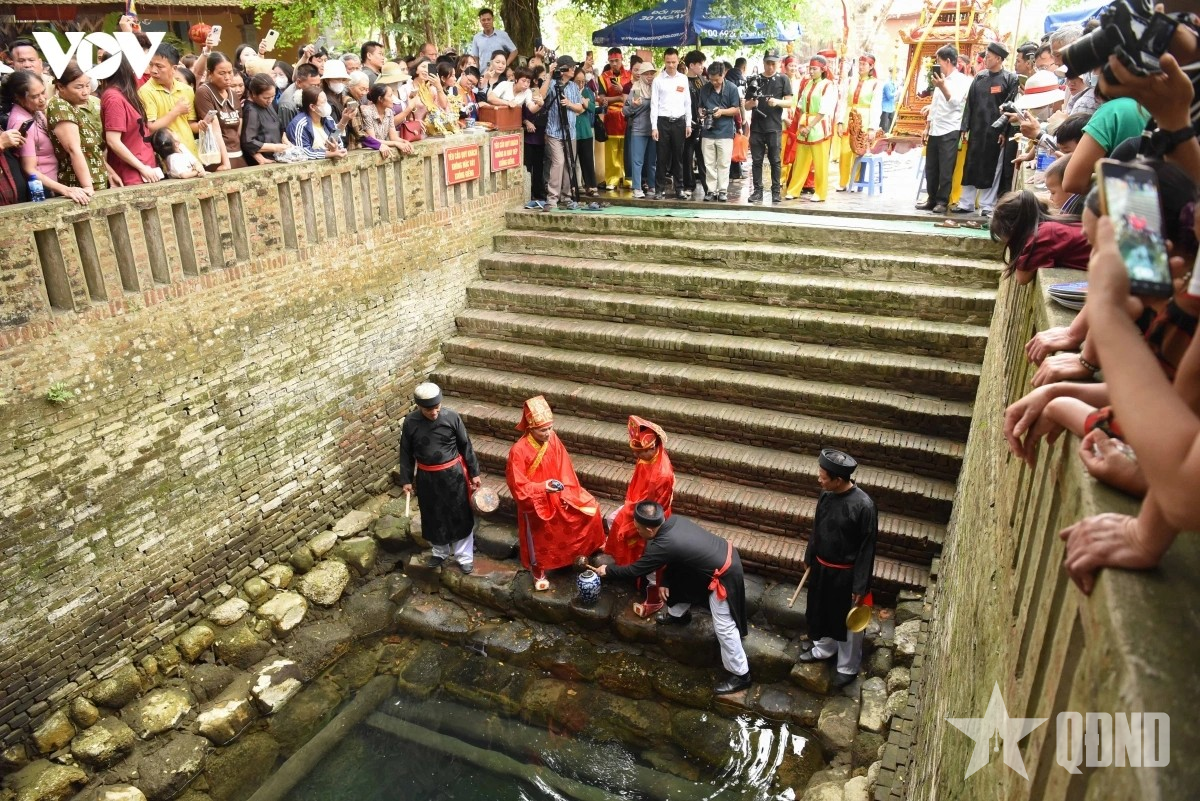 |
| The ritual of fetching water at the Queen Mother Ancestor Quan Ho Festival (Diem Village Festival), Bac Ninh province. Photo: VAN GIANG |
In Vietnam, a village is not just a residential unit. It is a cultural structure. Legal and administrative studies have shown that small communities such as villages, hamlets, and settlements in rural Vietnam are the product of the accumulation and cohesion of communities over decades, centuries, and even millennia. In other words, behind a village name often lies not just a geographical location, but also the history of its founding, the community's genealogy, temples and shrines, festivals, village regulations, traditional crafts, kinship ties, memories of resistance, memories of livelihood, and even how people identify themselves within a larger social space.
Therefore, it is important to emphasize that merging villages and residential areas may be a requirement of governance, but it must not lead to the "erase" of cultural identity at the grassroots level. The reality in Vietnam shows that despite previous changes in boundaries, names, divisions, or mergers, many villages have retained their cultural traditions and familiar names in community life, even though they may have been officially renamed villages, hamlets, or residential areas. This demonstrates that administrative reform and the preservation of cultural identity are not mutually exclusive, if we approach it with sufficient subtlety and respect for the community.
The key here is to distinguish between "administrative units" and "cultural spaces." A new village may be formed after a merger for easier management, but within that village, it is possible and necessary to continue to acknowledge the old cultural sub-spaces: old villages, old hamlets, old neighborhoods, old craft guilds, old traditional residential clusters. If modern governance can manage using digital data, identification codes, and digital maps, then there is even less reason to simplify cultural life to the point of erasing names deeply ingrained in the memories of generations. In other words, what needs streamlining is the administrative structure, not impoverishing the symbolic heritage of the community.
2. The most important lesson here is the story of naming. The names after mergers are not just for convenience in administrative management, civil transactions, or database updates. Names are also symbols of identity. A correct name can preserve the historical memory; a superficial name can create a feeling of rootlessness and alienation even within one's own homeland. Current law clearly defines the establishment, dissolution, merger, division, naming, and renaming of villages and residential areas as matters under the authority of local governments and are advised and managed by the internal affairs agency. This means that local authorities have full responsibility and also the leeway to choose a careful naming method that considers cultural depth, instead of mechanically numbering or rigidly combining names.
In my opinion, the naming of merged places should adhere to at least four principles. First, it must be clear, easily recognizable, and convenient for management and daily life. Second, it must respect the history of the community's formation, avoiding disruption to place names with deep cultural significance. Third, it must be consistent with local identity, reflecting the most representative elements of the region, such as traditional crafts, historical relics, historical figures, ancient place names, or a cultural symbol recognized by the community. Fourth, it must be based on genuine community participation, because the name is something the community will use daily, pass down to future generations, mention in family genealogies, commemorative texts, and festivals, not just appear on an administrative seal.
This is especially important in localities with a high density of village heritage sites, such as Hanoi, Bac Ninh, Hung Yen, Ninh Binh, and many areas of the Northern Delta. In these places, the village is not just a place to live, but also a natural "cultural brand." A village name can evoke an entire ecosystem of values: crafts, food, festivals, folk songs, architecture, customs, and collective memory. In the context of developing cultural industries, cultural tourism, and creative design, village names are often invaluable intangible assets. When mentioning a craft village, a Quan Ho village, an ancient village, a village of scholars, or a village associated with a historical figure, we are not just referring to a geographical location, but to a story that can be developed into a cultural product, a tourist route, a heritage education program, or a creative local identity.
 |
| Leaders of the Ministry of Culture, Sports and Tourism present the Decision to officially recognize the Thanh Tri rice roll making craft to leaders and artisans of Vinh Hung ward, Hanoi. Photo: VIET HUNG |
For Hanoi, this requirement must be emphasized even more strongly. Hanoi is not only the administrative capital but also the cultural capital, where each ancient village, each traditional craft village, and each traditional residential area contributes to the cultural structure of a unique urban center. Preserving the names and symbolic structures of famous villages is crucial for preserving valuable resources for future strategies in cultural industry development, cultural tourism, and local branding. A village like To Village, or many other craft villages, ancient villages, and villages with famous festivals, if completely dissolved under a vague new administrative name, will suffer not only from negative community sentiment but also long-term damage to the entire development strategy.
Here, we need to broaden our perspective on the spirit of Resolution No. 80-NQ/TW on the development of Vietnamese culture. The resolution emphasizes that culture is a crucial endogenous resource; cultural values need to permeate all aspects of social life; and the building and development of culture must truly become a solid foundation, an endogenous strength, and a regulating system for the rapid and sustainable development of the country. If this is the case, then the reorganization of villages and residential areas cannot simply be a matter of the administrative apparatus, but must be a matter of cultural development. We cannot use the pretext of streamlining to further impoverish the symbolic resources at the grassroots level. On the contrary, this reorganization process should be seen as an opportunity to re-identify, digitize, better preserve, and more strongly promote the values of villages and communities in the new context.
3. From a policy perspective, I believe that, along with perfecting legal regulations and guidelines for reorganization, several crucial but flexible requirements should be added. Each village and neighborhood reorganization plan should include a cultural impact assessment; historical factors, heritage, beliefs, festivals, traditional crafts, and community structures should be reviewed before deciding on a plan. Local authorities should compile a list of ancient village names, hamlet names, and traditional cultural space names that need to be prioritized for preservation. After the merger, the flexible use of the "new administrative name" model should be allowed, while still recognizing, preserving, and promoting the "traditional cultural name" in signage, heritage records, tourism products, digital data, local education, and community activities. By doing so, we can not only avoid the disillusionment of the people but also transform administrative reform into an opportunity to enrich the community's self-identification capacity.
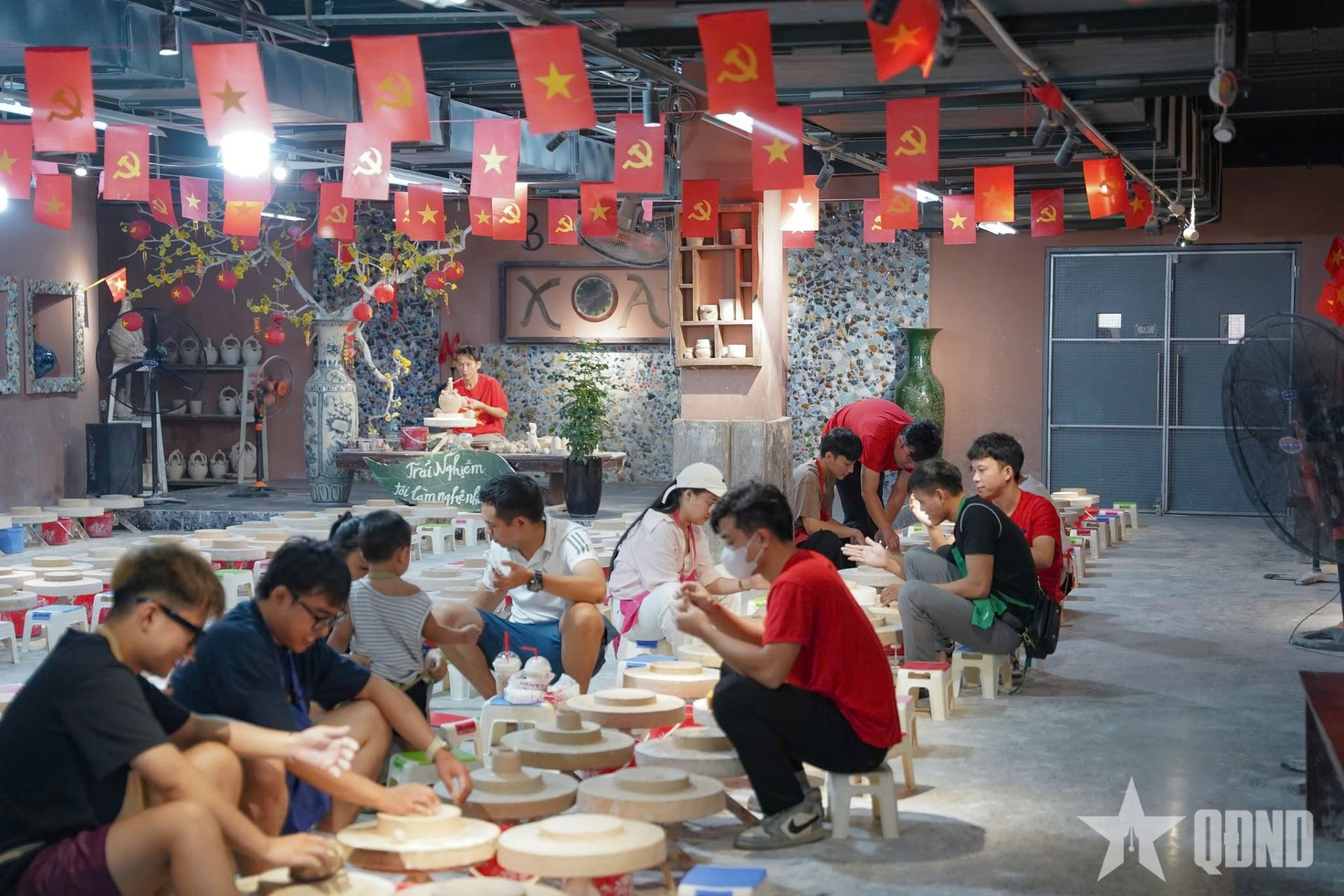 |
Tourists experience pottery making at Bat Trang pottery village, Hanoi. Photo: Phuong Thuy. |
Ultimately, a strong nation is not one that merely streamlines its organizational structure, but one that simplifies its apparatus while still cherishing the deepest underlying currents that give it its vitality. Villages, hamlets, and neighborhoods can be reorganized for greater efficiency, but the soul of each community cannot be recreated if it has already been lost.
Therefore, in this reorganization, what needs to be preserved is not only a more rational boundary, but also the names of villages, customs, community memories, and the ability for each locality to continue telling its cultural story in the future. Streamlining is necessary. But streamlining while preserving the soul of the homeland is the true success.
Source: https://www.qdnd.vn/van-hoa/doi-song/giu-ten-lang-giu-hon-xom-trong-sap-xep-thon-to-dan-pho-1041996

![[Image] Nearly 125,000 Hanoi students completed the Literature exam for the 10th grade entrance exam.](https://vphoto.vietnam.vn/thumb/1200x675/vietnam/resource/IMAGE/2026/05/30/1780117233041_ndo_br_thiet-ke-chua-co-ten-2-png.webp)





























































































Comment (0)