

Efforts to maintain classrooms in disadvantaged areas
In mountainous areas facing numerous challenges, the demand for vocational training to develop the economy , create jobs, and increase people's income is growing. However, vocational education and continuing education centers are still facing many obstacles regarding teaching staff, facilities, training funding, and student recruitment.
Mr. Bui Tien Phuong, Director of the Vocational Education and Continuing Education Center of Kbang ( Gia Lai ), said that the unit is responsible for the communes of Kbang, Son Lang, To Tung, Kong Bo La, Krong, and Dak Rong. These are all areas inhabited by ethnic minorities, where people's lives are still difficult, and the percentage of poor and near-poor households is high.
The majority of the local workforce is engaged in agriculture, with uneven levels of education and limited access to the labor market. Despite this, the demand for vocational training to develop production and increase income is growing.
According to Mr. Phuong, in recent years, the Kbang Vocational Training and Continuing Education Center has coordinated with the People's Committees of the communes to promote and advise on vocational training. In addition, they have organized short-term vocational training courses for rural laborers, contributing to helping people develop their household economies and gradually stabilize their lives.
The training content focuses on occupations that closely match the practical needs of the locality, such as: high-yield rice cultivation techniques, coffee and sugarcane care; techniques for raising and preventing diseases in buffaloes and cattle; repair of small-capacity plows and civil construction techniques...
To maintain student enrollment, the Center implements various solutions such as organizing awareness campaigns and encouraging students to attend classes through various means; providing accommodation; organizing boarding activities, collective labor, and visits to traditional cultural sites in the locality. The unit continues to maintain the "Mobilizing and Maintaining Student Enrollment" emulation movement launched by the Department of Education and Training, and simultaneously implements the "Overcoming Difficulties - Achieving Academic Progress" model for students in remote and disadvantaged areas such as Dak Rong, Krong, and Son Lang.
In particular, each homeroom teacher not only directly teaches but also closely monitors the students' learning progress, promptly advising on solutions to help them overcome difficulties and reduce the rate of students dropping out of school midway.
Pressure from teacher shortages and difficulties in student recruitment.
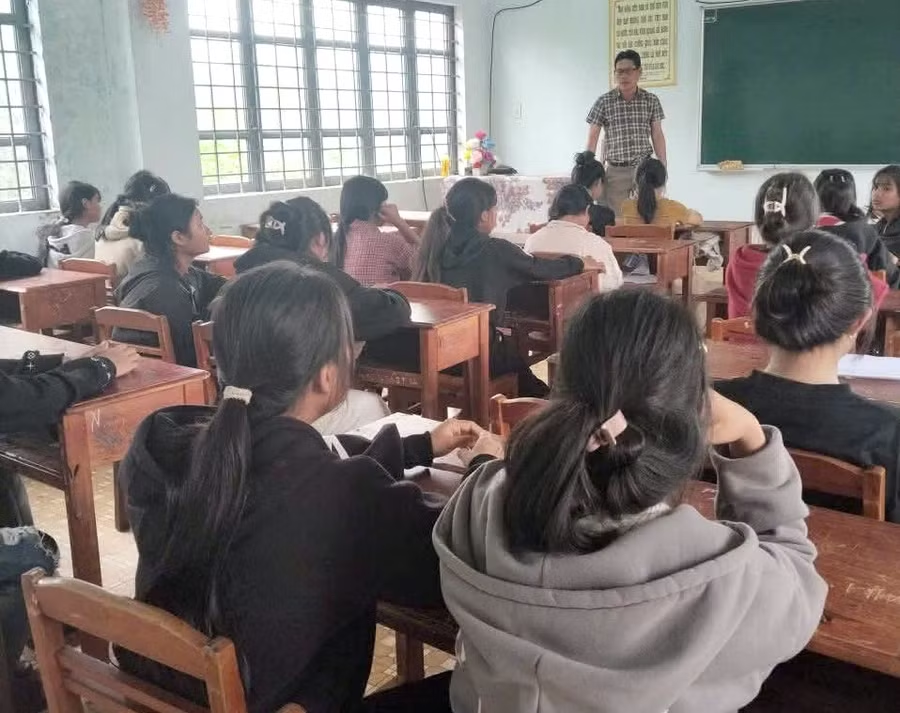
Despite achieving many positive results, vocational training at the Kbang Vocational Education and Continuing Education Center still faces numerous challenges.
According to Mr. Phuong, the vocational training center currently has a shortage of teachers, failing to meet the requirements for multi-disciplinary training, and therefore largely relies on visiting lecturers.
For the 2025-2026 academic year, the Center will have 11 staff members, including teachers and employees, but will need to contract an additional 10 visiting lecturers. Of these, 4 teachers from Luong The Vinh High School will teach high school-level cultural subjects including Mathematics, Chemistry, History, and Geography, and 6 teachers will participate in vocational training for rural workers.
Furthermore, the training facilities and equipment are inadequate and outdated. The center currently lacks essential facilities such as functional classrooms, computer rooms, a library, a security guardhouse, and a parking garage. Equipment for information technology applications, digital transformation, and educational statistics is limited. The computer system for learning only has about 10 sets, most of which are old and damaged; the interactive whiteboards, installed a long time ago, are also outdated but have not been replaced.
The large geographical area, difficult transportation, and scattered learners create many obstacles in organizing classes. The majority of students are Bahnar people from remote areas with difficult travel conditions and a lack of access to information for their studies.
"Some students still have a sense of dependence, and parents don't really care about their children's education, so there are still cases of students dropping out midway, affecting the efforts to maintain student enrollment," Mr. Phuong shared.
Furthermore, some trainees are part-time officials at the village level, so during the period when the local authorities are arranging and assigning jobs, many are unable to continue their studies to complete the program. Another difficulty is that funding for vocational training is often allocated late, affecting the implementation of vocational training classes at the grassroots level.
According to Mr. Phuong, the center plans to enroll approximately 40 students in the 2026-2027 academic year, but the assigned target is 150, making it very difficult to meet. The unit estimates that it can only enroll about 70 students.
However, Mr. Phuong said that enrollment in recent years has seen positive changes as parents are increasingly interested in vocational training for their children. Thanks to vocational training partnerships, after graduation, many students are supported in finding jobs at businesses with salaries of around 7-8 million VND/month along with accompanying benefits and allowances.
To improve the effectiveness of vocational training, the Kbang Vocational Education and Continuing Education Center recommends that the Gia Lai Provincial Department of Education and Training consider supplementing the number of vocational teachers; investing in facilities and practical equipment suitable to local needs; and providing financial support for training and travel expenses for learners from ethnic minority and disadvantaged areas.
The unit also proposed strengthening the connection between businesses and vocational education institutions to link training with job placement. At the same time, it hoped that the People's Committees of the communes would continue to cooperate closely in surveying needs, recruiting students, and managing classes in their localities.
Source: https://giaoducthoidai.vn/go-kho-dao-tao-nghe-o-vung-dong-bao-dan-toc-thieu-so-post779098.html



![[Image] Close-up view of the interchange connecting the two expressways and Long Thanh Airport.](https://vphoto.vietnam.vn/thumb/1200x675/vietnam/resource/IMAGE/2026/05/25/1779703378210_ndo_br_z7863716673926-224453a31600126cce10622af6290afd-4549-jpg.webp)

![[Image] Hanoi's urban life under the challenge of a "scorching hot" environment](https://vphoto.vietnam.vn/thumb/1200x675/vietnam/resource/IMAGE/2026/05/25/1779706979265_nang-nong-t5-2026-minh-duy-7-4636-jpg.webp)



















































































Comment (0)