

Natural wood is a vital resource for construction and furniture making. It is also highly valued for its versatility, recyclability, and aesthetic appeal.
However, many new potentials for wood are beginning to emerge as scientists devise methods to fine-tune the optical, thermal, mechanical, and ionic transport properties of wood materials through chemical and physical modifications to the inherent porous structure and chemical composition of wood.
To pursue this goal, in recent years researchers have devised innovative strategies to transform wood in relation to its potential for new applications.
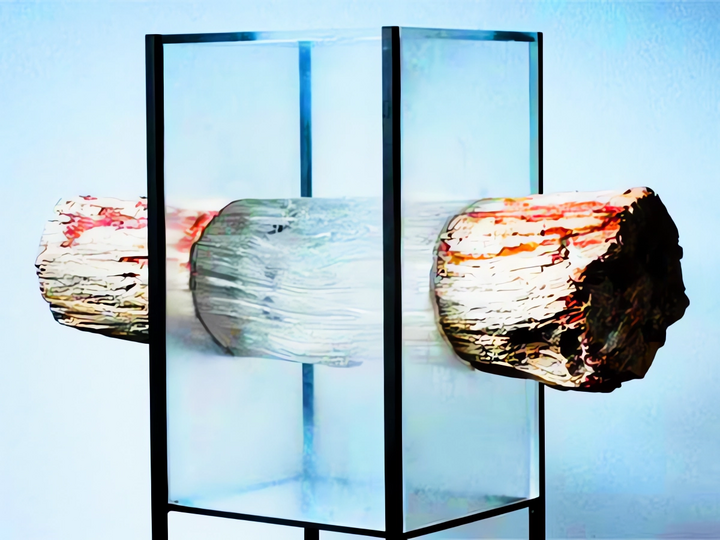
Scientists develop transparent wood for smartphone screens and transforming windows. (Illustrative image: Shutterstock)
Previously, Siegfried Fink created transparent wood by removing pigments from plant cells within the wood. He detailed this technological process in a specialized journal focusing on wood technology in 1992.
For over a decade afterward, Siegfried Fink's 1992 publication served as the primary source of accurate information on transparent wood technology. Another scientist at the Royal Institute of Technology KTH in Sweden, Lars Berglund, stumbled upon this publication and used it for his research.
Now, another group of researchers, led by materials scientist Liangbing Hu at the University of Maryland at College Park, has been actively involved in developing transparent wood through direct processing techniques on natural wood.
According to the research team, wood consists of many small, vertical, tubular cells, like a bundle of straws tied together with glue. These tubular cells function to transport water and nutrients within the tree.
To produce transparent wood, scientists have to modify or remove a substance called lignin. In fact, this substance both binds the cell bundles together and gives the trunk and branches their earthy brown color.
After bleaching or removing the color of the lignin in the wood, opaque white cell walls remain. This is because the cell walls refract light differently than the air inside the cell sacs that have had the lignin removed, which gives the wood its color.
To achieve transparency, these wood cell air pockets must be filled with a material such as epoxy resin, which bends light, allowing the wood to be seen through. The finished product, this transparent wood, allows over 85% of light to pass through. It can capture sunlight without glare, saving energy and providing more comfortable indoor lighting.
Transparent wood also possesses strong mechanical integrity, addressing safety concerns often associated with glass materials. Furthermore, transparent wood outperforms glass in terms of thermal insulation, potentially assisting buildings in pushing heat away.
In their work, Liangbing Hu's research team used polyvinyl alcohol (PVA), a polymer commonly found in adhesives and food packaging, to infuse treated wood cells. This resulted in transparent wood with a thermal conductivity five times lower than that of glass.
Lars Berglund and his research team at the Royal Institute of Technology KTH in Sweden have also discovered a way to replicate the functionality of smart windows made from transparent wood material. This technology can switch between transparent and tinted states to control visibility or block sunlight.
Their method involves layering an electrochromic polymer capable of changing color via an electric current, placed between layers of transparent wood coated with an electrochromic polymer for conductivity.
According to some assessments, as technology advances, transparent wood materials will become more versatile, more transparent, and more sustainable, potentially leading to applications in everything from ultra-durable smartphone screens to lighting devices.
HUYNH DUNG (Source: Interestingengineering)
Source

![[Photo] Prime Minister Pham Minh Chinh attends the Conference on the Implementation of Tasks for 2026 of the Industry and Trade Sector](/_next/image?url=https%3A%2F%2Fvphoto.vietnam.vn%2Fthumb%2F1200x675%2Fvietnam%2Fresource%2FIMAGE%2F2025%2F12%2F19%2F1766159500458_ndo_br_shared31-jpg.webp&w=3840&q=75)

















































































Comment (0)