

According to Google, the leap day in 2024 – February 29th – only occurs every four years to ensure the calendar aligns with the Earth's orbit around the Sun. Google's Doodle celebrating the leap day on February 29th, 2024, has a global reach.
To celebrate the leap year of 2024, the February 29th Doodle depicts the number 29 in the middle of the Google logo with a frog. This number is positioned between the numbers 28 and 1, symbolizing the leap day in February (which has 28 days).
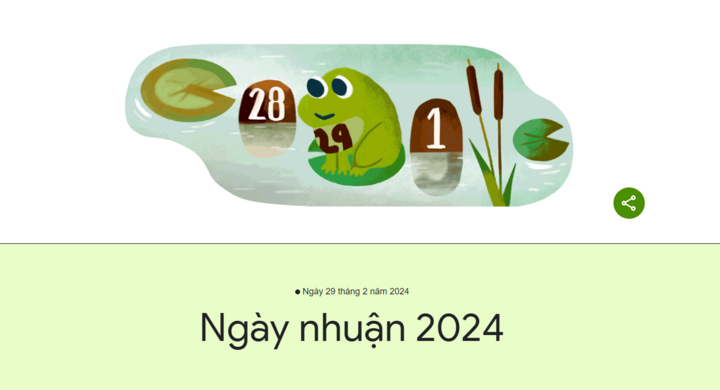
Google Doodle celebrates Leap Day 2024. (Screenshot)
According to the Gregorian calendar, the standard calendar currently used throughout most of the world , it takes the Earth approximately 365.25 days to complete one orbit around the sun. By convention, a year has 365 days, meaning each year has an extra 0.25 day, or 6 hours. Over four years, this results in an extra day or 24 hours, and over a century (100 years) it would be almost a month.
To avoid these errors, calendar makers have stipulated that every four years an extra day is added to February in the Gregorian calendar. This day is called a leap day, and years with a leap day in February are called leap years in the Gregorian calendar.
According to the lunar calendar, a month has 29.53 days, so a lunar year is rounded to 354 days, 11 days less than the solar year. Therefore, three years will be 33 days shorter, and this extra time accumulates into one month. Thus, after three years according to the lunar calendar, we have an extra month, which is added to a leap year to ensure the lunar and solar calendars don't differ too much.
Calculating leap years is very simple. According to the Gregorian calendar, there is a leap day every four years. To calculate a leap year, divide the year number by four; if there is no remainder, then that year is a leap year.
According to the calculations of the lunar calendar, every 19 years there is an extra leap month every two years. This calculation results in 7 extra leap months, which are placed in the 3rd, 6th, 9th or 11th, 14th, 17th, and 19th years of the 19-year cycle.
Therefore, to determine if a year is a leap year, simply divide the Gregorian year by 19. If the division is exact or leaves remainders of 3, 6, 9, 11, 14, or 17, then that lunar year will have a leap month.
Google Doodles are different images of the Google logo, with icons and images temporarily replacing the logo on Google's homepage to celebrate holidays, events, achievements, and people.
Instead of using the traditional logo, Google Doodle was created to transform it into vibrant images accompanied by specific meanings. This aims to make the experience more enjoyable for users when using Google's search engine.
Source

![[Photo] National Assembly Chairman Tran Thanh Man attends the groundbreaking ceremony for the National Highway 1A spatial axis project.](https://vphoto.vietnam.vn/thumb/1200x675/vietnam/resource/IMAGE/2026/05/19/1779161360398_ndo_br_bnd-1412-jpg.webp)
![[Photo] Capturing the moment the tide recedes at Yen Binh Son rapids - a million-year-old scenic spot in Quang Ngai.](https://vphoto.vietnam.vn/thumb/1200x675/vietnam/resource/IMAGE/2026/05/19/1779175463885_yen9-1199-jpg.webp)
![[Photo] General Secretary and President To Lam presides over a meeting on the implementation of Directive No. 34-CT/TW of the Party Central Committee.](https://vphoto.vietnam.vn/thumb/1200x675/vietnam/resource/IMAGE/2026/05/19/1779187768672_a1-bnd-2350-631-jpg.webp)


































































![[Photo] General Secretary and President To Lam receives Indian Defense Minister Rajnath Singh](https://vphoto.vietnam.vn/thumb/402x226/vietnam/resource/IMAGE/2026/05/19/1779184046302_anh-man-hinh-2026-05-19-luc-16-46-58.png)


































Comment (0)