

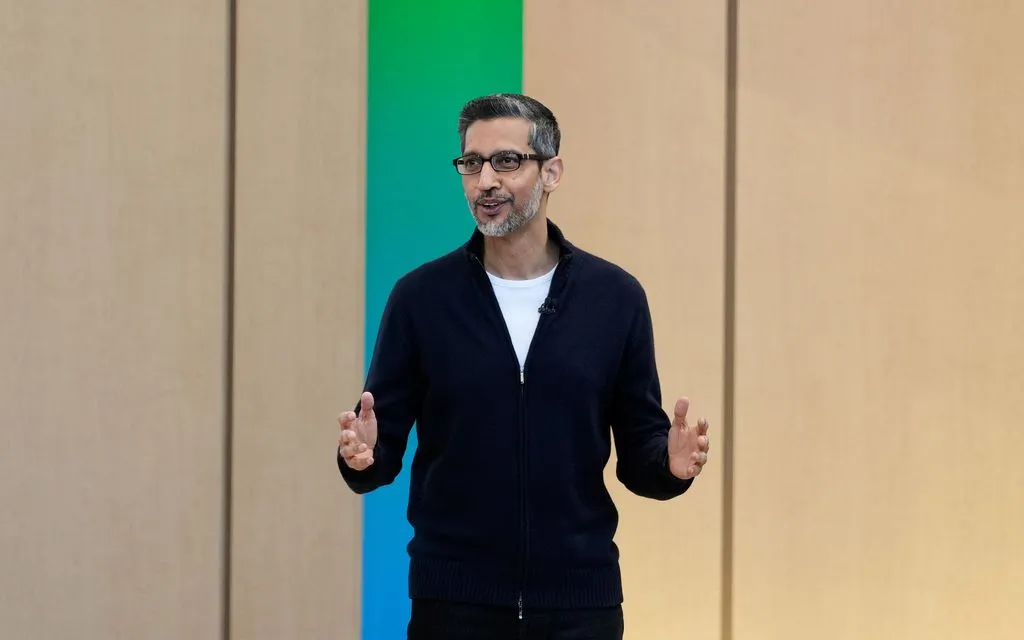
Alphabet CEO Sundar Pichai speaks at the Google I/O event in Mountain View, California, USA, on May 19, 2026. (Photo: AP)
Google I/O 2026 is not just an event to introduce new products, but also shows how Google wants to reshape almost the entire digital user experience in the age of artificial intelligence (AI). From search engines, Gmail, YouTube, Docs, Chrome to smart glasses, Google is trying to integrate AI agents into the new operational layer within its ecosystem of products already used by billions of people.
At its annual developer conference, Google announced a series of upgrades centered around Gemini, the company's flagship AI model. According to the company, the Gemini assistant now has approximately 900 million users, while users have created over 50 billion images using Gemini. These figures demonstrate that Google no longer views AI as an add-on feature, but is transforming it into a core infrastructure for its familiar services.

Robby Stein, Vice President of Product at Google Search, speaks at the Google I/O event in Mountain View, California, USA, on May 19, 2026. (Photo: AP)
The most notable change is in Google Search. The company introduced a “smart search box,” designed to handle longer, more natural, and more complex queries than traditional search. Instead of just returning a list of links, the new search engine can provide contextual answers, generate images, short videos , or visual interfaces relevant to the user's question.
This represents a major shift for Google Search, a product previously defined by green links leading users to other websites. With these new features, Google aims to encourage users to stay in the search environment longer, interact directly with AI, and receive aggregated results in a more actionable format. However, this change could also increase concerns among publishers, who are already under pressure as search traffic is being impacted by AI responses.
Along with search, Google has also made Gemini 3.5 Flash the default model in the Gemini app and AI Mode on Search. According to the company, Gemini 3.5 Flash focuses on speed, programmability, and agent tasks, and is developed with enhanced security measures to reduce the risk of creating harmful content or mistakenly rejecting legitimate requests.

Josh Woodward, Vice President of Google Labs and Gemini, introduces Gemini Spark at the Google I/O event in Mountain View, California, USA, on May 19, 2026. (Photo: AP)
Another highlight is Gemini Spark, a cloud-based personal AI agent. Unlike chatbots that only respond when asked, Spark is designed to track, aggregate, and execute tasks that span extended periods. This tool can read meeting notes, emails, chats, and documents in Google Drive, then generate summaries, to-do lists, or assist in managing recurring tasks.
Google emphasized that Spark will require user confirmation before performing sensitive actions such as sending emails or making purchases. This detail shows the company understands the growing concerns about user control when AI is given the ability to act in place of humans. However, the fact that an AI agent can run continuously, read personal data, and suggest actions still raises significant questions about privacy, reliability, and the extent of user dependence on the platform.

Google DeepMind co-founder and CEO Demis Hassabis introduces Gemini Omni at the Google I/O event in Mountain View, California, USA, on May 19, 2026. (Photo: AP)
In the field of content creation, Google introduced Gemini Omni, an AI model capable of creating videos from various inputs such as text, images, video, and audio. The company stated that Omni initially focuses on video, but in the long term will aim to create a wider range of output formats. Videos created by Omni will have a SynthID digital watermark to identify content created using AI.
Google is also expanding AI into YouTube, Gmail, Docs, and Keep. The Ask YouTube feature allows users to ask natural questions to find relevant videos, even jumping to related content. Meanwhile, Docs Live can transform users' disjointed speech into more structured drafts, and Gmail Live supports searching for information within the inbox using voice commands. These tools reflect Google's clear direction: making AI a seamless assistant in work, entertainment, and personal information management.
Google is also integrating shopping into its new AI strategy through Universal Cart, a shared shopping cart that works across Search, Gemini, YouTube, and Gmail. When users add products to their cart, the system can track prices, suggest deals, alert them when items are back in stock, and support Google Pay payments in some cases. If widely implemented, this feature could help Google delve deeper into the online shopping journey, from product search to payment decisions.
Besides software, Google is also returning to its wearable device ambitions with a line of smart glasses in collaboration with Samsung, Gentle Monster, and Warby Parker. The company says there will be two types of glasses: an audio version, allowing users to chat with Gemini via voice, and a version with a display screen in the lens. These glasses can assist with navigation, managing information on the phone, live translation, and answering questions based on what the camera sees.

Shahram Izadi, a representative of the Android XR platform and products, introduces the smart glasses at the Google I/O event in Mountain View, California, USA, on May 19, 2026. (Photo: AP)
The return of smart glasses is particularly significant for Google, following the failure of Google Glass more than a decade ago. This time, the company isn't just selling hardware, but placing the glasses within a broader AI ecosystem, where Gemini could become the primary interface between humans and the digital world . However, the cameras on the glasses could also revive old concerns about privacy in public spaces.
Google also adjusted the pricing of its paid AI packages. The company created an AI Ultra package priced at $100 per month and reduced the price of its top-tier package from $250 to $200 per month. This move shows Google wants to expand its paid user base while keeping the most powerful features for customers willing to pay more.
Overall, Google I/O 2026 shows the company entering a more intense phase of AI competition, not only with rivals like OpenAI and Anthropic, but also with the traditional internet model that once helped Google dominate. As search becomes conversational, email becomes a data source for personal assistants, videos can be created using descriptions, and smart glasses become real-world AI interfaces, the question is no longer whether Google will incorporate AI into its products, but how much power users will give AI in their digital lives.
Source: https://vtv.vn/google-io-2026-tat-ca-cong-bo-dang-chu-y-100260520143442551.htm

![[Image] Close-up view of the interchange connecting the two expressways and Long Thanh Airport.](https://vphoto.vietnam.vn/thumb/1200x675/vietnam/resource/IMAGE/2026/05/25/1779703378210_ndo_br_z7863716673926-224453a31600126cce10622af6290afd-4549-jpg.webp)


![[Image] Hanoi's urban life under the challenge of a "scorching hot" environment](https://vphoto.vietnam.vn/thumb/1200x675/vietnam/resource/IMAGE/2026/05/25/1779706979265_nang-nong-t5-2026-minh-duy-7-4636-jpg.webp)































































































Comment (0)