

According to a representative of the Ha Giang tourism agency , charging an entrance fee to the Dong Van Karst Plateau Geopark is "a necessary step" to meet the criteria for a UNESCO-recognized site.
Following the announcement that Ha Giang province would be charging a tourism fee for the Dong Van Karst Plateau Geopark, a wave of conflicting opinions arose. This was something the province's leaders had anticipated.
"If there were no fees, would people accept a quality of tourism that is only at the level of free services?", asked Mr. Hoang Xuan Don, Head of the Geopark Management Board.
The Dong Van Karst Plateau Geopark was established in September 2009, encompassing four districts: Quan Ba, Yen Minh, Dong Van, and Meo Vac, with a total natural area of approximately 2,356 km2. In 2010, the Dong Van Karst Plateau was recognized by UNESCO as the first UNESCO Geopark in Vietnam. The number of visitors to the Geopark has steadily increased, reaching nearly 2.3 million in 2022.
Statistics from the province show that approximately 65% of visitors to Ha Giang visit the Geopark area. The number of visitors and tourism revenue in the Geopark area increased by an average of 15-20% per year from 2010 to 2020, higher than the provincial average (10% per year) and is the main driving force for tourism development in Ha Giang.
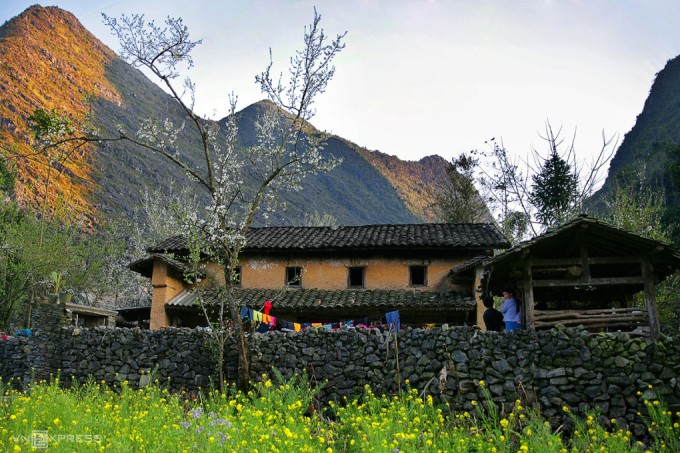
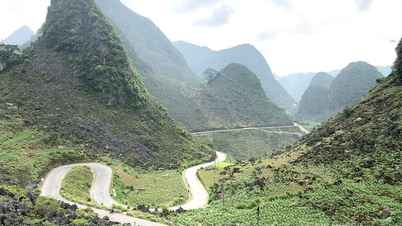
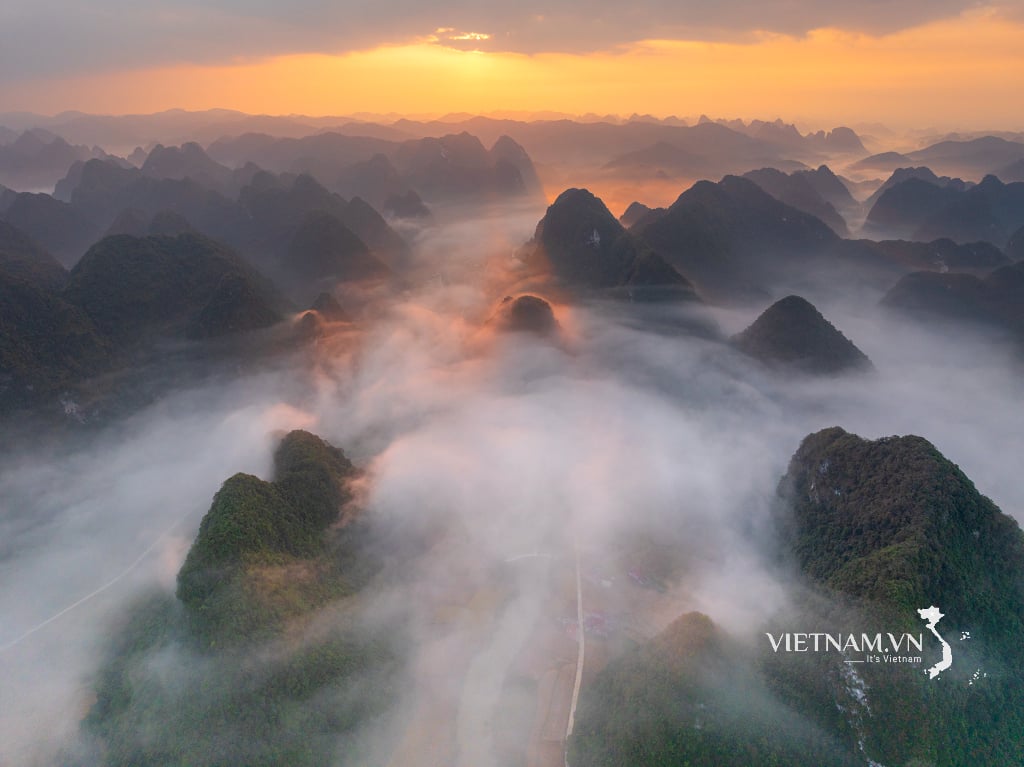
Springtime in Pho Cao, Ha Giang. Photo: Nguyen Huu Thong
Mr. Don stated that UNESCO reassesses the development of the Geopark every four years. Each time, the organization makes a series of recommendations for the Geopark to implement over the next four years. To be considered complete, 90% of the recommendations must be implemented; otherwise, it will receive a yellow card (allowing two more years to implement) or a red card (revocation of the title).
Typically, UNESCO recommends a wide range of activities, from conservation, planning, community education , community development, protection of minority cultures, biodiversity, to investment and sustainable tourism. Each such plan directly costs the province hundreds of billions of VND annually, not including indirect costs such as transportation, electricity, water, and telecommunications projects. According to Mr. Don, these plans, despite the enormous cost, all bring benefits to the people.
"The proposal is not solely for tourism, so the amount of money spent is substantial," Mr. Don added.
The question is, where will the money come from to implement these recommendations? Due to its mountainous location, activities such as expanding electricity, water, and telecommunications systems in Ha Giang are very difficult. With the rapid growth of tourism in recent years, the pressure on Ha Giang province is "very high." On the other hand, Ha Giang is a poor province with few services for tourists to spend money on. Tourists mainly come to admire the scenery, so service costs are not high, and revenue flowing into the province is very small, making it difficult to improve the lives of the people and develop tourism.
Mr. Don also pointed out that within the Geopark area, there are about 40 sites that meet the criteria for collecting entrance fees, but the province has only collected fees at three sites: Lung Khuy Cave (Quan Ba); Vuong House, and Lung Cu flagpole (Dong Van). From 2017 to 2021, revenue from entrance fees reached approximately 29 billion VND, leaving 17.2 billion VND after tax.
On the other hand, since 2011, experts from the UNESCO Global Geopark Network (GGN) have mentioned the need for fee collection and financial autonomy for the Geopark Management Board. By 2018, fee collection and financial autonomy became a mandatory recommendation. Ha Giang province also assessed that, given the current development trajectory of the Geopark, relying solely on the state budget would lead to a severe funding shortfall, making it impossible to meet the needs of construction and development.
"This also creates fairness; whoever uses tourism resources should pay for it," Mr. Don said.
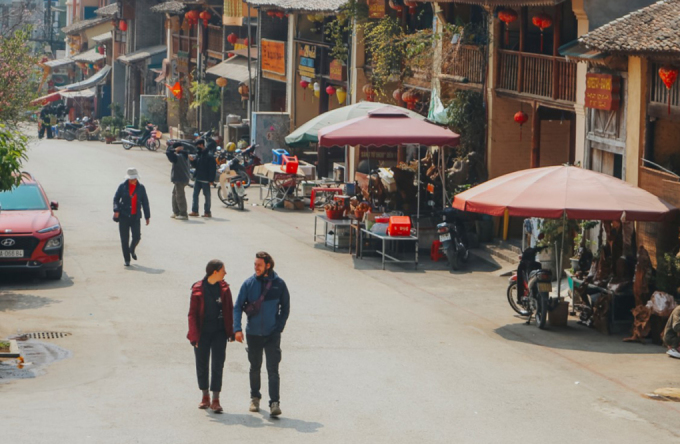
Foreign tourists walking in the old town of Dong Van. Photo: Xuan Phuong
Ha Giang conducted a survey with tourists at the Geopark, and the results showed that over 50% of visitors agreed to pay an entrance fee. For foreign visitors, the agreement rate reached over 90%. The question most frequently asked by foreign visitors was what benefits the fee would bring to both tourists and the Geopark.
Mr. Don stated that if the fee collection is implemented, the province will have the budget to pay for resources serving the conservation, management, and operation of heritage sites, environmental protection, infrastructure reinvestment (public sanitation, parking lots), and reinvestment in local people.
Representatives from the Geopark management board added that collecting fees is not just about budget matters. It's also a way for Ha Giang to raise tourists' awareness of heritage values, categorize target visitors, and help guide tourists, reducing overcrowding. At the three current fee collection points, the water, electricity, and waste treatment systems are functioning well, unlike many other locations.
According to the survey, the most popular option among tourists is charging fees at heritage sites; an entrance gate that allows access to all heritage sites. The least popular option is charging fees through accommodation services, calculated per night. Regarding the price, tourists prioritize the lowest price.
Despite these results, the method of implementing the fee collection "still needs careful consideration." If fees are collected at each point, the Geopark management is concerned that it will inconvenience tourists who have to pay individually. Setting up fee collection points is also not easy as it involves road traffic laws. In addition, establishing more fee collection points would be costly in terms of human resources and would "bloate" the management apparatus.
The management board of the Geopark and many leaders of Ha Giang province are leaning towards a plan to charge an overnight fee, with the facility owner responsible for collecting it. This is considered a fair and non-offensive fee collection method that directly benefits the local people. Approximately 20% of this tourism fee will be returned to the accommodation facility owner.
During the project development, Mr. Don noticed that many tourist destinations around the world are also applying this type of fee. According to Euronews, Brussels (Belgium) collects a tourism fee included in the hotel room rate, averaging from 8.2 USD - depending on the hotel category. Austria collects an overnight fee of approximately 3.02% of the total hotel bill. In Asia, Indonesia applies a tourism tax specifically in Bali, approximately 9.8 USD per foreign visitor.
According to research by the UNESCO World Heritage site management board, many UNESCO heritage sites around the world are charging very high fees, such as Bwindi Impenetrable National Park (Uganda) - $700; Komodo National Park (Indonesia) - $252; Serengeti (Tanzania) - $70.8.
In Italy, many cities such as Bologna, Catania, Florence, and Genoa also charge tourist fees based on hotel category. In Vietnam, Ha Long Bay is also a prime example of charging fees through day or overnight bay tours, with prices ranging from 250,000 to 750,000 VND per person.
Mr. Don said he learned from the approach of the Ha Long Bay management board when developing the plan for the Geopark. Initially, the fees might not be high and there might be some losses. However, this is a stage to raise awareness among tourists about the destination: the Geopark is a UNESCO-recognized heritage site, and tourists need to pay a fee for its preservation and tourism development.
"If fees are charged, everything will be invested in more systematically and meticulously. Without fees, the quality of tourism will hardly improve," Mr. Don reiterated.
Tu Nguyen
Source link
![[Image] Nearly 125,000 Hanoi students completed the Literature exam for the 10th grade entrance exam.](https://vphoto.vietnam.vn/thumb/1200x675/vietnam/resource/IMAGE/2026/05/30/1780117233041_ndo_br_thiet-ke-chua-co-ten-2-png.webp)











![[Video] The timeless beauty of the century-old Capital Railway Station](https://vphoto.vietnam.vn/thumb/402x226/vietnam/resource/IMAGE/2026/05/30/1780132528002_1080-jpg.webp)


































































Comment (0)