

Positive changes
Regarding the concept of "green" in urban areas, experts affirm that in Vietnam, the term "green" has been mentioned in state policies such as Resolution No. 148/ND-CP dated November 11, 2022, which promulgates the Government's Action Program to implement Resolution No. 06/ND-TW dated January 24, 2022, of the Politburo on planning, construction, management, and sustainable development of Vietnamese cities until 2030, with a vision to 2045. However, there is currently no complete and unified definition of a green city and green infrastructure within urban areas.
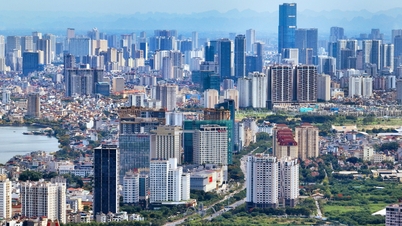
However, although there are still no complete and unified definitions, for many years, the various levels and sectors of Hanoi have implemented measures to build a green city in a sustainable direction according to "soft" criteria such as: green city; green infrastructure; green transportation; green drainage; green water supply; green parks; green lighting; green waste management; and green environmental sanitation.
For example, in the field of green waste management, at the end of 2022, Hanoi put into operation the Thien Y Waste-to-Energy Plant – a project of significant importance in changing the method of handling household waste in the capital towards a modern approach, ensuring environmental hygiene. Along with that, the city has piloted a waste sorting at source program in four inner-city districts: Hoan Kiem, Ba Dinh, Dong Da, and Hai Ba Trung, aiming to raise awareness and promote environmental protection among organizations and individuals in the area.
From a green transportation perspective, Hanoi has implemented numerous measures to encourage and mobilize people to use public transportation and reduce the use of private vehicles. Specifically, the city has focused on developing environmentally friendly transportation systems such as trams, electric buses, and public bicycle rental services to minimize emissions that negatively impact the capital's environment.
In particular, during the period 2016-2020, the Department of Construction assigned functional units to plant 987,187 shade trees and various types of forest trees; 113,155 individual trees and clumps; and 147,450 m2 of trees and grass under the program to plant 1 million green trees.
Furthermore, in implementing Plan No. 76/KH-UBND dated March 8, 2023, of the Hanoi People's Committee on planting 500,000 new urban trees in the city from 2021 to 2025, functional units have planted 101,758 trees and are expected to plant approximately 400,000 more in the near future. In addition to renovating existing spaces, Hanoi is also constructing nine new large-scale parks.
Fill the policy "gap" quickly.
Regarding the development of green urban infrastructure, many experts assert that this is a task that cannot be accomplished overnight. However, to achieve this goal, changes in policy are urgently needed to remove obstacles and mobilize the participation of various economic sectors in the development of green cities.
Specifically, according to Ms. Nguyen Minh Thuy from the Institute of Urban Research and Infrastructure Development, environmental protection in general, and urban sanitation in particular, have been specifically regulated in the current legal framework. These are significant steps forward in the development and promulgation of policies and legal documents on environmental management in general, and urban environment management in particular.
In Vietnam, on-site solid waste treatment contributes approximately 54.28% to the country's greenhouse gas emissions. Due to a lack of data, accurate figures on emissions in tons or other units are not specifically mentioned in available data sources.
However, it should be noted that the majority of these emissions are methane – a toxic greenhouse gas released when organic waste decomposes in landfills – and that approximately 85% of the nation's waste goes directly to landfills without any prior treatment.
Sarah Remmei - Environmental urban planning expert at Spatial Decisions
However, our country's legal and policy system still lacks specific regulations for certain areas such as urban environmental management, solid waste management, and the reform and promotion of sustainable development in urban drainage and sanitation. Furthermore, policies and laws related to urban issues in general, and urban sanitation infrastructure in particular, have not been adequately recognized, resulting in a lack of sufficient attention given the rapid pace of urbanization.
On the other hand, laws related to urban environmental sanitation are currently contained in numerous legal regulations belonging to different sectors, with diverse issuing entities and different regulatory mechanisms.
"Environmental sanitation is a 'living organism,' involving many fields, especially planning, construction, population, science and technology... Therefore, having only general regulations without specific laws will render environmental sanitation ineffective," Ms. Nguyen Minh Thuy stated.
Sharing the same view, Mr. Nguyen Duc Hung, Director of the Hanoi City Technical Infrastructure Management Center, said that the capital's green space system has played and continues to play an important role in building a green city. However, to date, Hanoi still lacks economic and technical standards and public service prices for the management, supervision, maintenance, and upkeep of the urban green space system; it has not yet issued a list of trees encouraged for planting, trees restricted from planting, and trees prohibited from planting in urban areas to serve as a basis for management... causing many difficulties in building a green city.
On the roads and streets within the 12 inner districts and 17 districts and towns of Son Tay, the area under management according to the unit's decentralization includes 2.4 million m2 of lawns, shrubs, hedges, perennial flowers, and ornamental plants; 1,500 m2 of seasonal flowers; approximately 194,000 shade trees; and 510,000 acacia, melaleuca, and eucalyptus trees on 644 roads and streets in the 12 districts, 107 expressways, national highways, ring roads, provincial roads, and roads in the districts and towns of Son Tay. According to incomplete statistics, the district-level People's Committees manage approximately 460,900 trees in the remaining areas…
Nguyen Duc Hung - Director of the Hanoi City Technical Infrastructure Management Center
Source: https://kinhtedothi.vn/ha-noi-no-luc-xay-dung-do-thi-xanh-ben-vung.html


































































Comment (0)