

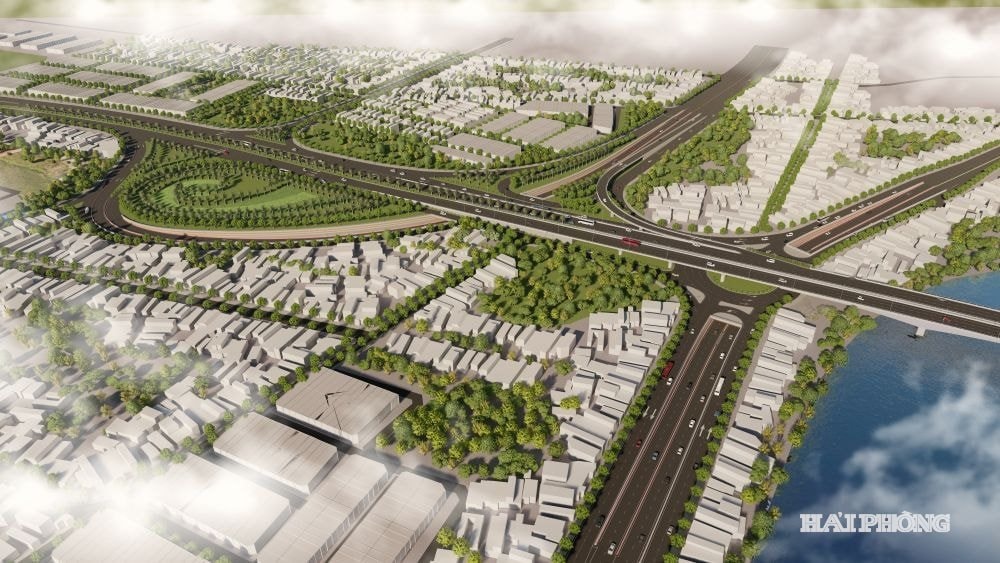
Unlocking the driving force for regional development.
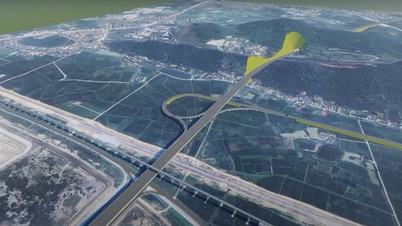
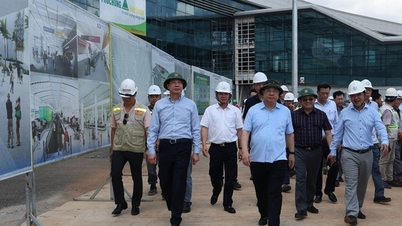
On May 14th, the People's Committee of Hai Phong City simultaneously commenced construction on three key transportation projects with a total investment of over 11 trillion VND. These include routes connecting National Highway 5 with National Highway 10 through the Kien An and Vinh Bao areas, and the Ninh Binh - Hai Phong expressway project, specifically the construction of the Van Uc 2 bridge section through Hai Phong.
The commencement of these three projects not only signifies the completion of a synchronized transportation system within the city, reducing congestion on existing national highways, but also contributes to promoting regional and inter-regional connectivity.
In fact, after more than three years of implementing Resolution No. 30-NQ/TW on socio-economic development and ensuring national defense and security in the Red River Delta region until 2030, with a vision to 2045, and other resolutions of the Politburo , Hai Phong has not only affirmed its role as a growth pole of the region with many outstanding results in socio-economic development, but has also made a strong mark in promoting regional linkages to create a ripple effect and effectively exploit potentials and advantages.
According to Comrade Le Anh Quan, Permanent Vice Chairman of the People's Committee of Hai Phong city, Hai Phong identifies regional linkages not only as a requirement for development but also as a driving force for the city to maximize its potential and advantages.
The city proactively coordinates with localities to invest in strategic transportation infrastructure, promoting connectivity in logistics, industry, and services, thereby creating a ripple effect throughout the Red River Delta region.
To date, Hai Phong has been coordinating and investing in many important transportation projects with a total capital of over 32,000 billion VND, such as the Dong Viet bridge connecting Bac Giang, the Hoa River bridge connecting Thai Binh, the Ben Rung and Lai Xuan bridges connecting Quang Ninh, the Hai Hung and Nghin 2 bridges connecting Hung Yen , etc.
The city has also actively participated in national strategic infrastructure projects, committing nearly 11 trillion VND to the Lao Cai - Hanoi - Hai Phong railway line and approximately 3,800 billion VND to the Ninh Binh - Hai Phong expressway project. Along with infrastructure investment, Hai Phong is one of three localities that completed the adjustment of its planning on schedule as required by the central government, creating a basis for synchronizing regional, sectoral, and local planning.
Strengthening linkages and promoting the role of growth poles.
.jpg)
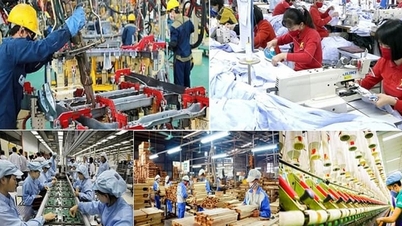
According to the revised planning for the Red River Delta region for the period 2021-2030, with a vision to 2050, Hai Phong is oriented to become a leading industrial, service, and logistics growth hub in the North, playing a pioneering role in the development of high-tech industries, manufacturing industries, supporting industries, and international seaport services.
Hai Phong serves as an international trade gateway for the region and the country, connected to the Lach Huyen gateway port and the Lao Cai - Hanoi - Hai Phong - Quang Ninh economic corridors. It is also a modern logistics, energy, and maritime economic center. This means that Hai Phong not only develops for its own benefit but also plays a driving role in the growth of the entire northern region.
Based on its development orientation, the city concretizes it with specific goals, targets, tasks, and solutions. Among these, it steadfastly aims to become a modern, civilized, ecological, and livable industrial port city; and is determined to affirm its position as a center for maritime economy, logistics, and high-tech industries…
To realize this goal, one of the city's continued focus is strengthening regional linkages, proactively coordinating with localities in the Red River Delta region, centrally-governed cities, the Northern region, and the whole country; promoting Hai Phong's role as a growth pole in the Hanoi - Hai Phong - Quang Ninh economic triangle and along coastal economic corridors.
The city has identified key investments in developing a comprehensive and modern infrastructure, including: researching and constructing a connection between Gia Binh Airport and Lach Huyen Port; completing coastal roads and routes connecting seaports, economic zones, industrial parks, and other localities in the region; upgrading the inland waterway port system and waterway corridors connecting Hai Phong with Quang Ninh, Hanoi, and the northern delta and midland provinces; developing coastal and river-sea transport linking tourist areas such as Do Son, Cat Ba, Ha Long Bay, and major river estuaries; focusing on improving and enhancing the operational capacity of the Hanoi-Hai Phong railway line; coordinating the implementation of railway projects from Lao Cai to Hanoi to Hai Phong, Yen Vien to Pha Lai to Ha Long to Cat Lan, and Kep to Ha Long to strengthen the connection of the Vietnam-China economic corridor and the Hai Phong seaport system… Along with this, the city promotes the development of tourism and culture…
However, alongside local initiative, a synchronized and sufficiently strong regional linkage mechanism from the central government is urgently needed, especially strengthening decentralization, delegation of power, and prioritizing resources for strategic infrastructure projects connecting the region.
With strong political determination and an open, proactive development mindset, Hai Phong is gradually asserting its role as an important growth pole in the Red River Delta region.
The city not only provides impetus for local development but also contributes to promoting genuine and effective regional linkages, expanding new development opportunities for both the northern region and the country as a whole.
HA MINHSource: https://baohaiphong.vn/ha-tang-chien-luoc-tao-da-phat-trien-lien-vung-543432.html

![[Image] Close-up view of the interchange connecting the two expressways and Long Thanh Airport.](https://vphoto.vietnam.vn/thumb/1200x675/vietnam/resource/IMAGE/2026/05/25/1779703378210_ndo_br_z7863716673926-224453a31600126cce10622af6290afd-4549-jpg.webp)
![[Image] Hanoi's urban life under the challenge of a "scorching hot" environment](https://vphoto.vietnam.vn/thumb/1200x675/vietnam/resource/IMAGE/2026/05/25/1779706979265_nang-nong-t5-2026-minh-duy-7-4636-jpg.webp)











































































Comment (0)